Talk to our experts
The average organization stores data in seven different systems. Yet only 26% of marketers feel fully satisfied with how those systems connect, according to Salesforce’s 10th edition state of marketing report. Every disconnected source means a personalization decision made with incomplete context.
The cause is not a lack of data. Most enterprise commerce teams already have enough customer data they need, but it is stored in separate places. Order history gets saved in the commerce platform, and the account details in the CRM. Any campaign that needs both becomes a manual export and match exercise. That work usually gets done by two people, which limits personalization to whatever they can put together manually.
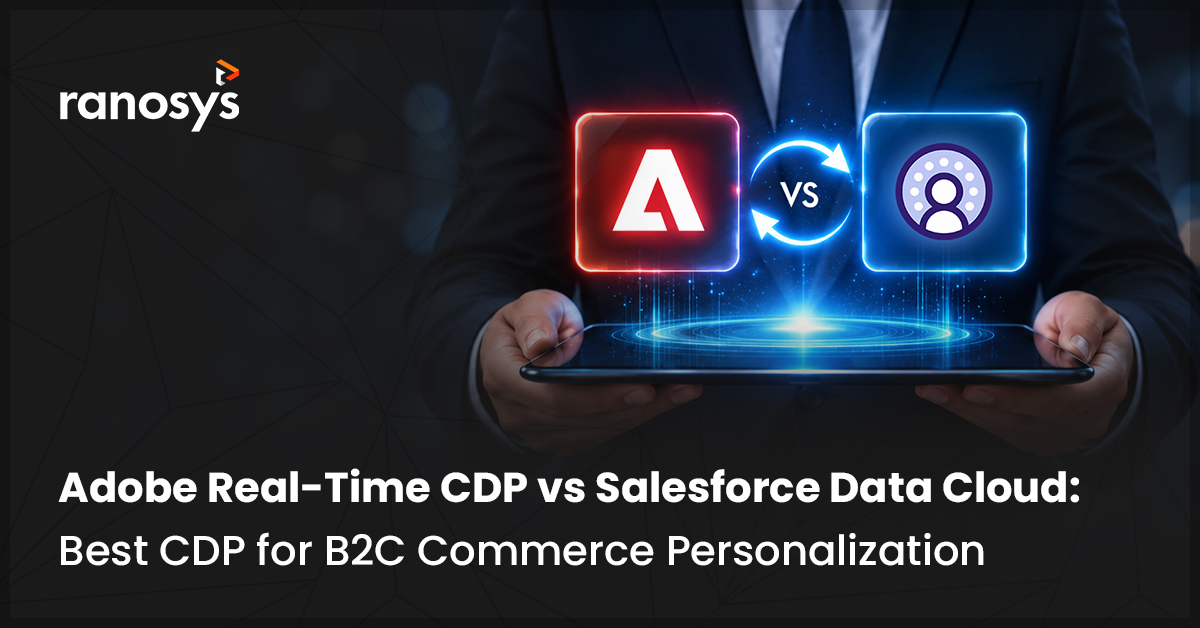
A customer data platform fixes that problem at the source, but the harder question is which one to choose. This guide compares Adobe Real-Time CDP vs. Salesforce Data Cloud (Also known as Salesforce Data 360) for B2C commerce personalization.
What makes a CDP effective for B2C personalization at scale?
For B2C brands, scale means millions of profiles. Most of those shoppers stay anonymous until they check out. An effective customer data platform software handles these jobs at that volume:
- Updates profiles in real time: Browse, cart, and order events update the profiles within the session, so the next page reflects what the shopper just did.
- Link identities across devices: Cookies, app IDs, emails, and loyalty numbers resolve into one person once a shared identifier appears.
- Consent and governance controls: Usage labels and policies travel with the data, so information collected for service is not activated for advertising without permission.
- Activation without exports: Audiences flow directly into the storefront, email, ad, and service tools instead of moving through CSV handoffs.
Salesforce’s research shows just 51% of marketers have full visibility into commerce data, which means the transaction record, the strongest personalization signal a retailer owns, often never reaches the team running campaigns.
What is Adobe Real-Time CDP?
Adobe Real-Time CDP is Adobe’s customer data platform. It runs on Adobe Experience Platform, and the license includes the platform services it needs. It collects data from different enterprise sources such as websites, apps, commerce platforms, CRM, and offline sources. It then combines that data to create one unified customer profile. Every team works from that same profile when it builds audiences and personalizes channels.
How it builds one customer profile
Adobe follows three steps to build each profile:
- Standardize: The platform maps all incoming data to one common format, the Experience Data Model (XDM). It also checks the data as it arrives.
- Match: Adobe’s Identity Service links the records that belong to the same person.
- Merge: The platform combines those records into one real-time profile that every team can use.
What it does for B2C personalization
- Real-time audiences: A shopper joins or leaves an audience the moment their behavior changes. For example, a shopper who abandons a cart can see a personal offer in the same session, not the next day.
- AI-based scoring: Propensity scores predict which customers are most likely to buy. The platform also finds new prospects who behave like your best customers.
Real-Time CDP shares one customer profile with Adobe Journey Optimizer and Customer Journey Analytics. So an audience you build in the CDP is ready to use in your journeys and reports, with no export. This makes it a strong fit for retailers who already use Adobe tools. Consumer brands choose the B2C Edition, which Adobe offers in Prime and Ultimate packages.
What is Salesforce Data Cloud (Data 360)?
Salesforce Data Cloud is the customer data platform native to the Salesforce ecosystem. It was rebranded as Data 360 in October 2025. Like any other CDP, it pulls data from multiple sources such as apps, websites, data lakes, and older systems into one trusted profile per customer. The main difference is where that profile stays. It stays inside the same platform as your Sales, Service, Marketing, and Customer apps. Your Service agents and marketers see the same customer record.
How it builds one customer profile
Salesforce Data 360 brings data in through three routes:
- Prebuilt connectors: More than 200 connectors bring in data from Salesforce clouds, MuleSoft, databases, and common third-party apps.
- Zero Copy: Data 360 reads live data in Snowflake, Databricks, Google BigQuery, and AWS without copying it.
- SDKs and APIs: Your developers can connect any other source through SDKs and APIs.
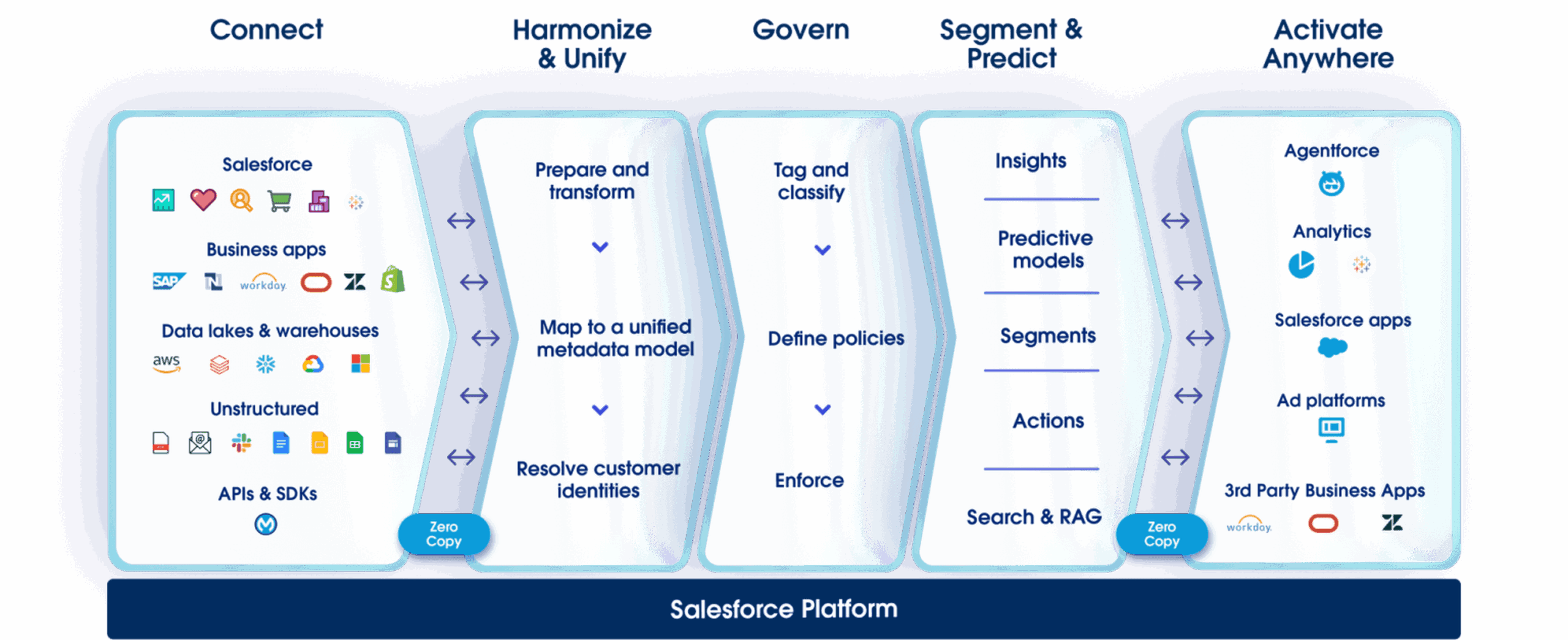
Once the data arrives, identity resolution matches each customer across devices, channels, and anonymous sessions. It then turns those records into known profiles your teams can act on.
What it does for B2C personalization
- Personalized journeys: Real-time behavior and preferences trigger messages across every channel.
- Built-in scores: A low-code builder calculates metrics such as propensity to buy and customer lifetime value for each customer.
- Context for service: Service reps and Agentforce agents see the full interaction history, so they resolve questions faster.
Data 360 sits inside the Salesforce metadata framework. As a result, its profiles work inside Sales, Service, and Marketing Cloud. Teams can act on them with low-code tools like Flow. This makes it a strong fit for retailers who already run commerce, service, or marketing on Salesforce.
Adobe Real-Time CDP vs Salesforce Data Cloud: side-by-side comparison
The best customer data platform for a B2C brand depends mostly on the software you already run. Feature checklists matter less than where your commerce, content, and CRM data already live.
Direct comparison
Use this CDP comparison as a starting point. It draws on each vendor’s own product pages.
| Feature or Dimension | Adobe Real-Time CDP | Salesforce Data 360 (Data Cloud) |
| Primary ecosystem fit | Adobe Experience Cloud (AEM, Adobe Commerce, Journey Optimizer, Adobe Analytics, Adobe Target) | Salesforce Customer 360 (Sales, Service, Marketing, and Commerce Cloud, plus Agentforce) |
| Data model | Experience Data Model (XDM); setup needs a data architect for schemas and identity | Customer 360 Data Model; turns data into native Salesforce objects and fields |
| Identity matching | Identity Service links records into one profile per person | Identity resolution across devices, channels, and anonymous sessions |
| Warehouse access | Builds audiences straight from your warehouse without copying data | Zero-copy reads live data in Snowflake, Databricks, Google BigQuery, and AWS |
| Real-time personalization | Streaming segmentation updates audiences within the same session | Real-time behavior triggers journeys across every channel |
| Commerce connection | Sends audiences into Adobe Commerce | Pulls data from Salesforce Commerce Cloud through the B2C Commerce Intelligence Connector |
| Built-in AI | Propensity scores, lookalike audiences, and CX Enterprise Coworker workflows | Propensity to buy and lifetime value scores; data foundation for Agentforce |
| Pricing model | Based on edition and profile count, with a custom quote | Consumption-based Flex Credits or flat per-profile pricing |
| Primary strength | Real-time web, app, and advertising audiences across Adobe’s marketing stack | One customer profile shared across sales, service, commerce, and AI agents |
Salesforce’s own comparison page claims that Adobe uses warehouse data only to build audiences, not to unify profiles. If your warehouse drives personalization, test this point in a small pilot.
How to decide which CDP fits your B2C commerce stack
Choose Adobe Real-Time CDP if:
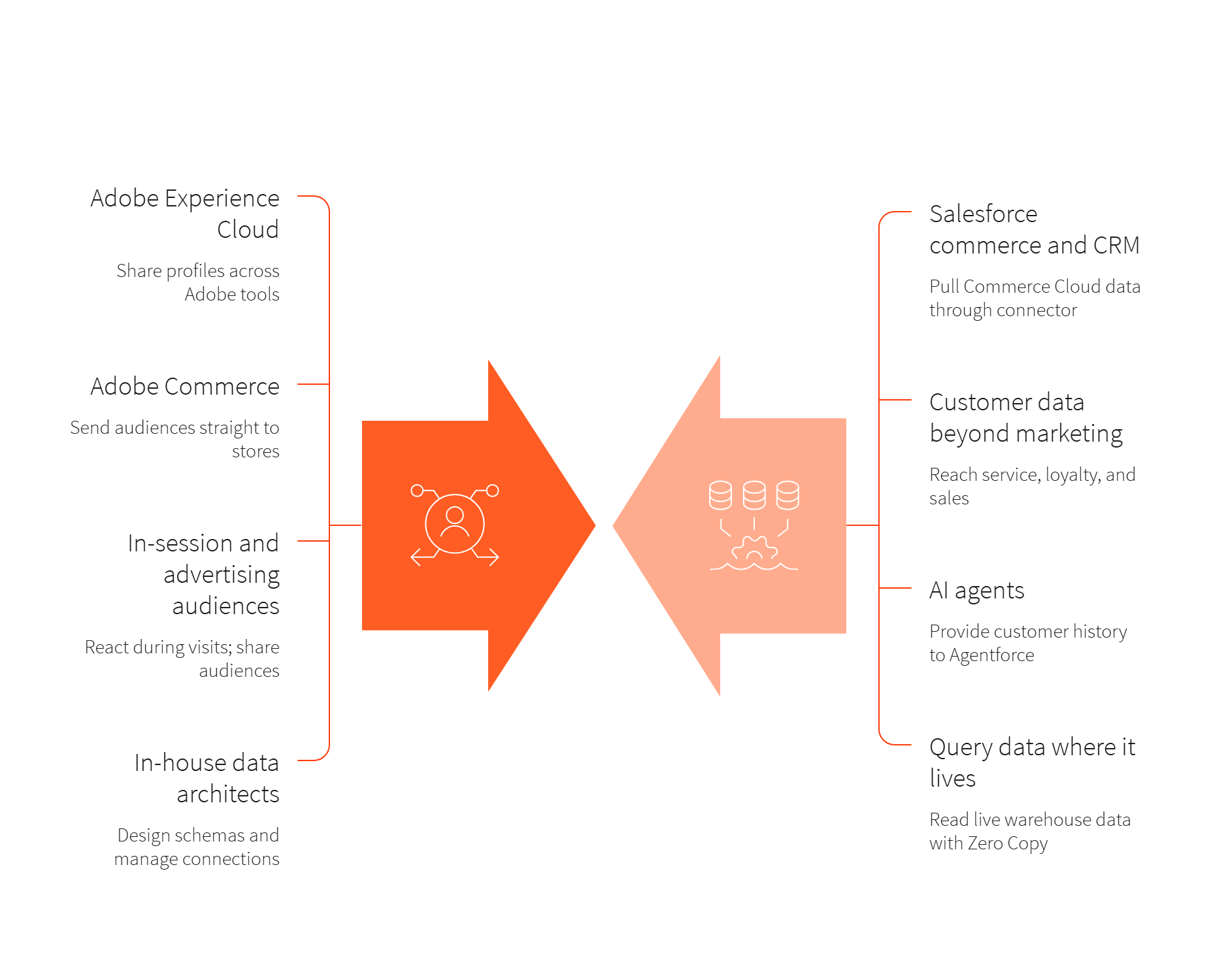
- You already run on Adobe Experience Cloud: Your content runs on AEM, and your journeys run on Journey Optimizer or Adobe Analytics. Real-Time CDP shares one profile with these tools, so audiences move between them with no export.
- You sell on Adobe Commerce: Real-Time CDP sends audiences straight to your store. Merchandisers then personalize cart offers, banners, and pricing for known shoppers and anonymous visitors.
- You focus on in-session and advertising audiences: You want to react to shopper behavior during the same visit. You also want to share audiences with ad and publisher partners through Real-Time CDP Collaboration.
- You have data architects in-house: Your team can design XDM schemas, set identity rules, and manage connections to non-Adobe systems.
- Keep in mind: Real-Time CDP has its deepest native connections with Adobe products. Outside that stack, plan for more integration work.
An airline’s duty-free retail arm runs its Singapore and Australia storefronts on AEM and Adobe Commerce. It connects Adobe Target and Adobe Analytics for personalization and measurement.
Choose Salesforce Data 360 (Data Cloud) if:
- Your commerce and CRM run on Salesforce: Your stack relies on Salesforce Commerce Cloud, Service Cloud, and Sales Cloud. Data 360 pulls Commerce Cloud data through the B2C Commerce Intelligence Connector.
- You want customer data to reach beyond marketing: You want the same profile to reach service agents, loyalty programs, and sales teams. Common Salesforce Data Cloud use cases include product recommendations based on browsing, in-store purchases, and past service cases. Our guide to Salesforce omnichannel retail covers this setup.
- You plan to deploy AI agents: Data 360 is the data foundation for Agentforce. It gives agents the customer history they need to answer correctly.
- You want to query data where it lives: Zero Copy reads live data in your warehouse, so you avoid building duplicate pipelines.
A UK cycling retailer connected Salesforce Order Management, Service Cloud, and Marketing Cloud. It now runs personalized campaigns from a single customer view.
Still unsure? If your stack mixes both vendors or centers on a data warehouse, run a small pilot. Test your top use case on each platform before you commit.
Pricing models: what to budget for
Neither vendor publishes full list prices for enterprise use, and their pricing models work differently.
How Adobe prices Real-Time CDP
Adobe prices Real-Time CDP by edition and number of profiles. Each customer gets a custom quote, and features differ by package. To add AI agents such as Audience Agent to existing Experience Cloud apps, you need a separate Agent Orchestrator license.
How Salesforce prices Data 360
Salesforce offers two pricing models for Data 360:
- Flex Credits: You buy credits at $500 per 100,000. Salesforce deducts credits for each Data 360 action. You can also spend them on Agentforce.
- Per-profile pricing: You pay a flat rate for each profile. This rate covers core actions and keeps bills predictable.
Salesforce customers can also set up Data 360 for free with limited storage and credits. This option works well for a small pilot.
Costs to plan for on either platform
- Profile volume, including anonymous visitors and how long you keep their data.
- Data loading method. On usage-based plans, streaming every event in real time costs more than loading slow-changing data once a day.
- Related licenses, such as Journey Optimizer, Adobe Target, or Marketing Cloud.
- Setup, data design, and ongoing support after launch.
B2C commerce personalization use cases for each platform
Both platforms cover the core B2C use cases, but each one adds its own strengths. Here is how retailers put each one to work.
Adobe Real-Time CDP use cases
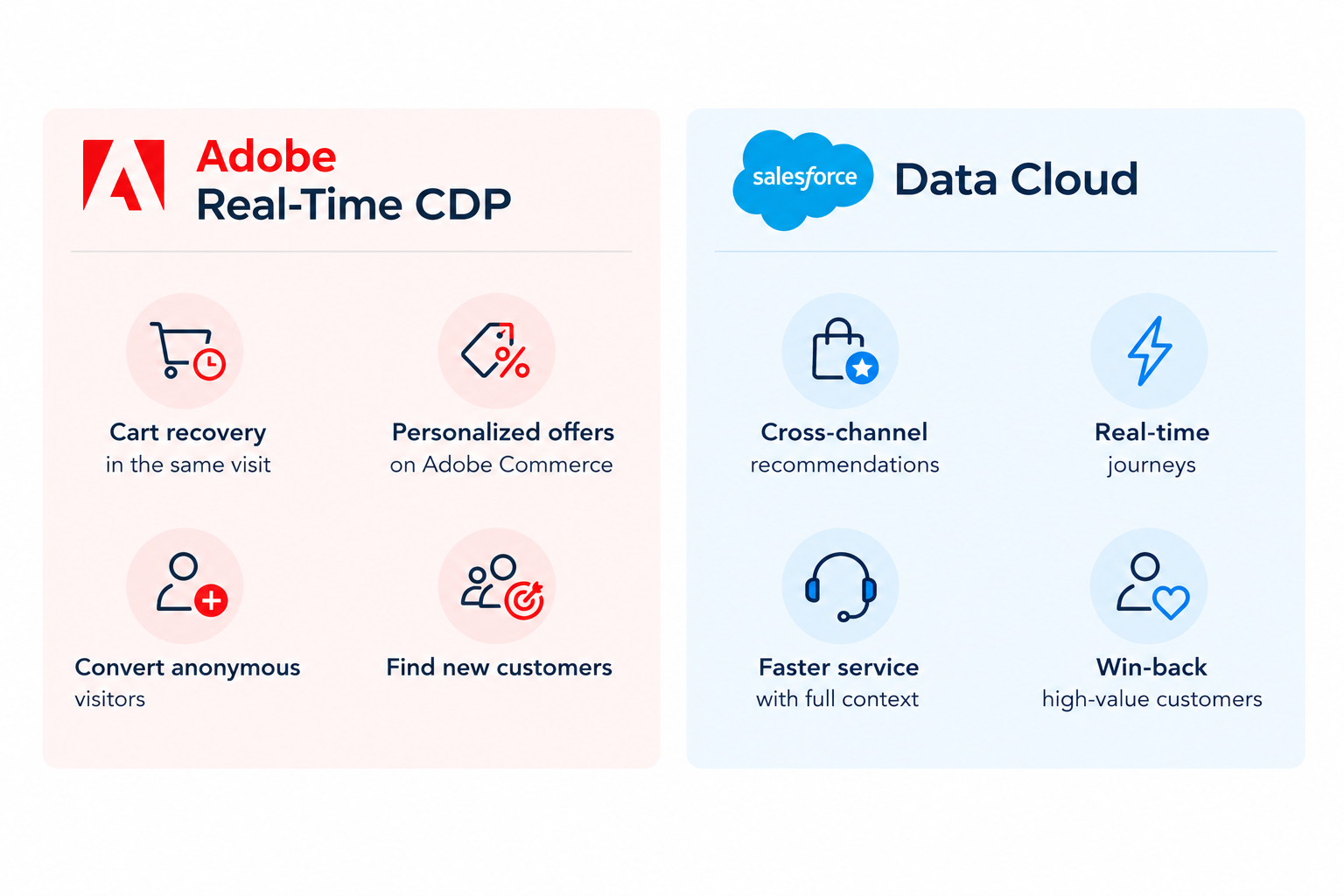
- Cart recovery in the same visit: When a shopper abandons a cart, Real-Time CDP adds them to an audience right away. Your site can then show a reminder or offer before the visit ends, not the next day.
- Personalized offers on Adobe Commerce: Merchandisers apply Real-Time CDP audiences to cart offers, banners, and promotional pricing. Both known shoppers and anonymous visitors see offers that match their behavior.
- Converting anonymous visitors: The platform recognizes returning visitors who have not logged in. It then retargets them with personalized experiences to move them toward a first purchase.
- Finding new customers: Propensity scores show which shoppers are most likely to buy. Lookalike audiences then find new prospects who behave like your best customers, without relying on third-party cookies.
Salesforce Data Cloud use cases
- Recommendations that reflect every channel: Data 360 bases product recommendations on browsing, in-store purchases, and past service cases. For example, a shopper who bought running shoes in a store sees matching socks online, not the same shoes again.
- Journeys triggered by real-time behavior: A shopper’s live behavior and preferences trigger messages across every channel. A product view or a lapsed purchase can start the next step in a journey automatically.
- Faster service with full context: Service reps and Agentforce agents see each shopper’s complete interaction history. They resolve order and return questions faster, without asking customers to repeat themselves.
- Win-back for high-value customers: Built-in scores estimate each customer’s propensity to buy and lifetime value. Marketers use these scores to target win-back offers at valuable customers who have stopped buying.
The main difference lies in where the profile goes next. Adobe focuses on marketing and advertising channels, while Salesforce carries the same profile into service and sales.
Implementation: what it takes to get value from either CDP
Most CDP projects that fall short fail on data design, not on software. These four problems show up with either vendor.
| Feature or Dimension | Adobe Real-Time CDP | Salesforce Data 360 (Data Cloud) |
| Primary ecosystem fit | Adobe Experience Cloud (AEM, Adobe Commerce, Journey Optimizer, Adobe Analytics, Adobe Target) | Salesforce Customer 360 (Sales, Service, Marketing, and Commerce Cloud, plus Agentforce) |
| Data model | Experience Data Model (XDM); setup needs a data architect for schemas and identity | Customer 360 Data Model; turns data into native Salesforce objects and fields |
| Identity matching | Identity Service links records into one profile per person | Identity resolution across devices, channels, and anonymous sessions |
| Warehouse access | Builds audiences straight from your warehouse without copying data | Zero-copy reads live data in Snowflake, Databricks, Google BigQuery, and AWS |
| Real-time personalization | Streaming segmentation updates audiences within the same session | Real-time behavior triggers journeys across every channel |
| Commerce connection | Sends audiences into Adobe Commerce | Pulls data from Salesforce Commerce Cloud through the B2C Commerce Intelligence Connector |
| Built-in AI | Propensity scores, lookalike audiences, and CX Enterprise Coworker workflows | Propensity to buy and lifetime value scores; data foundation for Agentforce |
| Pricing model | Based on edition and profile count, with a custom quote | Consumption-based Flex Credits or flat per-profile pricing |
| Primary strength | Real-time web, app, and advertising audiences across Adobe’s marketing stack | One customer profile shared across sales, service, commerce, and AI agents |
A Salesforce Data Cloud implementation usually connects Salesforce CRM and commerce data first, since those connectors come built in. Teams add external sources later. Adobe projects follow a similar order.
FAQs about B2C customer data platforms
Adobe CDP vs Salesforce CDP: which is better for a B2C brand?
Both are strong choices, and the better fit depends on your current stack. Adobe’s platform works best for brands that run their store, content, and journeys on Adobe Experience Cloud. Salesforce’s platform works best for brands that keep their commerce, service, and CRM data on Salesforce.
How do analysts rate the two platforms?
Both rank as leaders. Forrester named Adobe a Leader in the Forrester Wave: Customer Data Platform for B2C, Q3 2026. Salesforce has also been named a Leader in Customer Data Platform by Gartner.
Can Data 360 use data from Adobe products?
Yes. Salesforce offers connectors for Adobe Analytics, Adobe Commerce, and Marketo Engage. You can also send data back to Adobe products through MuleSoft.
Do we need to move data out of our warehouse?
No. Both platforms can work with data that stays in your warehouse. Salesforce uses Zero Copy, and Adobe uses federated audience composition.
Why choose Ranosys for Adobe & Salesforce CDP implementation
The Adobe Real-Time CDP vs Salesforce Data Cloud choice rarely comes down to features alone. It depends on where your commerce, CRM, and content already live. It also depends on how well you design your data model before launch.
Ranosys is a Salesforce Summit Partner and an Adobe Solution Partner. We work with both platforms, so our advice follows your stack, not a single vendor. Our CDP team helps with:
- Platform selection: We rank your use cases and check each platform against your current stack.
- Adobe implementation: Our Adobe Real-Time CDP implementation services help consumer brands go live.
- Salesforce implementation: Our Salesforce Data 360 implementation services include Agentforce setup.
- Commerce integration: We connect audiences to Adobe Commerce and Salesforce Commerce Cloud.
- Managed services: We monitor usage, control costs, and roll out new use cases after launch.
With one trusted profile, every store visit and service conversation can reflect what you know about the customer.