Talk to our experts
Retailers can lose margin even after a customer buys the product. Returns, failed fulfillment, order changes, inventory mismatches, and manual exception handling can add operational costs while customers wait for answers. Every unresolved order issue can also create work across customer service, fulfillment, warehouse, finance, and logistics teams.
Many retailers manage orders across commerce platforms, ERP systems, OMS platforms, warehouse applications, payment services, carrier platforms, and customer service tools. When an order moves between these systems, teams may have limited visibility into its current state. A customer asking about a delayed delivery may require an agent to check several applications before identifying the issue and deciding what happens next.
ServiceNow for retail provides a workflow layer for coordinating order activities across capture, enrichment, decomposition, fulfillment, exception management, and post-purchase service. ServiceNow Order Management can connect these activities with existing enterprise systems, giving teams a shared view of order progress and the actions required to complete it.
Why order management is becoming a retail priority
An online order may look simple to a customer, but the underlying process can involve inventory confirmation, payment authorization, warehouse processing, shipment creation, delivery updates, customer notifications, and post-purchase support.
The complexity increases when customers request changes, select different fulfillment options, receive partial shipments, report delivery issues, or initiate returns. Each exception can require coordination between several teams and systems.
For retailers, the objective is to establish a consistent order lifecycle where teams can understand order status, identify dependencies, and act on exceptions without manually reconstructing information across multiple applications.
Retail demand is also becoming more distributed across digital and physical fulfillment channels. Adobe Analytics reported $257.8 billion in U.S. online spending during the 2025 holiday season, up 6.8% year over year. Smartphones accounted for 56.4% of online transactions, while curbside pickup represented 17.1% of online orders among retailers offering the service. These figures reinforce the need for order workflows that can coordinate multiple channels, fulfillment locations, and customer service activities. Source: Adobe Analytics, January 7, 2026
The same Adobe analysis found that generative AI tools drove a 693.4% year-over-year increase in traffic to U.S. retail sites during the 2025 holiday season. As AI-assisted discovery grows, retailers need the operational workflows behind the shopping experience to keep pace with increased digital demand and more complex customer journeys. Source: Adobe Analytics, January 7, 2026
Where ServiceNow fits into the retail order lifecycle
ServiceNow Order Management can coordinate activities from order capture through fulfillment and closure. Its capabilities include order enrichment, decomposition, fulfillment task management, order visibility, exception handling, and order operations.
A typical retail architecture can follow this model:
Customer channels → Commerce platform → ServiceNow Order Management → Enterprise systems → Customer service
The commerce platform can continue managing the digital shopping experience while ServiceNow coordinates downstream workflows and service activities. ERP, OMS, inventory, warehouse, payment, logistics, and other systems can continue performing their specialised functions.
This approach is particularly relevant for retailers that already have an OMS. ServiceNow can work with an existing OMS rather than requiring every order-processing capability to move into a single platform.
ServiceNow vs. dedicated OMS platforms
Retailers evaluating ServiceNow order management implementation often ask whether ServiceNow should replace their existing OMS.
The answer depends on the retailer’s architecture and business requirements. A dedicated OMS typically focuses on order routing, inventory availability, sourcing, fulfillment decisions, and order execution. ServiceNow provides workflow, task management, customer service, exception handling, and enterprise service capabilities.
| Requirement | Dedicated OMS | ServiceNow |
| Order Management | Purpose-built for end-to-end order lifecycle management | Supports order-related workflows through configuration and integrations |
| Order Routing & Sourcing | Native order routing and sourcing capabilities | Typically handled through integrations with commerce, ERP, OMS, or other systems |
| Inventory Visibility | Often provides centralized inventory visibility across channels | Can surface inventory data from connected systems |
| Fulfillment Orchestration | Core capability for coordinating fulfillment across locations and channels | Supports fulfillment workflows and orchestration through connected systems |
| Customer Service Workflows | Usually requires integration with a CRM or customer service platform | Strong case, task, workflow, and agent workspace capabilities |
| Order Exception Handling | Dedicated workflows for cancellations, delays, returns, and fulfillment exceptions | Can manage exceptions through cases, tasks, workflows, and automation |
| Enterprise Service Management | Generally outside the core OMS scope | Native platform capability across enterprise service processes |
| Agent Workspace | Depends on the OMS platform and connected applications | Provides configurable workspaces for service agents |
| Integration with Existing OMS | May serve as the primary order management platform | Can integrate with and coordinate workflows across an existing OMS |
| Best Fit | Complex order orchestration, inventory, sourcing, and fulfillment requirements | Service workflows, customer operations, and orchestration across enterprise systems |
For many retailers, the practical model is ServiceNow working with the existing OMS. The OMS can continue handling specialised order decisions while ServiceNow coordinates workflows, service operations, exceptions, and customer interactions.
Omnichannel fulfillment with ServiceNow
Customers expect retailers to support multiple fulfillment options, including buy online, pick up in store (BOPIS), ship-from-store, curbside pickup, home delivery, and split fulfillment.
Each option introduces additional workflow dependencies. A single order may require inventory confirmation from several locations, store associate actions, warehouse activities, carrier coordination, and customer notifications.
A ServiceNow BOPIS workflow, for example, can follow these steps:
- Capture the order from the commerce channel.
- Validate customer and order information.
- Check inventory availability.
- Create a store fulfillment activity.
- Assign the activity to the appropriate store team.
- Track picking and staging.
- Notify the customer when the order is ready.
- Record pickup completion.
The same model supports ship-from-store and split fulfillment. When different items in a single customer order must be fulfilled from separate locations, each generates its own fulfillment task while remaining linked to the original order record. Teams can track each component independently without losing sight of the overall order status.
This is the foundation for ServiceNow omnichannel order management: fulfillment activities across stores, warehouses, and delivery networks coordinated through connected workflows rather than separate manual processes.
A UK-based omnichannel cycling retailer with 14 stores implemented Salesforce
Order Management alongside Commerce Cloud and Service Cloud, enabling a unified customer profile and coordinated post-purchase service across all channels.
Key capabilities for retail order management
1. Order capture and enrichment
Orders can originate from e-commerce, stores, contact centers, B2B channels, or APIs. ServiceNow can provide a consistent workflow for capturing and enriching order information before downstream fulfillment activities begin.
2. Order decomposition and orchestration
Complex orders can be divided into fulfillment activities based on product, location, service requirements, and business rules. For example, products available from two warehouses can generate separate fulfillment activities while remaining part of the same customer order.
3. Fulfillment visibility
Teams can monitor order status, fulfillment tasks, dependencies, and exceptions through connected workflows. This helps customer service and operations teams understand what has happened to an order and what action is required next.
4. Order fallout management
Order fallout occurs when an error or exception prevents an order from progressing normally. Common causes include payment failures, inventory discrepancies, address validation issues, integration errors, system timeouts, and fulfillment delays.
A ServiceNow order fallout management process can follow four stages:
Identify and classify → Assign → Investigate and resolve → Verify and close
The workflow can route an exception to the responsible team, track its SLA, record investigation details, and continue the order process after resolution.
This creates a structured process for handling exceptions instead of relying on emails, spreadsheets, or manual follow-ups.
5. Managing cancellations and order amendments
Customers may request a cancellation, quantity change, delivery address update, or fulfillment modification after placing an order.
The workflow needs to consider the current order state before applying the requested change.
A typical order cancellation ServiceNow workflow can follow:
Customer request → Validate order → Check fulfillment state → Determine eligibility → Cancel or amend → Update connected systems → Notify customer
For example, an order that has not entered warehouse processing may be easier to cancel than one already being picked or shipped. The workflow should therefore evaluate downstream dependencies before confirming the change.
The same approach can support order amendments where permitted, helping teams maintain consistency between the customer order and connected fulfillment systems.
6. Returns management for retail
Returns continue the customer journey after delivery. A return can involve eligibility checks, authorization, pickup or drop-off, warehouse receipt, inspection, refund or replacement, inventory updates, and customer communication.
A ServiceNow returns management retail workflow can coordinate these activities across customer service and fulfillment teams.
A typical return lifecycle includes:
- Return request: Customer submits the request.
- Eligibility check: Validate the purchase, product, policy, and return period.
- Return authorization: Create the required return activity.
- Logistics: Arrange pickup or provide drop-off instructions.
- Receipt: Confirm the returned item has reached the designated location.
- Inspection: Record product condition and disposition.
- Refund or exchange: Trigger the appropriate financial or replacement process.
- Inventory update: Record the resulting inventory status.
- Customer notification: Communicate the final outcome.
Connecting these activities gives customer service teams greater context when customers ask about returns, refunds, or exchanges.
A practical ServiceNow order management implementation
A successful ServiceNow order management implementation starts with the order journey and existing system landscape.
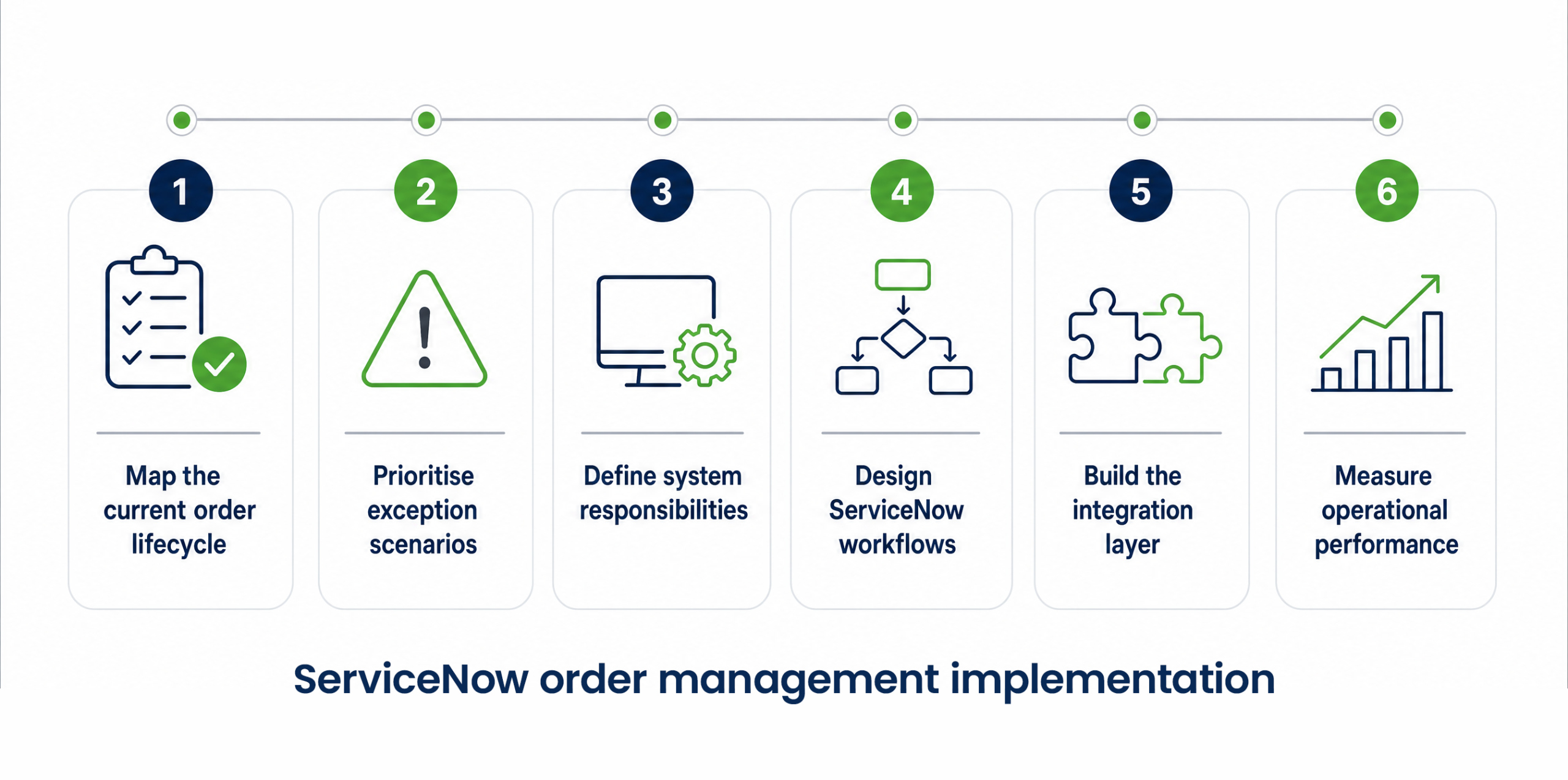
1. Map the current order lifecycle
Document order creation, fulfillment, delivery, cancellation, amendment, return, refund, and closure. Identify the systems and teams involved at each stage.
2. Prioritise exception scenarios
Identify the issues creating the most manual work, such as payment failures, inventory discrepancies, delayed shipments, split orders, cancellations, and returns.
3. Define system responsibilities
Establish which platform owns each data element and business decision. Commerce may own the cart, an OMS may manage sourcing, ERP may manage financial transactions, and WMS may execute warehouse activities.
4. Design ServiceNow workflows
Define workflows for order orchestration, fulfillment tasks, customer service, exceptions, cancellations, and post-purchase activities.
5. Build the integration layer
A ServiceNow order management integration can use APIs, events, middleware, Integration Hub, or other approved integration patterns based on the retailer’s existing technology environment.
6. Measure operational performance
Track order cycle time, fallout rate, exception resolution time, cancellation rate, return processing time, customer service handling time, and fulfillment performance.
How ServiceNow AI agents support retail order management
AI can assist retail order operations when it has access to appropriate order context, business rules, and connected operational data.
Current ServiceNow capabilities include AI-supported order operations, order capture assistance, order fallout processing, and other order-related workflows.
Practical ServiceNow AI agents retail use cases include:
- Investigating order-related questions
- Summarising order information for agents
- Identifying and classifying fallout
- Creating fallout records from identified issues
- Supporting order changes
- Routing exceptions to appropriate teams
- Assisting with customer order requests
AI should operate within defined workflows, permissions, data controls, and human escalation paths. This allows retailers to introduce AI assistance while maintaining control over customer, order, payment, and fulfillment processes.
The business case for connected order workflows
The business value of order management often becomes most visible when an order does not follow its expected path.
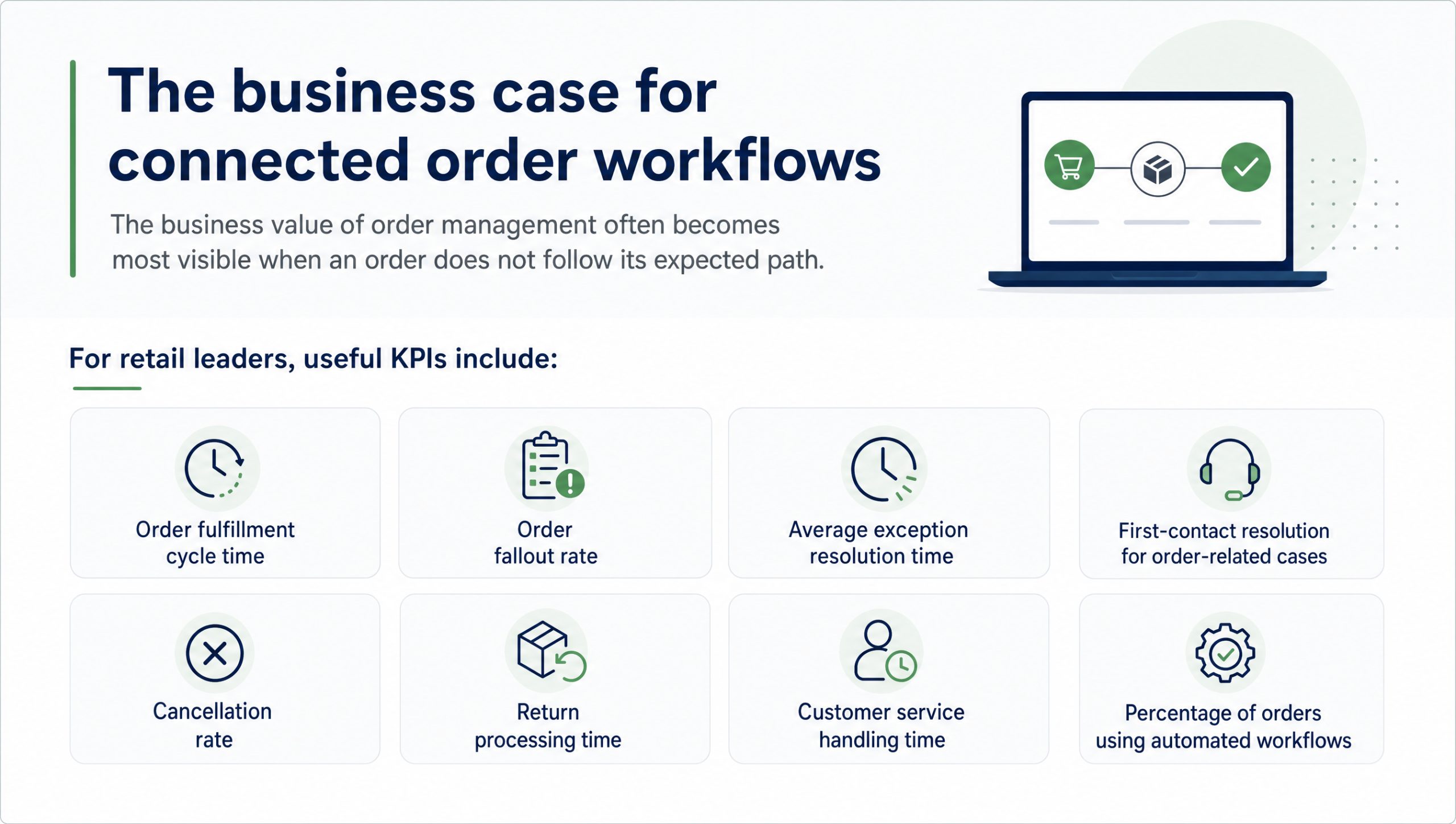
A successful order may require little operational intervention. A failed payment, inventory issue, delivery delay, cancellation, or return can require several teams to coordinate before the customer receives a resolution.
For retail leaders, useful KPIs include:
- Order fulfillment cycle time
- Order fallout rate
- Average exception resolution time
- First-contact resolution for order-related cases
- Cancellation rate
- Return processing time
- Customer service handling time
- Percentage of orders using automated workflows
These measures help connect technology investment with operational performance and customer service outcomes.
Why Ranosys for ServiceNow retail order management implementation
Ranosys brings experience across digital commerce, enterprise integrations, customer experience, and ServiceNow delivery. This combination is relevant to retailers because order management connects commerce, OMS, ERP, inventory, warehouse, payment, logistics, and customer service processes.
Our approach starts with the retailer’s existing order journey and technology landscape. We assess current processes, system responsibilities, integration points, exception scenarios, and customer service requirements before defining the target solution.
Our capabilities include:
- ServiceNow order management implementation
- ServiceNow order management integration
- ServiceNow Retail Service Management
- Order fulfillment workflow design
- Order fallout management
- Customer service workflow integration
- Enterprise API and system integration
- AI-supported service workflows
- Retail transformation and delivery governance
As a ServiceNow retail implementation partner, Ranosys can support discovery, solution design, implementation, integration, testing, deployment, and delivery management.
Conclusion
Retail order management connects commerce, fulfillment, customer service, inventory, logistics, payments, and returns. When these processes operate across separate systems, resolving exceptions and customer requests can require significant manual coordination.
ServiceNow Order Management for Retail provides capabilities for order capture, enrichment, decomposition, fulfillment orchestration, fallout management, order operations, and AI-supported workflows. It can also work with existing OMS, ERP, warehouse, payment, logistics, and commerce platforms.
For retailers planning their next stage of order transformation, the starting point should be the customer order journey, followed by process ownership, system responsibilities, integration design, exception handling, and measurable business outcomes.

Vimal (Parihar) Kumar
Project Manager
Vimal Kumar is a Project Manager at Ranosys with experience leading enterprise digital commerce and transformation programs across Adobe Commerce, ServiceNow, AEM, and Shopify ecosystems. He works across clients, product teams, engineering, QA, DevOps, UX, and business stakeholders to translate business goals into practical technology delivery. His focus areas include retail technology, commerce transformation, enterprise integrations, delivery governance, and AI-assisted delivery. Connect with him on LinkedIn.