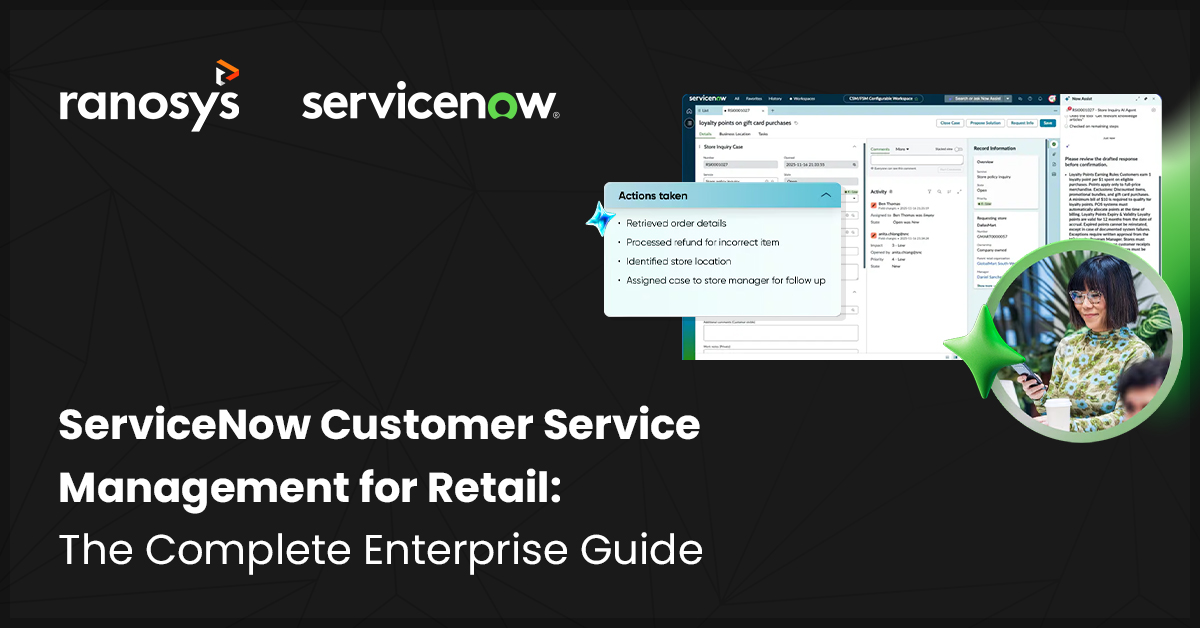
The volume of customer service requests landing on retail operations teams has outpaced the systems built to handle them. For enterprise retailers managing hundreds of stores and millions of annual transactions, ServiceNow CSM has become a strategic priority. According to a Gartner survey from October 2025, 91% of customer service and support leaders are now under pressure to implement AI in their operations, reflecting how much competitive ground is at stake.
You’ve already made the foundational investments: an OMS, a CRM, an e-commerce platform, and separate tools for loyalty, store operations, and field service. Each made sense. The friction comes from the space between them: agents crossing four platforms to answer one question, and no consolidated view of a customer across their full journey.
ServiceNow Customer Service Management addresses this at the system level, connecting every service touchpoint, team, and back-office function in a single platform built for enterprise retail scale.
What is ServiceNow Customer Service Management (CSM)?
ServiceNow CSM is an enterprise service platform that connects customer-facing teams with the back-office systems, workflows, and data they need to resolve issues completely. Unlike a traditional CRM, it connects service delivery across middle-office, back-office, and field service operations so issues are resolved at the source rather than just logged. It treats each case as part of a continuous customer relationship, linked to order history, entitlements, SLAs, and operational context.
For retail, this means a single workspace where contact center agents, store operations teams, logistics staff, and field service technicians collaborate on the same case, with automated workflows coordinating actions across functions. The platform covers case management, knowledge management, omnichannel engagement, self-service portals, Predictive Intelligence, and AI-powered automation on ServiceNow’s Now Platform.
Why modern retailers need ServiceNow CSM
Retail customer service has become structurally more complex. Shoppers browse online, buy in-store, return through a third-party carrier, and follow up by chat. In most retail organizations, each step lands in a different system, producing a fragmented operation where agents spend more time on context-gathering than resolution.
The same Gartner survey (February 2026) identifies customer satisfaction, operational efficiency, and self-service success as the top three priorities for 2026, all directly interconnected, and all addressed through ServiceNow Customer Service Management for retail.
ServiceNow CSM core capabilities for retail
ServiceNow CSM addresses retail service complexity across six interconnected capability areas, each handling a layer that fragmented point solutions cannot resolve. Unified case management
Every service request, whether a missing order, a loyalty point dispute, or a store equipment failure, is captured, categorized, prioritized, and routed from a single platform. Agents work from a configurable Agent Workspace with guided playbooks and AI-generated recommendations, giving them full case context and step-by-step guidance without switching systems.
Omnichannel service engagement
ServiceNow CSM connects service delivery across phone, chat, email, web portals, and social channels, with agents and AI systems responding from one unified interface. Channel context moves with the case, so customers who start on chat and follow up by phone do not need to repeat themselves.
Knowledge management
Agents and customers access a centralized knowledge base through ServiceNow’s knowledge management module. During case handling, agents receive AI-suggested articles matched to the current issue. AI agents also create new knowledge articles from resolved cases, so the knowledge base builds continuously as caseload grows.
Customer service workflow automation
ServiceNow CSM automates repetitive case workflows from intake to routing to resolution. For retail, this includes returns authorization, order status notifications, SLA-based escalations, and field service dispatch for in-store equipment. Proactive service workflows detect rising patterns in case volume and trigger outreach before the queue is overwhelmed.
Predictive Intelligence
Rather than waiting for customers to report problems, Predictive Intelligence uses AI to anticipate service needs before they become inbound contacts. It analyzes case patterns to automate resolutions for known issue types and reduce total case volume, particularly valuable during returns seasons, shipping delays, or product launches.
CMDB and asset integration for store operations
ServiceNow’s CMDB integration links POS terminals, self-checkout kiosks, warehouse scanners, and network infrastructure directly to service cases. When a POS terminal goes down, the case is pre-populated with the asset record, store location, and priority level automatically, removing manual triage where every minute counts.
Retail use cases: ServiceNow CSM in action
Across returns, fulfillment, loyalty, and store operations, ServiceNow CSM applies the same logic: structured case types, automated routing, and full context at every handoff.
Returns and refund case management
Structured workflows route each return type (product defect, wrong item, change of mind) to warehouse, finance, or customer care automatically, with agents managing every case from one workspace.
Order status and fulfillment inquiries
Real-time order data surfaces in the agent workspace through OMS integration, and proactive notification workflows alert customers on progress before they contact support.
Delivery and last-mile issue resolution
Delayed, damaged, or missing delivery cases are classified and routed automatically based on order and carrier data, connecting customer care to logistics without manual handoffs.
Loyalty and account management
Points disputes, tier adjustments, and promotional credits route through structured case types with full customer history visible, ensuring loyalty members receive prioritized, context-aware handling at every touchpoint.
Warranty and product recall management
Warranty claims and recall-related cases are classified and escalated automatically to the relevant product, legal, or logistics team. AI agents handle product recall intake, classification, and customer communications autonomously, without individual agent triage.
Click-and-collect (BOPIS) coordination
Pickup delays, inventory discrepancies, and scheduling issues for buy-online-pickup-in-store orders are managed through dedicated case types connected to OMS and store inventory data.
In-store experience and complaint management
Store-level complaints, from product quality to staff interactions, route to store management or customer relations through structured case types with full incident context attached.
Store operations and maintenance
Store teams submit equipment and facility requests through a self-service portal with automated routing and status tracking. Carrefour built its ‘Click & Repair‘ application on ServiceNow CSM and FSM, enabling staff to scan asset QR codes and route maintenance cases to the right technician instantly, with significant improvement in repair times across stores.
How AI and ServiceNow Now Assist are transforming retail customer service
ServiceNow Now Assist brings generative AI and agentic AI into every CSM service channel. In October 2025, ServiceNow released Now LLM v2.0 and Now SLM v2.0, upgraded AI models with updated training data and expanded agentic workflow support across voice, chat, email, and web.
For retail contact centers, Now Assist for CSM operates at two levels. At the agent level, every case opens with an AI-generated summary of interaction history, account context, and recommended next actions, so agents arrive with full context rather than spending the first minutes gathering it. At the customer level, autonomous AI agents handle routine requests, such as order status checks and return eligibility, from intake to resolution without routing to a human agent, operating 24/7 to scale service capacity without adding headcount. Virtual agents deflect Tier 1 contacts before they reach the queue, and knowledge surfacing runs throughout: matched articles and response suggestions appear in context during live interactions, without agents leaving the workspace.
ServiceNow describes Now Assist for CSM as enabling faster resolution “with GenAI and agentic AI across every service channel,” with autonomous workflows executing multi-step actions when no human decision is required.
ServiceNow CSM implementation roadmap for retail enterprises
A ServiceNow CSM implementation for an enterprise retailer follows five phases aligned to operational readiness and business priority:
Phase 1: Discovery and scope definition
Map service workflows across contact center, store operations, and logistics. Identify integration points with ERP, OMS, POS, and loyalty systems. Define case types, SLAs, and baseline KPIs.
Phase 2: Core platform configuration
Configure the CSM workspace, routing logic, and knowledge base. Build and test integration connectors, then configure the self-service portal for customers and store teams.
Phase 3: AI and automation layer
Deploy Now Assist skills for case summarization, recommended responses, and virtual agent workflows. Configure Predictive Intelligence rules and proactive service triggers for high-volume retail scenarios.
Phase 4: Training and go-live
Train agents and store teams on the new workspace and run a controlled regional rollout. Monitor resolution metrics and adoption daily through the first peak period.
Phase 5: Ongoing optimization
Track case deflection rates, first-contact resolution, and AI agent handling volume monthly. Adjust routing rules and knowledge content with the aim of increasing self-service resolution and reducing agent-handled volume each quarter.
KPIs, ROI, and business benefits of ServiceNow CSM in retail
Enterprise retail organizations track ServiceNow CSM performance across service efficiency (resolution time, first-contact resolution rate, self-service deflection), operational cost (agent hours per case, inter-team handoffs, peak-season overhead), and customer impact (CSAT and NPS trends, repeat contact rate, churn from service failures).
Across documented customer deployments, ServiceNow’s product page reports a 20% reduction in customer churn, 30% of key processes automated, and organizations consolidating up to five legacy service systems into a single ServiceNow deployment. These results reflect what becomes possible when case management, self-service, workflow automation, and AI operate on one connected architecture.
The Carrefour deployment illustrates this in retail. Their ‘Click & Repair’ application, built on ServiceNow CSM and FSM, produced significant improvement in repair times, less in-store disruption, and a measurable employee NPS improvement. Guillaume Verkant, Carrefour France’s Technical Director, noted: monitoring became much more thorough, more precise.
For contact center operations specifically, the return on investment comes from reducing agent context-gathering time, increasing first-contact resolution, and deflecting routine contacts through self-service and AI agents running 24/7.
Why Ranosys for ServiceNow CSM retail implementation
Ranosys is a ServiceNow implementation partner with delivery experience across retail, BFSI, and enterprise services. For retail CSM projects, we bring pre-built integration frameworks for OMS, POS, and loyalty systems, cutting design and testing time on custom connector work. We assess your service workflows, scope integration requirements, and build a phased plan around your priorities: reducing peak-season resolution time, decreasing contact volume through self-service, or deploying Now Assist AI capabilities across your contact center.
Our ServiceNow CSM services for retail include:
- Current-state service workflow assessment and friction-point audit
- CSM platform design, configuration, and user acceptance testing
- Integration with ERP, OMS, POS, and loyalty systems
- Now Assist and AI agent deployment
- Customer-facing and store operations self-service portal development
- Agent and store team training and change management
- Post-go-live performance optimization and quarterly roadmap support
If your contact center is managing too much friction and your store operations teams are working around fragmented tools, a structured assessment of the highest-value improvements is the right place to start.