Talk to our experts
In today’s digital world, businesses need to provide outstanding online experiences to stay ahead. With tough competition and fast-changing technology, having a strong online presence and efficient operations is crucial. According to Forrester’s June 2025 Forrester report, customer experience quality in the U.S. has hit an all-time low, with 25% of brands seeing their rankings decline for the second consecutive year. This study also suggests, companies that align brand experience with customer experience can achieve up to 3.5 times revenue growth and significantly boost customer retention and loyalty.
The content management systems market is experiencing robust growth, with the global CMS market valued at USD 24.56 billion in 2026 and projected to reach USD 45.88 billion by 2035, reflecting a CAGR of 7.19%. This growth is driven by widespread cloud adoption (72% of enterprises), AI-enabled personalisation (62%), and omnichannel publishing needs.
However, achieving this high level of customer satisfaction can be hard, especially for businesses with limited resources and technical know-how. This is where Adobe Experience Manager (AEM) comes into play. AEM is a powerful tool that helps businesses manage their online content and deliver personalized experiences across different channels. However, using AEM to its full potential can be challenging. It requires specialized skills, ongoing maintenance, and the ability to adapt to changing business needs.
To overcome these challenges, many businesses are using Adobe AEM Managed Services. These services offer expert support, proactive monitoring, and continuous optimization. This allows businesses to focus on what they do best, while ensuring their AEM system runs smoothly and efficiently.
In this comprehensive guide, we’ll explore AEM Managed Services, their benefits, and how they can help your business succeed in the digital world.
What is AEM Managed Service?
Adobe Experience Manager is a powerful and comprehensive digital experience platform that allows businesses to create, manage, and deliver personalized content across multiple channels. However, harnessing the full potential of AEM can be a complex and resource-intensive process, requiring specialized expertise and continuous support. This is where AEM Managed Services come into play.
AEM Managed Services are a suite of offerings provided by certified Adobe partners and experts, designed to support businesses throughout the entire AEM lifecycle. These services include a wide range of activities, including implementation, hosting, infrastructure management, security and compliance, performance monitoring, content and asset management, technical support, and upgrades and patch management.
By leveraging AEM Managed Services, businesses can reduce the operational complexities associated with managing an AEM environment, freeing up internal resources to focus on their core competencies and strategic initiatives.
Adobe Experience Manager as a Managed Service
Adobe Experience Manager (AEM) is the industry-leading digital experience management solution for enterprises and SME businesses. AEM offers a modern, scalable foundation to create engaging experiences that enhance brand engagement, stimulate demand, and boost customer loyalty. AEM includes comprehensive tools to design, manage, and deliver digital experiences across all channels.
When leveraging Adobe Experience Manager as a Managed Service, the AEM solution is hosted in a dedicated environment, fully managed and supported by Adobe. Core infrastructure components such as web application hosting, redundancy, and storage are provided through Adobe-certified cloud service providers and maintained by Adobe experts. This setup ensures optimal performance, security, and scalability, allowing organizations to focus on delivering exceptional digital experiences.
What are the advantages of AEM Managed Services?
Implementing AEM Managed Services can significantly improve a business’s digital strategy and operations. Here are the key benefits:
#1. Cost-efficiency and resource optimization: Outsourcing AEM management to a specialized vendor helps businesses avoid the high costs of an in-house team. Managed services providers offer flexible pricing, allowing for scalable services and efficient resource allocation. Organizations often see strong AEM managed services ROI within months due to reduced operational costs, faster time to market, improved uptime, and enhanced digital performance.
2. Expertise and Best Practices: AEM Managed Services vendors are experts in AEM capabilities and best practices, allowing businesses to leverage their full potential without investing in training. They provide tailored solutions aligned with business goals and implement advanced AEM DevOps and CI/CD workflows to automate deployment, maintain consistent environments, and speed up release cycles.
3. Security and Compliance: Security is crucial for any business, and AEM Managed Services vendors focus on robust AEM security and compliance features to protect digital assets, customer data, and sensitive information. They actively monitor for vulnerabilities and ensure compliance with industry regulations like GDPR, HIPAA, and PCI-DSS, which is vital for regulated industries such as healthcare and finance.
4. Optimization and Performance: AEM Managed Services offer ongoing support and maintenance to optimize platform performance. This includes comprehensive AEM monitoring capabilities that extend beyond basic uptime tracking. Ranosys, as a managed service provider, implements AEM performance monitoring best practices such as real-time health checks, resource utilization tracking, proactive alerts, and detailed analytics. This continuous performance monitoring optimization ensures a seamless user experience and enables businesses to adapt to changing user behavior and emerging technologies.
5. Scalability and Flexibility: Business needs can change rapidly, and AEM Managed Services are designed with scalability and flexibility in mind. Whether a business is experiencing rapid growth or needs to downsize temporarily, these services can adapt to their requirements through cloud scalability and automation. This ensures that AEM resources align with the current state of the business, preventing overinvestment or resource shortages.
How can AEM managed services benefit my business?
AEM Managed Services can benefit businesses in multiple ways, enabling them to thrive in the competitive digital landscape:

Source: https://business.adobe.com/products/experience-manager/managed-services.html
- Accelerated Time-to-Value: By partnering with an experienced AEM Managed Services vendor, businesses can increase the implementation and deployment of their AEM instance. This accelerated time-to-value ensures that businesses can quickly leverage the full capabilities of AEM, including advanced AEM integrations with other Adobe Experience Cloud solutions, driving faster ROI.
- Focus on Core Competencies: By offloading the operational complexities of managing an AEM environment, businesses can redirect their internal resources towards core competencies and strategic initiatives that drive growth and revenue. This allows for greater agility and adaptability in an ever-evolving digital landscape.
- Seamless Integration and Migration: AEM Managed Services providers are experienced in integrating AEM with existing systems and migrating content and assets from legacy platforms. This seamless integration and migration process minimizes disruptions to business operations and ensures a smooth transition to the AEM platform.
- Improved Customer Experiences:By leveraging the expertise of AEM Managed Services vendors, businesses can optimize their digital experiences, delivering personalized, engaging, and consistent content across multiple channels. This can lead to improved customer satisfaction, increased customer retention, and ultimately, increased business revenue.
- Reduced Risk and Compliance Assurance:Adobe Experience Manager Managed Services providers prioritize security and compliance, implementing robust measures to safeguard digital assets, customer data, and sensitive information. They ensure that the AEM platform remains compliant with industry regulations, reducing the risk of non-compliance and potential penalties.
What are Edge Delivery Services in Adobe Experience Manager?
Edge Delivery Services represents Adobe’s next-generation approach to content delivery, enabling organizations to achieve exceptional website performance with perfect Lighthouse Scores while dramatically accelerating content creation. This modern framework pushes content rendering closer to end users through a multi-cloud SaaS solution, delivering faster time-to-market and superior AEM performance optimization.
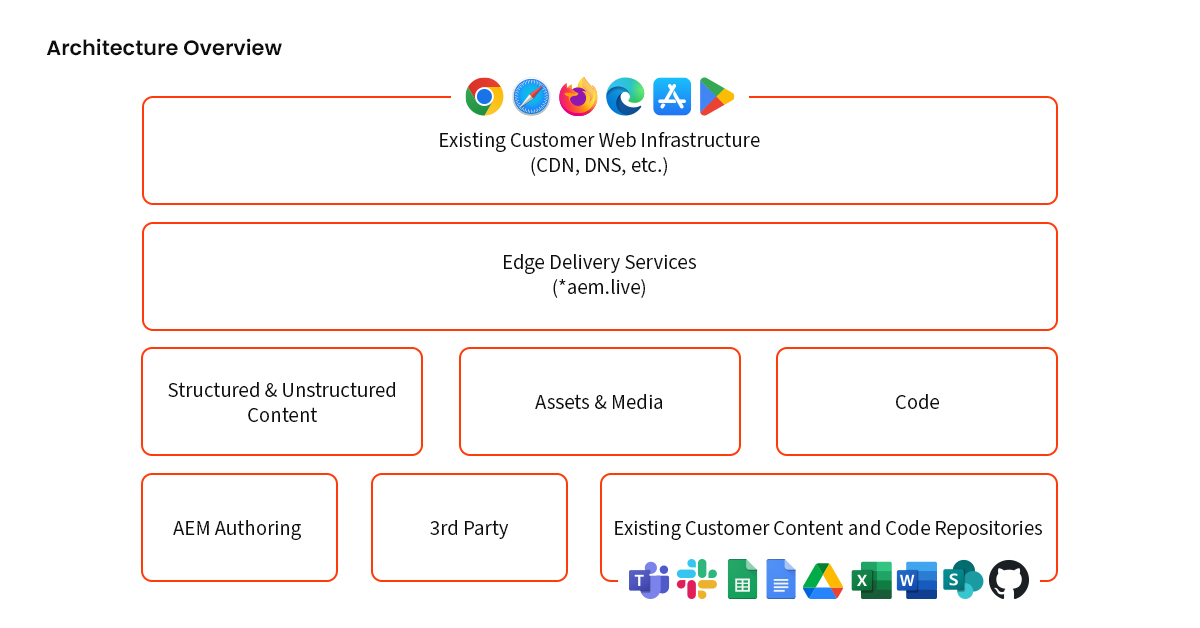
Source: https://www.aem.live/docs/architecture
Key Capabilities
- Flexible Authoring Options: Content teams can choose between document-based authoring using familiar tools like Microsoft Word or Google Docs for instant publishing, or the Universal Editor for sophisticated visual editing with real-time previews.
- Exceptional Performance: Organizations consistently achieve 100 Lighthouse performance scores through intelligent phased rendering that prioritizes loading prominent page elements first, resulting in faster load speeds, reduced bounce rates, and improved SEO rankings.
- Streamlined Development: Direct GitHub integration enables developers to deploy code without complex build processes using plain HTML, modern CSS, and vanilla JavaScript, supporting modern AEM DevOps and CI/CD workflows for continuous deployment.
- Built-in Monitoring: Operational telemetry provides real-time AEM monitoring insights for diagnosing performance issues while preserving visitor privacy.
How AEM Managed Services Enhance Edge Delivery
When organizations combine Edge Delivery Services with AEM Managed Services, managed services providers optimize Edge Delivery implementation, coordinate dual-stack environments running alongside traditional AEM Sites, facilitate hybrid authoring transitions, and implement workflows that capitalize on instant publishing capabilities while maintaining AEM security and compliance features and brand consistency.
Organizations implementing Edge Delivery Services through managed services partnerships typically see new sites launch in weeks rather than months, consistent 100 Lighthouse scores driving improved engagement, reduced infrastructure complexity through cloud scalability and automation, and increased author productivity with familiar authoring tools.
Optimize your AEM performance with edge delivery services
AEM integration with Adobe Analytics and Adobe Target
One of the most powerful aspects of Adobe Experience Manager is its native integration capabilities with other Adobe Experience Cloud solutions. AEM integrations with Adobe Analytics and Adobe Target create a comprehensive digital experience ecosystem that enables data-driven personalization, detailed behavioral analysis, and measurable business outcomes.
Why These Integrations Matter
Modern digital experiences demand intelligent, data-driven personalization based on deep customer insights. The AEM integration with Adobe Analytics and Adobe Target enables organizations to understand user behavior comprehensively, deliver personalized experiences at scale, measure and optimize performance, and accelerate decision-making with real-time insights. Research demonstrates that organizations integrating Adobe Target and AEM with audience segmentation achieve 10% increase in average order value (AOV) when personalization strategies are properly aligned.
Adobe Analytics Integration
The AEM integration with Adobe Analytics provides comprehensive visibility into user interactions. Adobe Analytics captures granular behavior data including page visits, form submissions, video interactions, and transactions, creating a unified customer journey view. Organizations can monitor real-time performance metrics such as conversion rates by segment, bounce rates, traffic sources, and content consumption patterns. AI-powered insights automatically identify trends and opportunities, while cross-channel attribution reveals which touchpoints drive the most valuable outcomes across all marketing channels.
Adobe Target Integration
The AEM integration with Adobe Target empowers content creators to deliver highly targeted experiences without deep technical expertise. Authors create multiple content variations within AEM and serve them to specific audience segments based on demographics, behavioral data from Adobe Analytics, real-time interactions, and predictive AI-driven models.
The integration supports seamless workflows where authors can create offers using AEM’s Experience Fragments, define targeting rules, launch A/B tests without developer involvement, and monitor performance automatically. Unlike client-side personalization that causes content flashing, AEM’s integration with Adobe Target supports server-side decisioning, evaluating personalization rules before page render for seamless experiences without performance degradation.
How AEM Managed Services Optimize Integrations
Successfully implementing and maintaining AEM integrations requires specialized expertise. AEM Managed Services providers design integration architectures balancing performance with functionality, configure proper data flow between systems, establish governance frameworks for personalization, and implement AEM DevOps and CI/CD workflows for integrated deployments. They continuously monitor integration health following AEM performance monitoring best practices, identify personalization opportunities, maintain data quality, and implement AEM security and compliance features across integrated systems.
Measuring Integration Impact
Organizations implementing comprehensive AEM integrations with Adobe Analytics and Adobe Target typically see 15-30% improvements in conversion rates through personalized experiences, enhanced customer engagement with increased time on site, operational efficiency from unified workflows, and data-driven decision making based on comprehensive analytics. The AEM Managed Services ROI extends significantly when integrations are properly maintained, as organizations continuously optimize digital experiences based on concrete performance data at enterprise scalability & security.
What do I expect from my AEM Managed Services vendor?
When partnering with an AEM Managed Services vendor, businesses should expect the following:
- Comprehensive Services: An experienced AEM Managed Services vendor should offer a comprehensive suite of services covering the entire AEM lifecycle, from initial implementation and migration to ongoing support, maintenance, and optimization. This includes AEM managed hosting, infrastructure management, and continuous AEM performance optimization.
- Expertise and Experience: The vendor should have a team of certified AEM experts with extensive experience in implementing, configuring, and managing AEM environments across various industries and use cases. They should stay up-to-date with the latest AEM features, best practices, and industry trends. Look for providers who are expert in modern AEM DevOps and CI/CD workflows and can architect solutions that support cloud scalability and automation.
- Customized Solutions: The vendor should work closely with the business to understand their unique requirements, challenges, and goals, and provide tailored solutions that align with their digital strategy. This includes evaluating your AEM upgrade strategy for cloud vs on-prem deployments based on your specific needs.
- Integration and Migration: The vendor should have the capability to seamlessly implement AEM integrations with existing systems and migrate content and assets from legacy platforms, ensuring minimal disruption to business operations.
- Security and Compliance: The vendor should prioritize security and compliance, implementing robust AEM security and compliance features to safeguard digital assets, customer data, and sensitive information. They should ensure that the AEM platform remains compliant with industry regulations.
- Monitoring and Optimization: The vendor should continuously monitor the AEM environment, proactively identifying and addressing performance issues, and optimizing the platform for optimal performance and scalability. They should implement AEM performance monitoring best practices including real time dashboards and regular performance audits.
- Support and Communication: The vendor should provide responsive and timely support, addressing any technical issues or concerns that may arise. Clear and transparent communication channels should be established to ensure effective collaboration and knowledge transfer.
- Scalability and Flexibility: The vendor should offer scalable and flexible services that can adapt to the changing needs of the business, allowing for seamless expansion or contraction of resources as required.
- Competitive Pricing: The vendor should offer competitive pricing models that align with the business’s budget and provide a clear return on investment (ROI) through cost savings, increased operational efficiency, and improved customer experiences.
What is the process of implementing AEM Managed Services?
Implementing AEM Managed Services is a multi-phased process that should be carefully planned and executed to ensure a successful deployment and ongoing management of the AEM environment:
- Assessment and Planning: The process begins with a comprehensive assessment of the business’s current digital landscape, identifying requirements for AEM integrations, goals, challenges, and determining the optimal deployment model. The AEM Managed Services provider will work closely with the business to understand their specific needs and devise a tailored implementation plan.
- Detailed Solution Design: Based on the assessment, the provider will create a detailed solution design, outlining the AEM configuration, AEM integrations with Adobe Analytics and Adobe Target, migration strategy, resources required, and the scope of services.
- Implementation: Once the solution design is finalized, the AEM Managed Services team will handle the implementation process. This includes configuring AEM to meet the business’s specific requirements, integrating it with existing systems, migrating content and assets, and ensuring that all necessary infrastructure is in place. Modern implementations often include Edge Delivery Services configuration to maximize performance
- Deployment and Training: After successful implementation, the configured AEM environment is deployed to production. The provider will then conduct hands-on training sessions to ensure that the business’s team is equipped with the necessary knowledge and skills to effectively utilize the AEM platform, including new capabilities like Edge Delivery Services and integration with Adobe Analytics and Adobe Target.
- Ongoing Support and Maintenance: AEM Managed Services extend beyond the initial implementation. The provider will offer continuous support, monitoring the system’s performance, and making necessary adjustments to ensure optimal functionality. This includes addressing technical issues, implementing security patches, and ensuring compliance with industry regulations.
- Continuous Optimization: The provider will continuously work with the business to optimize the AEM environment, leveraging best practices, monitoring performance metrics, and making proactive adjustments to improve the user experience, scalability, and overall efficiency of the platform.
Can I switch from in-house AEM management to managed services?
Absolutely! Switching from an in-house AEM management approach to AEM Managed Services is a common scenario, and many businesses opt for this transition to leverage the expertise and benefits offered by specialized service providers.
This process typically involves the following steps:
- Assessment and Discovery: The AEM Managed Services vendor will conduct a detailed assessment of the existing in-house AEM environment, including its configuration, customizations, AEM integrations, and infrastructure. This assessment helps recognize potential challenges, dependencies, and migration requirements.
- Migration Planning: Based on the assessment, the AEM Managed Services provider will create a comprehensive migration plan. This plan will outline the steps involved in transitioning the existing AEM environment to the managed services model, including data migration, system configuration, and integration strategies.
- Migration Execution: The provider will execute the migration plan, working closely with the business’s internal team to ensure a smooth and seamless transition. This may involve migrating content, assets, and data, reconfiguring the AEM environment for AEM performance optimization, and integrating with existing systems and processes.
- User Acceptance Testing: Once the migration is complete, the vendor will conduct thorough user acceptance testing to ensure that the new AEM environment meets the business’s requirements and functions as expected. This includes validating AEM integrations, testing Edge Delivery Services if implemented, and verifying AEM security and compliance features.
- Knowledge Transfer: The AEM Managed Services provider will conduct training sessions to ensure that the business’s team is equipped with the necessary knowledge and skills to work effectively with the new managed services model.
- Ongoing Support and Optimization: With the transition complete, the provider will assume responsibility for the ongoing support, maintenance, and optimization of the AEM environment, leveraging their expertise and best practices to deliver continuous AEM performance optimization and maximize your AEM Managed Services ROI.
Are AEM managed services a long-term commitment?
AEM Managed Services are typically designed as long-term partnerships, but the commitment level can vary depending on the specific needs and requirements of the business.
Many businesses opt for long-term AEM Managed Services engagements to ensure continuity, consistency, and ongoing support for their digital experiences. This long-term commitment allows for a deeper understanding of the business’s goals, processes, and challenges, enabling the service provider to deliver tailored solutions and optimization strategies that evolve with the business’s needs.
However, AEM Managed Services providers understand the dynamic nature of the digital landscape and the evolving requirements of businesses. As such, they often offer flexible engagement models that can accommodate both short-term and long-term commitments.
Short-term engagements may be suitable for businesses with specific projects or initiatives, such as implementing a new AEM environment, migrating from a legacy system, implementing Edge Delivery Services, or addressing specific performance or scalability challenges. In these cases, the service provider can offer project-based or time-bound engagements to meet the business’s immediate needs.
Long-term engagements, on the other hand, are typically preferred by businesses seeking a strategic partnership for the ongoing management, maintenance, and optimization of their AEM environment. These engagements often involve multi-year contracts, allowing for a more comprehensive and proactive approach to digital experience management with continuous AEM performance optimization.
What is the difference between AEM Managed Services and AEM resource augmentation?
AEM Managed Services and AEM Resource Augmentation are two distinct offerings that cater to different business needs and requirements:
1. AEM Managed Services: AEM Managed Services provide a comprehensive and holistic approach to managing and maintaining an AEM environment. These services encompass a wide range of activities, including implementation, AEM managed hosting, infrastructure management, AEM security and compliance features, performance monitoring, content and asset management, technical support, and upgrades and patch management.
With AEM Managed Services, businesses effectively outsource the operational complexities associated with managing an AEM environment to a specialized service provider. The provider takes full responsibility for ensuring the optimal performance, security, and scalability of the AEM platform, freeing up the business’s internal resources to focus on strategic initiatives and core competencies.
2. AEM Resource Augmentation: AEM Resource Augmentation, on the other hand, is a more focused offering that addresses specific resource gaps or requirements within a business’s existing AEM team or projects. It involves augmenting the internal team with highly skilled AEM professionals on a flexible, contract, or project basis.
Resource augmentation services are typically leveraged for specific initiatives or scenarios, such as:
| AEM implementation or migration projects | Major system upgrades | Architecture roadmaps and evaluations |
| Large-scale redesigns, site launches, or new channel rollouts | Optimizing experience performance and scalability | Technical audits and debugging |
| Developing complex custom components or integrations | Executing personalization strategies | Interim staff coverage during personnel changes |
With resource augmentation, businesses retain overall control and management of their AEM environment while supplementing their team with specialized expertise and additional resources as needed.
AEM Managed Services vs AEM as a Cloud Service
While both AEM Managed Services and AEM as a Cloud Service are offerings from Adobe, they differ in their delivery models, deployment options, and management responsibilities:
| Attribute | AEM Managed Services | AEM as a Cloud Service |
| Definition | AEM Managed Services is a service-based offering where businesses leverage the expertise and resources of a third-party service vendor to manage and maintain their AEM environment. The AEM platform itself is typically deployed on the business's own infrastructure or the service vendor's infrastructure.
| AEM as a Cloud Service, on the other hand, is a cloud-based offering from Adobe where the AEM platform is hosted and managed by Adobe in the cloud. It is a Software-as-a-Service (SaaS) model, where Adobe handles the underlying infrastructure, security, and maintenance of the AEM environment.
|
| Deployment | AEM Managed Services can be deployed on the business's infrastructure or the service provider's infrastructure. | AEM as a Cloud Service is hosted and managed by Adobe in the cloud. |
| Management | In AEM Managed Services, the service provider manages the technical aspects of the AEM environment. | AEM as a Cloud Service, Adobe manages the infrastructure and technical components. |
| Control | With AEM Managed Services, businesses have more control over the technical aspects of the AEM environment. | AEM as a Cloud Service, Adobe has more control over the underlying infrastructure and platform updates. |
| Pricing | AEM Managed Services typically involve a pricing model based on the scope of services and resources required. | AEM as a Cloud Service is a subscription-based model with pricing based on usage and features. |
| Edge Delivery Services | Can be integrated and managed by the service provider with customized implementation strategies. | Natively available with Adobe managed implementation and optimization. |
| Integrations | Flexible AEM integrations with Adobe Analytics, Adobe Target, and third party systems managed by the provider. | Pre configured integrations with Adobe Experience Cloud solutions with streamlined AEM integrations with Adobe Analytics and Adobe Target |
The choice between AEM Managed Services and AEM as a Cloud Service depends on the business’s specific requirements, IT infrastructure, security and compliance needs, and the level of control desired over the technical aspects of the AEM platform.
How to Choose the Right AEM Managed Services Provider
Selecting the right Adobe Experience Manager (AEM) Managed Services provider is crucial for optimizing your digital experience platform. Here are key factors to consider:
- Expertise: Look for a provider with a proven track record in managing successful AEM projects. Ensure their team includes certified AEM professionals whose expertise will be essential in maintaining and enhancing your AEM environment.
- Service Level Agreements (SLAs): Ensure that the provider’s SLAs align with your organization’s needs for uptime, performance, and resolution times. Clear, well-defined SLAs help prevent misunderstandings and ensure reliable service delivery.
- Client Reviews: Examine client reviews and testimonials to gauge the provider’s reputation and the quality of their services. Insights from previous clients can reveal the provider’s strengths and potential areas for improvement.
How can Ranosys assist with AEM Managed Services?
AEM Managed Services provides a strategic solution for managing an organization’s AEM environment, combining expert management, reliability, and cost-effectiveness. This empowers organizations to maximize their AEM investment while focusing on core operations. Selecting the right service provider, transitioning seamlessly, and continuous improvement are crucial for success.
Ranosys is an Adobe Solution Partner with over 15 years of experience delivering scalable Adobe Experience Cloud solutions, including AEM Sites, Forms, Assets, and Managed Services. Through its offering, Ranosys helps enterprises optimize performance, improve reliability, and reduce operational complexity across the entire AEM lifecycle from initial assessment and planning to ongoing support, maintenance, and optimization.
With extensive expertise and a comprehensive approach, Ranosys ensures clients’ AEM environments are optimized, secure, and aligned with business goals, enabling them to drive growth and deliver exceptional digital experiences.


