Talk to our experts
According to Salesforce’s State of Marketing report (10th Edition, 2026), 69% of marketers struggle to respond to customers promptly because they cannot access the unified data they need. For teams running Salesforce Marketing Cloud without a defined operations structure, that problem starts with the platform itself: fragmented data ownership, undocumented integrations, and no clear accountability for how the system is governed.
You have invested in the platform. Your team has built journeys, configured data extensions, and connected Marketing Cloud to your CRM. But as campaign volume grows and more business units come on board, the informal arrangements that held things together start breaking. One person owns Journey Builder with no visibility into data governance. Another manages integrations but was never trained on SFMC naming conventions.
Knowing how to build an SFMC operations team correctly means clarifying who owns what through the right marketing automation team structure. That clarity, not additional headcount, is what separates teams that scale from teams that fall behind.
Why Salesforce Marketing Cloud Operations Matter
Salesforce Marketing Cloud requires active stewardship across data management, campaign execution, integration maintenance, and platform governance. Without a formal SFMC marketing operations model, the same operational problems appear at companies of every size: a campaign misfires because a data extension was not refreshed, a Journey Builder best practices violation creates duplicate sends, or a Marketing Cloud Connect setup degrades silently because no one owns monitoring.
Organizations that scale Marketing Cloud successfully treat the platform as a managed product, and that distinction shapes their Salesforce Marketing Cloud team structure from the start.
Core Functions Every SFMC Operations Team Should Own
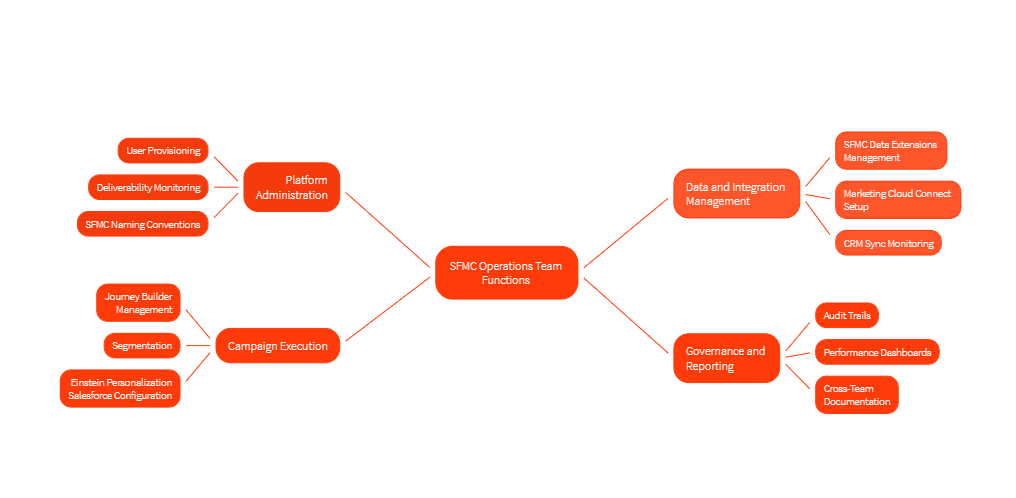
Every SFMC operations team must cover four functions:
- Platform administration: User provisioning, deliverability monitoring, and SFMC naming conventions.
- Data and integration management: SFMC data extensions management, Marketing Cloud Connect setup, and CRM sync monitoring.
- Campaign execution: Journey Builder management, segmentation, and Einstein personalization Salesforce configuration.
- Governance and reporting: Audit trails, performance dashboards, and cross-team documentation.
Salesforce Marketing Cloud Team Roles and Responsibilities
A well-structured SFMC operations team typically includes five core roles:
- SFMC Administrator: Platform configuration, user access, deliverability, and ongoing monitoring.
- Data Architect/Analyst: SFMC data extensions management, Marketing Cloud Connect setup, and integration governance.
- Campaign Manager: Journey Builder management, audience segmentation, and send scheduling.
- Content Producer: Email design, content build, and template management.
- Analytics Lead: Performance reporting, attribution modeling, and dashboard management.
For an SFMC operations team at a mid-market company, one person often covers two or three of these functions, which is where operational strain typically begins to show.
Certain capabilities must always sit inside the business:
- Campaign strategy and audience definition.
- Data architecture sign-off and Marketing Cloud Connect setup decisions.
- Journey Builder best practices enforcement.
- Performance interpretation and business reporting.
Technical execution, platform administration, and specialist integrations are appropriate candidates for outsourcing or augmentation.
How to Choose the Right Salesforce Marketing Cloud Operating Model
Knowing how to structure a marketing operations team for SFMC starts with the right delivery model, determined by campaign volume, data complexity, and how many business units share the platform.
Three models serve most organizations:
- Centralized: A single SFMC team serves all business units. Efficient for consistent campaign types; prone to bottlenecks at scale.
- Federated: Each business unit has its own team, with a central function maintaining platform standards. Scales well but requires strong governance.
- Center of Excellence (COE): Building a marketing automation COE Salesforce approach defines a shared services team that sets standards and manages governance while business units execute within those guardrails. This is the most mature marketing cloud operations model for enterprise organizations.
In-House vs Outsourced Salesforce Marketing Cloud Operations
The SFMC managed services vs in-house team decision is one of the most consequential a marketing operations leader makes.
| Criteria | In-House Team | SFMC Managed Services |
| Platform Depth | Knowledge develops gradually as the team gains hands-on experience. | Access to certified Salesforce Marketing Cloud specialists from day one. |
| Cost Structure | Fixed hiring, training, and employee overhead costs. | Flexible engagement model that scales based on business needs and campaign volume. |
| Time to Productivity | Typically requires 3–6 months for recruitment, onboarding, and training. | Immediate access to experienced resources and established processes. |
| Scalability | Scaling requires additional hiring and training cycles. | Easily scale resources up or down based on campaign demand and project requirements. |
| Specialized Expertise | May require multiple hires to cover integrations, automation, deliverability, and analytics. | Broad expertise across Journey Builder, Automation Studio, Data Cloud, integrations, and reporting. |
| Operational Risk | Dependent on internal resource availability and employee retention. | Reduced dependency on individual team members through shared expertise and documented processes. |
| Best Fit | Organizations with large internal teams and long-term platform ownership goals. | Businesses seeking faster execution, operational efficiency, and ongoing platform optimization. |
| When to Hire a Salesforce Marketing Cloud Consultant | When specialist expertise is required faster than internal hiring timelines allow. | When implementing, re-architecting, optimizing, or managing Salesforce Marketing Cloud at scale. |
Many mid-market organizations start with Salesforce Marketing Cloud team augmentation services, then transition toward a hybrid model as in-house capability matures.
Where Salesforce Marketing Cloud Operations Teams Fall Short
These structural weaknesses appear consistently in poorly structured SFMC operations teams:
- No ownership of SFMC data extensions management: Data extensions proliferate without documentation, segmentation becomes unreliable, and Journey Builder sends against stale data.
- No governance for SFMC naming conventions: Campaigns built without naming standards make performance analysis and audits exponentially harder.
- No monitoring of Marketing Cloud Connect setup health: Silent sync failures between Marketing Cloud and Salesforce CRM are a common source of personalization errors and contact duplication.
- Platform administration treated as an afterthought: SFMC administrator responsibilities extend well beyond access management. Deliverability monitoring and IP health require ongoing attention, particularly for high-volume senders.
How AI Is Transforming Marketing Operations Teams
Einstein personalization Salesforce capabilities and Agentforce have changed the math on team capacity:
- Einstein Engagement Scoring reduces list fatigue by identifying high-engagement contacts before a send goes out.
- Einstein Send Time Optimization determines the best delivery window per segment automatically, removing manual analysis.
- Agentforce deploys AI agents that handle repetitive tasks autonomously, including lead qualification, campaign trigger management, and customer query routing.
- According to Salesforce’s Agentforce Metrics report, Agentforce users report 34% increased productivity from agentic and generative AI.
For mid-market teams running lean, that productivity change determines whether the team executes or scales.
Best Practices for Scaling Salesforce Marketing Cloud Operations
These practices consistently separate SFMC operations teams that scale from those that fall behind:
- Establish data governance before scaling campaign volume.
- Document Journey Builder best practices and assign journey owners.
- Define your marketing cloud operations model enterprise architecture before campaigns go live.
- Enforce SFMC naming conventions across all campaigns, data extensions, and journeys.
- Review Marketing Cloud Connect setup health monthly to catch sync failures early.
A UK-based cycling retailer implemented Salesforce Marketing Cloud with a centralized operations model, using managed services to configure transactional email workflows. Post-purchase notifications and dispatch updates moved from manual processes to automated journeys, reducing operational overhead while improving communication consistency.
Salesforce Marketing Cloud Operations Team Checklist
- Named SFMC administrator owns platform health and access
- SFMC data extensions management has a defined owner and refresh schedule
- SFMC naming conventions are documented and enforced
- Journey Builder best practices are reviewed quarterly
- Marketing Cloud Connect setup is monitored with a defined escalation process
- Operating model (centralized, federated, or COE) is explicitly defined
- Einstein personalization Salesforce features are in use or on the adoption roadmap
As a 3X Salesforce Partner of the Year and Salesforce Summit (Platinum) Partner, Ranosys has delivered Marketing Cloud implementations and managed services engagements across retail, financial services, and enterprise B2B. Our Salesforce Marketing Cloud consulting practice helps clients define the right operating model, establish governance, and build team structures that work at scale.