
Talk to our experts
Summary
Evolving customer expectations demand personalized, consistent experiences across all digital touchpoints, pushing traditional CMS platforms beyond their limits. Adobe Experience Manager (AEM) Headless CMS offers a strategic solution, decoupling content from presentation to enable scalable, omnichannel delivery via APIs. This allows enterprises to create content once and reuse it everywhere, a critical shift towards more flexible and efficient digital experience infrastructure that addresses the rising cost of fragmented content delivery.
AEM Headless CMS delivers significant business value, including superior omnichannel content delivery without duplication and enhanced developer agility. Innovations like the AEM Universal Editor provide visual, in-context authoring on headless frontends, while AEM Edge Delivery Services optimize performance. Integrated GenAI further accelerates content production. This robust, composable DXP architecture empowers enterprises to scale, ensure brand consistency, and react rapidly to dynamic market demands across various channels.
Successfully implementing AEM headless requires specialized expertise. Ranosys, a certified Adobe Solution Partner, offers deep capabilities in Adobe Experience Manager, Digital Transformation, and Digital Commerce. Our team provides comprehensive services, from content architecture design and API configuration to Universal Editor implementation and multi-site governance. Ranosys helps enterprises across Retail, Financial Services, and Manufacturing strategically adopt, optimize, and scale their AEM headless solutions, driving enhanced agility and measurable ROI.
As customer expectations continue to evolve, so do the digital channels enterprises rely on to meet them. Customers today expect personalised experiences across every device, channel, and touchpoint, whether they are browsing a website, using a mobile app, or interacting with an in-store screen. Traditional CMS platforms are finding it increasingly difficult to keep up. This is where AEM headless CMS becomes a strategic advantage for enterprise organisations.
Adobe Experience Manager headless has evolved from a conventional content management platform into one of the most complete headless CMS solutions available. Headless CMS market growth statistics consistently point in one direction: the sector is projected to grow at over 20% compound annual growth, driven by enterprise demand for flexible, omnichannel content delivery. Enterprises across retail, manufacturing, healthcare, and financial services are making the move because the cost of staying on a traditional CMS, in lost speed, missed channels, and duplicated content effort, has become too high to ignore.
Here, we cover what headless CMS is, how it differs from traditional CMS, the latest AEM headless CMS capabilities, industry use cases, a comparison with leading alternatives, and how to implement it.
What is a headless CMS?
A headless content management system (CMS) decouples where content is stored (back end) from where it is presented (front end), with both layers communicating through APIs. In simpler terms, it separates content from the presentation layer, allowing you to manage and deliver content using APIs to any channel or application.
A headless CMS allows you to create content once and reuse it everywhere, delivering omnichannel experiences at scale to multiple touchpoints from a single place. It eliminates repetitive work by unifying content in a single hub, making it easier to distribute through virtually any application without losing consistency.
It is also worth noting that headless versus traditional does not have to be a binary choice in AEM. As Adobe’s official documentation states, headless features can be used to deliver content to multiple touchpoints while also enabling content authors to edit single-page applications, all within AEM. This flexibility is one reason AEM headless CMS remains the platform of choice for enterprise organisations managing complex, multi-channel content operations.
AEM Headless CMS vs Traditional CMS vs Hybrid CMS
Through the right tech stack, like Adobe Experience Manager for headless content, enterprises can personalise and deliver content without overburdening developers. Here is how the three approaches compare:
| Aspect | Traditional CMS | Headless CMS | Hybrid CMS |
| Architecture | Monolithic, with inseparable front end and back end. Content and presentation managed from one place. | Content separated from the presentation layer. A channel-neutral CDN delivers content to all channels and devices via APIs. | Front end and back end are separated, but includes a presentation layer that can optionally be used alongside decoupled content delivery. |
| Authoring | Easy to use with pre-built themes and templates. Good for simple web content. | Flexible and eliminates vendor lock-in. Supports fast omnichannel content delivery and easy integration with SEO tools, CRM platforms, and commerce systems. | Combines capabilities of both traditional and headless CMS: content reuse, CDN delivery, omnichannel distribution, and headless flexibility. |
| Delivery | Requires more development effort for multi-channel delivery. | Delivers content rapidly to any frontend: SPAs, mobile apps, IoT devices, ecommerce storefronts, and more. | Suits teams that want headless flexibility while retaining an optional page-based authoring experience. |
Headless CMS market growth statistics: What the Data Shows
The business case for AEM headless CMS is no longer a forward-looking argument. Headless CMS market growth statistics from multiple research providers consistently show accelerating enterprise adoption.
The global headless CMS market is projected to reach $23.5 billion by 2033, growing at a 20%+ CAGR, per Grand View Research. The headless CMS for ecommerce segment is growing at a comparable pace, driven by rising demand for omnichannel retail experiences across web, mobile, and in-store channels. Enterprise-level platform adoption has grown significantly over recent years, and organisational investment in digital experience infrastructure has increased consistently across industries between 2022 and 2024.
McKinsey research on omnichannel retail consistently shows that retailers with strong omnichannel capabilities outperform single-channel peers on revenue growth, and the content infrastructure to support that starts with how content is managed and distributed. For enterprises evaluating AEM headless CMS in 2026, these numbers reflect a market shift that is already well underway.
Why Does Your Organisation Need a Headless CMS?
Today’s consumers have dynamic, always-on expectations that a tightly coupled traditional CMS cannot consistently meet. Some of the primary reasons organisations move to AEM headless CMS are:
- Performance improves significantly when content is served through CDN infrastructure rather than from an origin server.
- A headless architecture gives you a single content source that reaches every channel simultaneously, eliminating slow, fragmented delivery.
- Development teams can build with modern frameworks like React, Next.js, or Vue without being constrained by the CMS front end.
- Your organisation needs to deliver content to mobile apps, IoT devices, digital signage, in-store kiosks, and emerging channels, all from one governed content repository.
- You need built-in translation and localisation capabilities to serve audiences across multiple languages and markets.
Key Benefits of AEM Headless CMS for Enterprise Teams
1. Omnichannel Content Delivery Without Duplication
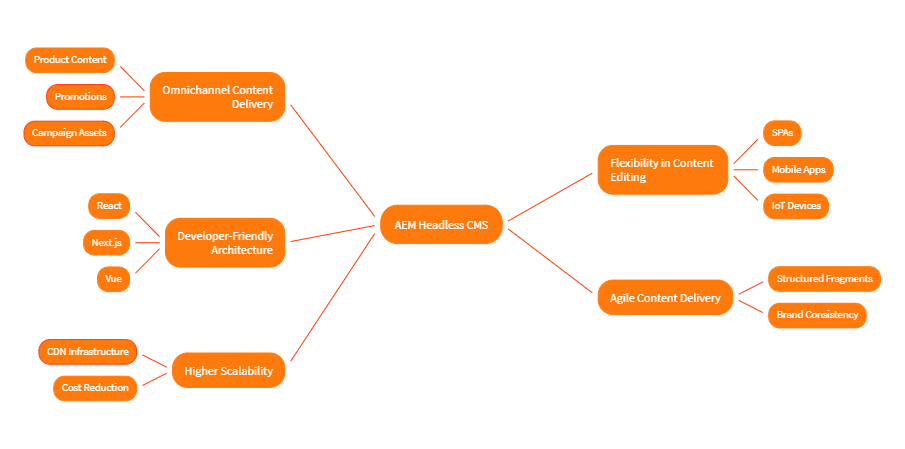
A headless CMS uses APIs to deliver content everywhere, removing the need to manually republish across multiple platforms. Headless CMS for ecommerce teams particularly benefits from this: product content, promotions, and campaign assets can be delivered simultaneously to a web storefront, mobile app, and in-store screen without rebuilding content for each channel. Marketers can focus on creating personalised experiences and delivering them at the right time and place.
2. Flexibility in Content Editing and Delivery
The same content can be published or updated across different applications, SPAs, mobile apps, IoT devices, social channels, without additional programming effort. Content authors can publish campaigns to any front-end presentation layer independently of the development team.
3. Developer-Friendly Architecture
A headless CMS is framework-agnostic and supports integrations with modern technologies like React, Next.js, Vue, and Angular. Developers can build faster and maintain cleaner codebases without being tied to the CMS front-end layer.
4. Agile Content Delivery with Reusable Content
APIs push the same piece of content to multiple platforms simultaneously. Since you create content in structured fragments, you reach wider audiences while maintaining brand consistency, without duplicating effort across channels.
5. Higher Scalability
With a decoupled delivery model, content is served through CDN infrastructure built for high traffic volumes. This reduces costs, complexity, and risk while making it easier to expand into new channels and markets as your business grows.
Core components of AEM headless CMS architecture
As defined by Adobe’s official documentation, Adobe Experience Manager (AEM) Headless is a CMS architecture that enables structured content in AEM to be delivered to any frontend application through APIs such as GraphQL and OpenAPI. Instead of coupling content with presentation, AEM Headless separates content management from the frontend experience, allowing websites, mobile apps, commerce storefronts, and other digital channels to consume the same content in a structured format.
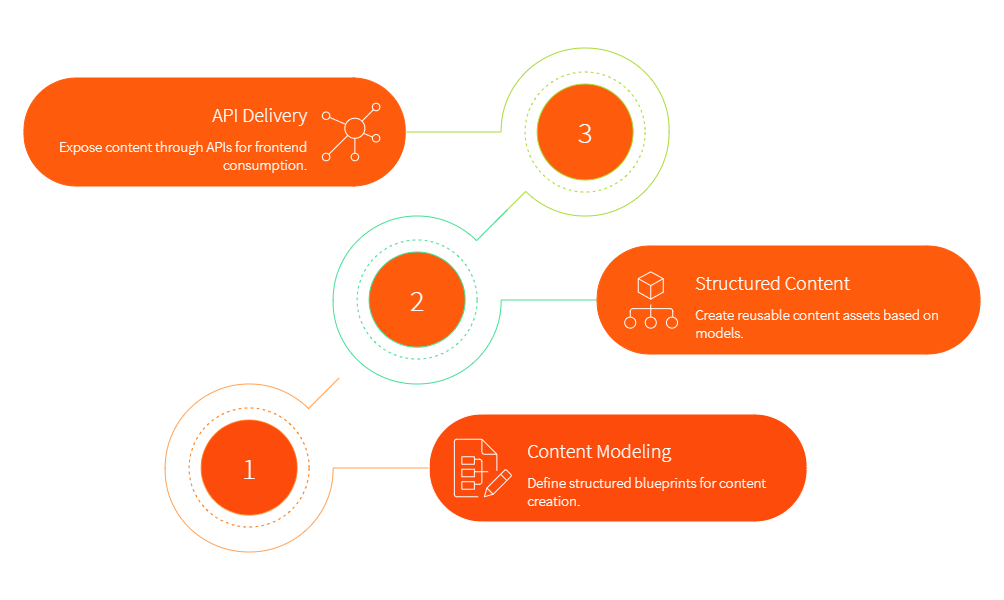
At its foundation, AEM headless architecture consists of three key building blocks: content modeling, structured content creation, and API-driven content delivery. Understanding each layer is essential before implementing an AEM headless solution.
Content Fragment Models (Content Modeling Layer)
Content Fragment Models (CFMs) serve as the foundation of AEM headless architecture. Created by information architects in the AEM Content Fragment Model Editor, these models act as structured blueprints that define the fields, data types, validations, and relationships content authors work within.
For example, a product content model may include fields such as product name, description, image, specifications, pricing, and category references. These predefined structures ensure consistency and scalability across channels.
Content Fragment Models are governed at the folder level, where administrators can define policies to control which models are available for content creation within specific folders.
Content Fragments and References (Structured Content Layer)
Content Fragments are structured, page-independent content assets created by authors based on predefined Content Fragment Models. Since they are not tied to webpages, they can be reused across multiple channels, including websites, mobile applications, kiosks, and commerce experiences.
Every Content Fragment contains a Main element, the core content structure that cannot be removed, along with Variations, which allow teams to tailor content for specific audiences, channels, or regions while maintaining consistency with the primary content.
AEM Content Fragments also support different types of references to create richer content relationships and nested structures, including:
- Content References for linking structured content
- Asset or Media References for images, videos, and digital assets
- Fragment References for reusable nested content structures
- Ad Hoc References for inline content linking
This modular structure enables teams to create reusable, omnichannel content experiences without duplicating content across systems.
AEM Content Fragments GraphQL and OpenAPI (Content Delivery Layer)
The delivery layer is what makes AEM truly headless. Instead of rendering HTML pages, AEM exposes structured content through APIs, enabling frontend applications to request and consume content in JSON format.
AEM Content Fragments GraphQL is the primary API used for headless content delivery. Since it is schema-based, Content Fragment Models automatically define the structure of GraphQL schemas. Client applications can request only the fields they need, improving performance and reducing unnecessary data transfer.
For production environments, Adobe recommends Persisted Queries, pre-defined GraphQL queries stored on the server that combine GraphQL precision with REST-like caching benefits for better scalability and performance.
In addition to GraphQL, AEM also supports Content Fragment Delivery with OpenAPI, a REST-based approach for structured content delivery. OpenAPI responses are optimized for CDN integration and active content invalidation, allowing content updates to propagate faster without waiting for cache expiration intervals.
It is important to note that Adobe has deprecated the Assets HTTP API for Content Fragments. For new implementations, Adobe recommends using Content Fragment Delivery with OpenAPI or the Content Fragments and Models Management OpenAPIs instead.
What’s New in AEM Headless CMS in 2026
AEM Universal Editor
The AEM Universal Editor is one of the most significant additions to the headless authoring experience. It allows content authors to edit content directly on a live, rendered front end, even when that front end is a headless React or Next.js application. Authors see exactly how their content will appear to end users in real time, without navigating to a separate editor.
This removes the most commonly cited frustration of headless CMS: that authors lose visual context when working in a decoupled environment. Marketing teams gain self-service editing on headless frontends without requiring a developer for each content change. The AEM Universal Editor works through HTML instrumentation on the frontend (data-aue-* attributes), making it compatible with any modern frontend framework without requiring a full architecture change.
In 2026, the AEM Universal Editor has become a mature, production-ready capability that distinguishes AEM headless CMS from alternatives like Contentful and Contentstack. As of 2026, neither offers an equivalent native in-context editing experience on decoupled frontends.
Ford Motor Credit Company (FMCC) uses the AEM Universal Editor within its MACH-architecture website, where new dynamic and static page modules are continuously developed and deployed without disrupting existing authoring workflows.
AEM Edge Delivery Services Headless
AEM Edge Delivery Services headless is a cloud-native, CDN-powered delivery system built for speed. According to Adobe’s official documentation, every page delivered through Edge Delivery Services is designed to achieve a 100 Google Lighthouse score, helping businesses reach faster load times, better search performance, and higher conversion rates on campaign pages and landing pages.
Content Fragments authored in AEM can be published directly to Edge Delivery Services, making AEM Edge Delivery Services headless delivery particularly valuable for performance-sensitive marketing and editorial pages. It supports two authoring approaches: document-based authoring through Microsoft SharePoint or Google Docs, and AEM-authored content with the AEM Universal Editor. It works alongside the full AEM headless architecture, handling performance-critical pages while AEM Content Fragments GraphQL powers personalised and commerce-connected experiences elsewhere on the same site.
AEM GenAI Authoring: Generate Variations and AEM Agents
With Adobe’s GenAI capabilities built directly into AEM headless CMS, content authors can generate content variations inside their authoring interface using Generate Variations, powered by Adobe Firefly. Authors define a target audience, input brand guidelines, and generate multiple content options, a formal post, a product description for mobile, and a campaign headline, from a single prompt. This accelerates the content supply chain for teams managing high-volume content production across multiple channels.
AEM Assets Content Hub extends the GenAI capability to digital assets. Marketing teams, agencies, and channel partners can search, remix, and distribute approved brand assets through a governed self-service interface, with Adobe Express enabling Firefly-powered generative fill and asset adaptation for different channel formats.
As Adobe confirms in its official documentation, all prompt inputs are stored separately and are not used to train the underlying AI models, a critical data privacy assurance for regulated industries.
AEM Agents, announced at Adobe Summit 2025 and continuing to evolve in 2026, represent a shift toward AI-orchestrated content operations where agents can propose, draft, route for approval, and publish content based on defined rules and objectives.
Composable DXP Headless CMS: Where AEM Fits
In 2026, composable DXP headless CMS has moved from an architectural aspiration to a mainstream enterprise strategy. A composable DXP headless CMS is assembled from best-of-breed, interchangeable services, as opposed to a monolithic suite where every capability is tightly coupled. This aligns with MACH principles: Microservices, API-first, Cloud-native, and Headless.
AEM headless CMS satisfies these principles. Content management through AEM Content Fragments and GraphQL satisfies the headless and API-first requirements. AEM’s cloud-native SaaS architecture satisfies the cloud-native requirement. The Adobe Experience Cloud ecosystem provides the surrounding microservices for analytics, personalisation, commerce, and orchestration.
For enterprises, the AEM headless architecture means replacing individual components of your stack without re-platforming everything, reducing strategic risk and making your technology investment more resilient as requirements change.
AEM Headless vs Contentful vs Contentstack comparison
Selecting a headless CMS is an architectural and organisational decision, not just a product comparison. Here is an objective look at how AEM headless CMS compares against the two most commonly evaluated alternatives:
| Dimension | AEM Headless CMS | Contentful | Contentstack |
| Architecture | Cloud-native DXP with headless, hybrid, and full-stack modes. Part of Adobe Experience Cloud. | Pure headless, API-first SaaS. No traditional CMS mode. | MACH-aligned headless CMS. API-first, microservices-based, cloud-native. |
| Enterprise Scalability | Built for multi-site, multi-language global enterprise deployments. | Scales well for mid-market to enterprise. | Strong enterprise scalability for large content operations. |
| Content Modeling | Structured Content Fragments with nested models, references, and reuse across channels. | Flexible content types with references. Clean modeling UI. | Advanced content type builder with taxonomy management and global fields. |
| GraphQL Support | Persisted queries, nested fragment support, schema introspection. OpenAPI REST also available. | Mature GraphQL API with rich filtering. Developer-first. | GraphQL and REST both supported. Strong developer tooling. |
| Personalisation | Native Adobe Target, RT-CDP, and Journey Optimizer integration. Real-time segmentation out of the box. | Requires third-party integrations for personalisation. | Marketplace-based personalisation with external tool integration. |
| Commerce Integration | Deep Adobe Commerce native integration. PIM-ready. Best suited for headless CMS for ecommerce teams within the Adobe ecosystem. | Requires custom integration. No native commerce CMS. | Marketplace connectors for Shopify, Salesforce Commerce, BigCommerce. |
| Authoring Experience | AEM Universal Editor for WYSIWYG in-context editing on headless frontends. Document-based authoring via Edge Delivery. | Structured editor without live preview natively. | Intuitive editing UI with in-app preview. |
| AI and GenAI | Generate Variations with Firefly. AI metadata tagging. AEM Agents evolving in 2026. | Contentful AI for content generation. Growing feature set. | Automation Hub and AI assist for workflow automation. |
| Security and Compliance | ISO 27001, SOC 2, GDPR. Adobe IMS role-based access. | SOC 2 Type II, GDPR-compliant. Role-based access control. | SOC 2, ISO 27001, GDPR compliant. Strong audit trails. |
| Adobe Ecosystem Fit | Native integration across the full Adobe Experience Cloud suite. | Adobe integration via API only. | Adobe integration via API only. |
| Pricing | Enterprise contract. High TCO. Best ROI with full Adobe stack. | Tiered SaaS pricing. Transparent and predictable. | Enterprise pricing, quote-based. |
| Best For | Global enterprise, Adobe ecosystem users, regulated industries, omnichannel commerce. | Mid-market to enterprise without Adobe investment. Developer-first teams. | Large enterprises with high-volume content operations. Media and publishing. |
AEM headless vs Contentful: AEM is the stronger choice for organisations already invested in the Adobe ecosystem. Native connections to Analytics, Target, Commerce, and Journey Optimizer create integration depth that Contentful cannot replicate without custom development. Contentful suits teams wanting a simpler, faster-to-implement headless CMS without the broader DXP investment.
AEM headless vs Contentstack: AEM headless CMS is the stronger choice when your use case involves deep Adobe ecosystem integration, complex digital asset management, or in-context visual authoring through the AEM Universal Editor. Contentstack is well-suited for large enterprises with high-volume content operations in media and publishing.
Singapore Airlines’ KrisShop runs on AEM integrated with Adobe Commerce Cloud, Akeneo PIM, Adobe Target, and Microsoft Dynamics 365, with campaign content authored once in AEM and delivered across the web storefront and mobile app simultaneously across Singapore and Australia.
The right platform decision depends entirely on your existing ecosystem, team capability, and content delivery requirements. Below is how AEM headless CMS performs across the industries where these decisions are most common.
AEM Headless CMS in Action: Industry Use Cases
eCommerce and Retail
Retail teams use AEM headless to structure product content, promotions, and campaign assets as Content Fragments delivered simultaneously to the web storefront, mobile app, in-store screens, and email through a single GraphQL API call. One update publishes everywhere. Teams running Adobe Commerce alongside AEM connect product catalogue data directly into AEM-authored pages through CIF connectors, so product descriptions and availability are always drawn from a single source.
Manufacturing
Manufacturers use AEM Content Fragment Models to structure technical documentation, including data sheets, spec sheets, and compliance certificates, so every required field is complete before content reaches any downstream channel. A single update propagates simultaneously to distributor portals, dealer apps, and field service tools. AEM’s built-in translation workflow manages localisation across markets without a separate platform.
Events and Exhibitions
Event organisations use AEM to serve audience-specific content journeys to attendees, exhibitors, and sponsors from a single platform. AEM Events manages live and upcoming conference content within the same authoring interface. Adobe Analytics tracks which content each audience segment engages with, giving teams the data to improve each experience before the next event cycle.
Government and Public Sector
Government agencies use AEM to manage high-volume content estates, complex multi-step public-facing application forms through AEM Forms, and strict multi-stage approval workflows, all from one platform. Role-based access controls ensure content reaches a published state only after required sign-off stages are complete, and all activity is logged for compliance and audit purposes.
Financial Services and BFSI
Financial services teams use AEM headless to update rate tables, product terms, and regulatory disclosures simultaneously across web, mobile banking apps, and branch kiosk screens in a single publishing action. Compliance approval workflows are built into the authoring process, and AEM’s audit logging captures every change for regulatory review.
Healthcare and Life Sciences
Healthcare organisations use AEM’s multi-stage governance to route patient-facing content through clinical and compliance review before it reaches any channel. Approved content is delivered from a single reviewed source to patient websites, portals, mobile apps, and telehealth platforms simultaneously, with no risk of version inconsistency across channels.
Media and Publishing
Editorial teams use AEM Content Fragments GraphQL to publish content once and reach the web, mobile apps, streaming platforms, syndication partners, and newsletters simultaneously. AEM Edge Delivery Services headless handles performance-critical pages, targeting a 100 Google Lighthouse score through CDN delivery with active cache invalidation, so updates reach readers immediately.
Implement AEM Headless CMS With Certified Experts at Ranosys
Ranosys is a certified Adobe Solution Partner with hands-on delivery experience across AEM headless CMS implementations for enterprise clients in retail, government, financial services, manufacturing, and hospitality. Our team covers the full implementation lifecycle: content architecture and Content Fragment Model design, front-end framework setup, AEM Content Fragments GraphQL and API configuration, Adobe Analytics and Adobe Target integration, AEM Universal Editor instrumentation, multi-site and multi-language governance, and ongoing managed support.
Whether you are evaluating AEM headless vs Contentful, assessing AEM headless vs Contentstack, or ready to begin your AEM headless CMS implementation, our certified Adobe Experience Manager headless team is here to help.
Talk to our AEM experts to discuss your requirements, explore implementation approaches, and see how we have delivered AEM headless solutions for organisations across the US, Singapore, and Southeast Asia.


