
Talk to our experts
Summary
Businesses face significant inefficiencies due to manual, repetitive tasks across customer service, sales, and marketing, leading to increased operational costs and suboptimal customer experiences. Salesforce Agentforce emerges as a critical solution, utilizing advanced AI agents to automate these time-consuming processes. This enterprise platform allows for the deployment of intelligent agents capable of understanding requests, reasoning, and taking autonomous actions, all grounded in real-time CRM data. It empowers organizations to shift human effort towards strategic engagements, enhancing productivity and delivering consistent, personalized interactions.
Agentforce significantly differentiates itself from traditional chatbots by deploying self-learning agents that reason, access live CRM and Data Cloud information, and execute multi-step tasks end-to-end, rather than following rigid scripts. Since its 2024 launch, the platform has rapidly evolved into Agentforce 360, a comprehensive enterprise AI operating system integrating humans, applications, and data. Ranosys, leveraging its deep expertise in Salesforce and AI & Analytics, understands these advanced capabilities, including the Atlas Reasoning Engine and robust Trust Layer, which are crucial for secure and impactful enterprise-wide deployment.
The business impact of Agentforce is tangible, delivering faster response times, reduced cost per interaction, and measurable increases in pipeline conversion across diverse industries like Retail, Financial Services, and Healthcare, without necessitating additional headcount. This enables significant Digital Transformation by automating complex workflows from customer service to supply chain. Ranosys, a trusted authority in Salesforce and Digital Transformation, helps organizations strategically implement, optimize, and scale Agentforce solutions, ensuring secure integration and maximizing ROI for sustained business growth.
Your support team spends hours each day answering the same questions. Your sales reps are buried in follow-ups and data entry instead of closing deals. Your marketing campaigns go out to broad audiences because there is not enough time to personalize at scale. And somewhere in the middle of all this, your customers are waiting longer than they should.
These inefficiencies add up to lost revenue, higher operating costs, and customers who move on.
The problem is not that your teams are not working hard enough. It is that a large portion of what they do every day is repetitive, manual, and time-consuming work that does not require a person to do it.
Salesforce Agentforce is built to fix this. As Salesforce’s enterprise AI agents platform, it uses Salesforce agentic AI to deploy agents across customer service, sales, marketing, and operations. AI agent automation Salesforce makes it possible to handle high-volume, routine work so your people can focus on what actually moves the business forward.
Since its launch in October 2024, Agentforce has gone through five major releases and crossed 18,500 customer deals. Companies using it are reporting faster response times, lower cost per interaction, and measurable increases in pipeline conversion, without adding headcount.
This guide covers how the platform works, what is new in Agentforce 360, real results from companies already using it, and which use cases are worth prioritizing first.
What is Salesforce Agentforce?
Agentforce is Salesforce’s AI agent platform. It lets businesses build, deploy, and manage AI agents in Salesforce that can handle real work: answering customer questions, qualifying leads, scheduling meetings, and processing returns, without a person needing to start or oversee each interaction.
Salesforce describes it as always-on digital labor that works for your customers, employees, and business processes around the clock. Agents can be deployed across customer service, sales, marketing, commerce, and internal operations.
Before we dive into Salesforce Agentforce, let’s understand what AI agents are.
A Salesforce AI agent is a software system that can understand a request in plain language, reason about what needs to happen, take action, and assess the result, all on its own. It does not follow a rigid script or wait to be told each next step. It figures out the right course of action based on the context it has access to, then carries it out.
In Salesforce, AI agents have access to your CRM data, your business processes, and your connected systems. That is what allows them to do things like look up a customer’s order history, determine whether a refund qualifies under your return policy, process the return, and send a confirmation, all within a single interaction, without a human touching any step.
Two types of agents are available.
- Autonomous agents: These agents complete tasks from start to finish on their own. You define the goal, connect the agent to the right data and tools, and it handles the rest.
- Assistive agents: These agents work alongside your team. They surface relevant information, suggest next steps, and draft responses, but a human makes the final call.
Both types can be deployed across customer service, sales, marketing, commerce, and internal operations.
How Agentforce Has Changed Since Launch
The Agentforce 360 platform is the version available today. According to Salesforce, it brings together humans, applications, AI agents, and data so that any company can safely deploy agents that work for their customers, suppliers, and employees around the clock.
Agentforce 1.0 (October 2024): Announced at Dreamforce 2024. The first version embedded autonomous AI agents directly into Salesforce CRM workflows. Agents could respond to customer inquiries, update records, trigger workflows, and assist sales and support teams using natural language. Data Cloud provided the contextual data. Primary use cases were customer service, lead qualification, and case resolution.
Agentforce 2 (December 2024): The focus shifted to making the platform enterprise-ready. Agent orchestration improved, integration with Salesforce Flows deepened, and support expanded across sales, service, and marketing functions. The key shift was from single-task assistants to agents capable of handling multi-step workflows.
Agentforce 2dx (March 2025): A developer-focused release. Salesforce introduced APIs and tools that allowed teams to extend and customize agents beyond the packaged defaults. Governance and observability capabilities were strengthened, and agents gained the ability to connect with external tools and workflows. The platform moved from packaged AI agents to customizable enterprise agents.
Agentforce 3 (June 2025): Agents moved deeper into core business processes, including prospecting, case resolution, and operations workflows. Multi-agent collaboration was introduced, allowing agents to hand off work to each other across departments. Salesforce also published the Agent-to-Agent (A2A) protocol, enabling Agentforce agents to work with agents on other platforms. Monitoring and control tools were improved across the board.
Agentforce 360 (October 2025): Announced at Dreamforce 2025, this was the biggest shift to date. Salesforce redefined the platform as a unified enterprise AI operating system connecting humans, agents, applications, and data. New capabilities included a hybrid reasoning engine, Agentforce Voice for phone-based interactions, Intelligent Context for grounding agents in live enterprise data, multi-modal support for documents and tables, and a redesigned low-code Agent Builder. Slack was added as a collaboration layer for workplace AI interactions.
Agentforce 360 Updates (January 2026) Following the Dreamforce launch, Salesforce rolled out general availability improvements, including faster agent deployment, a more capable Agentforce Builder, and stronger reasoning controls for enterprise workflows. The platform has moved from experimental AI features to core business infrastructure.
Agentforce 360: What the Current Platform Looks Like
Agentforce 360 is the version available today. According to Salesforce, it brings together humans, applications, AI agents, and data so that any company can safely deploy agents that work for their customers, suppliers, and employees around the clock.
The platform is organized around four pillars.
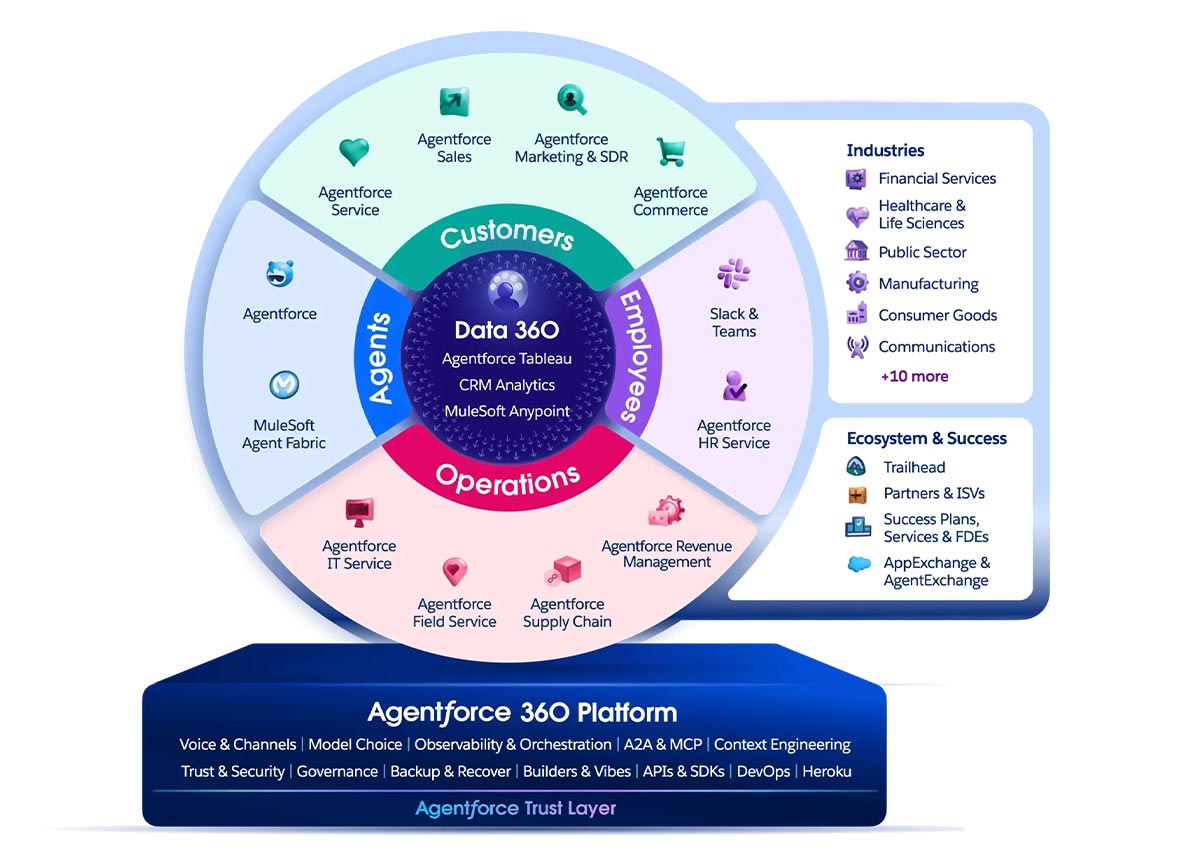
Agentforce 360 Platform is the core infrastructure. This includes the Atlas Reasoning Engine, Agentforce Builder, Agent Script, the Trust Layer, and the Observability dashboard. Everything needed to build, run, and monitor agents’ lives here.
Data 360 is powered by Salesforce Data Cloud. This gives agents access to unified, real-time data from across the business, including CRM records, purchase history, support tickets, website activity, and third-party sources. Agents need accurate data to make good decisions, and this is where that data comes from.
Customer 360 Apps are the pre-built agent experiences for sales, service, marketing, commerce, and industry-specific clouds. These are deployed to customer-facing channels.
Agentforce Ecosystem covers third-party integrations, partner-built agents, and AgentExchange, which is Salesforce’s trusted marketplace for ready-to-use agent actions and templates. If you need agents that connect to systems outside of Salesforce, this is where you find and configure those connections.
How Salesforce Agentforce Works
Understanding how Agentforce works helps you decide where to deploy it first. Here is what happens automatically every time a customer or employee interacts with an agent.
Step 1: The request comes in. A customer sends a message via chat, email, SMS, or phone. An employee asks a question in Slack or Salesforce Lightning. A background trigger fires because a deal has gone quiet or a renewal is due. Agentforce handles all three.
Step 2: The Atlas Reasoning Engine interprets the request. It reads the input, understands the intent, and determines what action is needed. A message saying “I never received my order” is recognized as a delivery issue, not a general inquiry, and the agent moves toward resolution accordingly.
Step 3: The agent retrieves the right data. Through Salesforce Data Cloud, the agent pulls live customer records including order history, support tickets, and account status. This is what makes AI agents for CRM automation effective: every response is grounded in real, current data rather than generic assumptions.
Step 4: The agent acts. It sends a reply, updates a record, processes a refund, books a meeting, or triggers a workflow. Complex situations may involve multiple actions in sequence, all completed within the same interaction.
Step 5: Everything is logged. Every action, response, and escalation is recorded in Agentforce Observability so you can track performance, identify gaps, and refine the agent over time.
Salesforce Agentforce ROI Calculator
Salesforce Agentforce vs Traditional Chatbots
A lot of businesses have already invested in chatbots for customer service or sales support. When they first look at Agentforce, the natural question is: how is this different from what we already have?
The answer is that they are different in almost every meaningful way. A traditional chatbot is built around scripts and decision trees. It can only go where you have already mapped a path. Agentforce agents reason through situations and take action. Here is how they compare across the areas that matter most.
| Aspects | Traditional Chatbots | Salesforce Agentforce |
| How it handles requests | Follows pre-written scripts and decision trees. Can only respond to what it was specifically programmed to handle. | Reads the request, understands the intent, and decides what action to take based on context and available data. |
| What happens with unexpected questions | Falls back to a generic error message or routes to a human because it cannot recognize the input. | Interprets the request even if the wording is new, and either handles it or routes to a human with full context included. |
| Data access | Works only with static data fed into it at setup. Does not pull live customer records during a conversation. | Pulls real-time data from Salesforce CRM, Data Cloud, and connected systems during every interaction. |
| What it can actually do | Answers questions and collects information. Cannot update records, process transactions, or trigger workflows. | Completes tasks end-to-end: processes returns, updates records, books meetings, triggers workflows, and more. |
| Personalization | Generic responses based on the channel or product category. Cannot tailor responses to the individual customer. | Every response is grounded in that specific customer's history, preferences, and current account status. |
| Learning over time | Does not improve without manual updates to the script. Performance depends entirely on how well it was programmed. | Logs every interaction through Agentforce Observability. Performance data is used to identify gaps and refine behavior. |
| How it handles complex situations | Escalates to a human with little or no context transferred. The customer often has to start over. | Passes to a human with the full conversation transcript and relevant CRM data already attached. |
| Setup and maintenance | Requires ongoing manual scripting for every new scenario. Adding new capabilities means writing new decision trees. | Built through Agentforce Builder using natural language and low-code tools. New topics and actions can be added without rewriting the whole system. |
| Cross-channel coverage | Typically limited to one or two channels, usually web chat or a messaging app. | Operates across chat, email, SMS, phone via Agentforce Voice, Slack, and Salesforce Lightning. |
| Compliance and auditability | Limited logging. Hard to audit what the bot said or why it responded in a particular way. | Full audit trail through Agentforce Observability. Every action, response, and escalation is logged and reviewable. |
| Multi-agent coordination | Not possible. Each bot is a standalone system. | Multiple agents can collaborate, hand off work to each other, and complete complex multi-step processes across departments. |
Technologies used in Salesforce Agentforce
The Salesforce Agentforce capabilities below form the technical foundation of the platform. Each tool plays a specific role in how agents are built, how they reason, how they act, and how they are monitored.
1. Atlas Reasoning Engine
Atlas Reasoning Engine is the core intelligence layer behind every Agentforce agent. It allows agents to understand what someone is asking, think through the steps required to respond, decide which action to take, and evaluate the result. You can improve the accuracy of your agents by defining topics, classifying them into specific categories, and setting clear scopes and rules.
The 2025 version introduced hybrid reasoning, letting you configure an agent to follow fixed, predictable steps for structured tasks while using more flexible AI reasoning for open-ended situations. Atlas now supports multiple foundation models: OpenAI, Anthropic Claude, and Google Gemini.
Key Features:
- Supports multi-step planning, so agents can break a goal into smaller actions and execute them in sequence
- Improves over time as administrators refine topics, rules, and scopes based on real interaction data
- Configurable for any industry use case without rebuilding from scratch
2. Agentforce Builder
Agentforce Builder is the AI agent builder Salesforce teams use to create, configure, and deploy agents. The 2025 version introduced a unified workspace that brings drafting, testing, and deployment into a single interface. Agents are defined using Topics (areas of responsibility), Actions (tasks the agent can perform), and Instructions (behavioral rules).
Actions can connect to existing Salesforce Flows, Apex code, APIs, or prompt templates. Every agent compiles into a portable JSON file for easy version control and sharing. Agentforce Vibes, built into Builder, is an AI coding partner that reads your org’s metadata and naming conventions to generate Lightning Web Components or Apex code that fits how your specific org is structured.
Key Features:
- Three ways to build: plain-language editor, low-code visual canvas, and developer script view
- Compiles agents to portable JSON for version control and cross-team sharing
- Agentforce Vibes generates org-specific code from plain-language descriptions
3. Agent Script
Agent Script is a scripting language for controlling exactly how Agentforce agents behave. It combines the adaptability of AI with the consistency of code, so agents perform the same way every time, regardless of how a conversation unfolds. This is especially useful in regulated industries where every agent interaction needs to be auditable, predictable, and consistent.
Key Features:
- Agents follow scripts exactly as written, regardless of input variation
- Supports full auditability for compliance-sensitive workflows
- Works alongside low-code and natural language options in Agentforce Builder
4. Agentforce Voice
Agentforce Voice brings AI agents into phone-based customer interactions. According to Salesforce, 80% of all customer inquiries start by phone. Voice agents handle inbound calls, resolve routine inquiries, and transfer complex calls to a human agent with full conversation context already attached. Every word is transcribed live in Salesforce, giving human agents real-time visibility from within the agent console when they need to step in.
Key Features:
- Handles inbound calls and resolves routine inquiries without human involvement
- Transfers calls to human agents with full conversation context included
- Live transcription is displayed inside the Salesforce agent console in real time
- Integrates with Amazon Connect, Five9, Genesys, NiCE, and Vonage
- Fully connected to Salesforce CRM data for personalized, context-aware responses
5. Intelligent Context
Intelligent Context ensures that agents work from your actual business data rather than generic knowledge. It automatically extracts, structures, and surfaces information from complex, unstructured sources, including PDFs, tables, images, and flowcharts, so agents can deliver accurate, business-specific answers.
Low-code configuration means teams can set up data pipelines in hours rather than days. When a customer asks about a specific order, policy exception, or account detail, the agent retrieves the exact information from your systems.
Key Features:
- Low-code pipeline setup that can be completed in hours
- Grounds every agent response in your live business data
- Reduces the risk of generic or inaccurate answers
6. Prompt Builder
Prompt Builder is the tool for writing and managing the instructions that guide agent behavior. Prompts can pull in live CRM data, including a customer’s name, order history, and account tier, so every interaction is based on the customer’s actual context rather than a generic script. Prompts can be tested and reviewed before going live, and everything runs within the Trust Layer so sensitive data is always protected.
Key Features:
- Pulls live CRM data directly into prompts for context-aware interactions
- Test and review prompts before deploying to production
- Works within the Trust Layer to protect sensitive customer data
- Supports reusable prompt templates across multiple agents and use cases
- Accessible to both admins and developers without deep technical setup
7. Model Builder
Model Builder lets data science teams build and deploy custom predictive AI models directly inside Salesforce without separate infrastructure. Models connect to your CRM and Data Cloud data and feed predictions into agent workflows or standard Salesforce processes.
Key Features:
- Supports churn scoring, fraud detection, demand forecasting, and propensity-to-buy models
- Integrates model outputs into agent workflows and Salesforce automation
- No separate data science infrastructure required
8. Trust Layer and Guardrails
The Trust Layer operates on every agent interaction. It masks sensitive information before it leaves your environment, enforces the topic and behavior rules you have set, and logs every action for compliance review. Agentforce Guardrails combine your own safeguards with Salesforce-managed protections to keep agents on track. They prevent deviations from core instructions, block off-topic or inappropriate conversations, and reduce the risk of hallucination or incorrect information. Guardrails are active by default and can be adjusted by administrators.
Key Features:
- Mask sensitive data before it reaches any external language model
- Logs every agent action for audit and compliance review
- Guardrails are on by default and fully configurable by administrators
9. Agentforce Observability
Agentforce Observability is the monitoring dashboard that tracks performance across all deployed agents in near real time. It covers metrics including total sessions, deflection rate, escalation rate and reasons, response latency, topic coverage gaps, and customer satisfaction scores. Conversation logs are stored in Data 360 for quality review or compliance purposes. The dashboard also surfaces optimization recommendations based on real interaction patterns.
Key Features:
- Traces agent reasoning, task completion, and operational impact across apps and systems
- Surfaces topic gaps and refinement recommendations based on live conversation data
- Provides the audit trail needed for regulated industries to demonstrate human oversight of AI activity
10. Agentforce Studio
Agentforce Studio is the unified workspace for building, managing, and optimizing agents. It brings together reasoning configuration, action setup, and system integrations in a single environment, so teams do not need to jump between tools to build and maintain agents.
Key Features:
- Configure reasoning, actions, and integrations from one place
- Manage multiple agents across departments without switching environments
- Reduces build and maintenance overhead for larger agent deployments
11. Agentforce Mobile SDK
The Agentforce Mobile SDK lets development teams embed AI agents directly into mobile applications using native iOS and Android SDKs. This extends agent capabilities to field teams, mobile customers, and any workflow that runs outside the browser.
Key Features:
- Native iOS and Android SDKs for direct app integration
- Extends agentic capabilities to field teams and mobile customer experiences
- Connects mobile interactions back to the same CRM data and Trust Layer protections
12. Batch Testing
Batch Testing lets teams simulate real-world scenarios and benchmark agent performance at scale before going live. Using the Agentforce Workbench, QA and development teams can run regression tests across large sets of inputs to catch gaps in agent behavior before they reach customers.
Key Features:
- Simulate high-volume, real-world scenarios before deployment
- Run regression testing to catch behavioral changes after updates
- Benchmark agent performance across different topic configurations
13. Model Context Protocol (MCP)
Model Context Protocol is an open standard that allows Agentforce agents to connect securely with external systems, models, and tools. It standardizes how context is shared and how agents coordinate across different platforms, making it possible to build multi-vendor agent workflows without custom integration work for each connection.
Key Features:
- Connects agents to any external system or model using open standards
- Enables secure context-sharing across agents, models, and third-party tools
- Supports multi-vendor orchestration without platform lock-in
14. AgentExchange
AgentExchange is the marketplace for pre-built agents, connectors, and templates built by Salesforce partners and the developer community. Teams can deploy proven agent components without building from scratch, and publish their own agents for others to use.
Key Features:
- Access pre-built agents and connectors across a wide range of industries and use cases
- Reduce build time by starting from partner-verified templates
- Publish custom agents to the community for reuse across organizations
Agentforce AI use cases across Industries
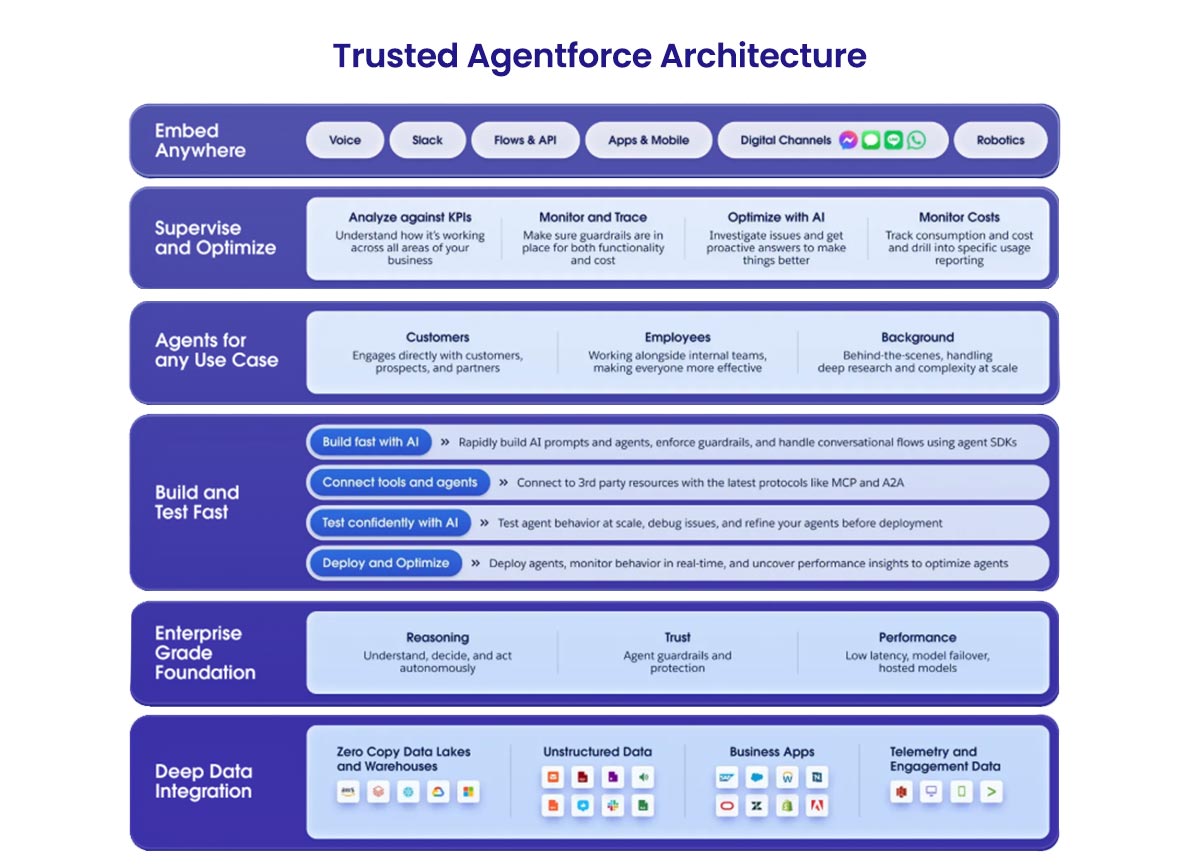
The agentforce ai use cases that deliver the fastest ROI depend on where your biggest operational costs and revenue gaps sit. CTOs and digital transformation leaders need to know where agents deliver impact without adding complexity. eCommerce managers and business unit heads need automation that works at scale without breaking the customer experience. Here is where Agentforce fits.
Retail and E-Commerce
Retail agents handle product recommendations, order status, returns, and post-purchase support. Inventory agents monitor stock levels and trigger reorder workflows automatically. Associates in physical stores get product and customer information surfaced during in-store conversations.
Companies using Agentforce in retail include Saks, Williams-Sonoma, Pandora, and SharkNinja.
Healthcare
Healthcare organizations can use agents to handle appointment scheduling, intake questions, patient record updates, and post-visit follow-ups . Predictive agents analyze data patterns to surface early warning signals for care teams, without replacing clinical judgment. All of this runs within Salesforce Health Cloud’s HIPAA-compliant setup.
Financial Services
Banks use agents for account inquiries, transaction verification, and fraud alerts. Insurance companies use them for claims intake, document collection, and case routing. Compliance agents monitor interactions for regulatory issues before they escalate. Investment agents analyze customer financial profiles and surface relevant options across savings, investment, and credit products.
Manufacturing
Manufacturers use agents to track orders, handle supply chain exceptions, and communicate with suppliers. Predictive maintenance agents analyze equipment data and schedule service before something breaks. Companies like FedEx and Dell have deployed Agentforce for logistics and supply chain coordination.
Telecommunications
Telecom agents handle billing questions, troubleshoot connectivity issues, and recommend plan upgrades based on actual usage data. Proactive agents reach out before contract renewals with relevant options, reducing churn before it happens.
Travel and Hospitality
Travel agents handle booking changes, loyalty inquiries, and disruption support, including rebooking passengers automatically when flights are canceled. Finnair and Heathrow Airport both use Agentforce for passenger services at scale.
Education
In education, agents answer prospective students’ questions at any hour, register students for campus visits, and guide applicants through the process. For enrolled students, agents handle registration questions, financial aid inquiries, and basic administrative requests.
Real Estate
Real estate AI agents qualify buyer leads, schedule property viewings, answer listing questions, and send personalized property alerts when new listings match a buyer’s stated preferences.
Agentforce AI Use Cases Across Every Business Function
The key question is where AI agents deliver measurable impact fastest, and which workflows can be automated without disrupting the customer experience. Here is where Agentforce fits across each function.
Service Agent
- Deflect high-volume, low-complexity tickets across chat, email, SMS, and phone without increasing headcount
- Handle order lookups, returns, and account updates autonomously, reducing cost per resolution
- Accept images and files mid-conversation so agents can process claims and issue reports without routing to a human
- Escalate to a live agent with full context attached, protecting customer experience at the handoff point
Sales Agent
Agentforce use cases for sales cover the full spectrum from top-of-funnel automation to pipeline management. A common question is: what is an appropriate use case for leveraging the Agentforce Sales Agent in a sales context? The answer starts with the tasks that drain rep time without requiring human judgment: lead outreach, qualification conversations, meeting scheduling, follow-up messages, and CRM record updates.
- Automate top-of-funnel activity, including lead outreach, qualification, and meeting scheduling, so reps focus on closing
- Eliminate manual CRM updates by pulling pipeline changes directly from call and email content
- Reduce ramp time for new hires with an AI coach that runs live practice scenarios and gives feedback in real time
Marketing Agent
- Move from static, manually built segments to targeting based on live customer behavior
- Run multivariate content and timing tests across audience segments automatically
- Reduce dependence on manual campaign management as volumes scale
Commerce Agent
- Deliver personalized product recommendations at scale without additional merchandising resources
- Automate order tracking, returns, and product queries across peak periods without proportionally increasing support costs
- Proactively re-engage customers on wishlist and back-in-stock events to recover potential lost revenue
Platform Agent
AI agents for employee support are one of the fastest-growing Agentforce deployment categories. Agents run inside Salesforce Lightning, Salesforce Mobile, and Slack so employees get help in the tools they already use, with no separate system to learn.
- Resolve IT requests, password resets, and ticket logging without helpdesk involvement
- Handle HR queries on benefits, policies, and onboarding at any hour without adding team headcount
- Enforce expense policies automatically and move approvals through the correct workflow without manual chasing
- Surface the right case study, pricing sheet, or brief to sales reps during active deals without them leaving their workflow
- Monitor internal communications continuously for compliance issues before they require escalation
Ranosys can help set up Agentforce for you
Ranosys has spent 17+ years building and deploying Salesforce solutions for enterprises across retail, eCommerce, financial services, healthcare, manufacturing, and more. As a 3X award-winning Salesforce Summit Partner, we have the certifications, the cross-industry experience, and the hands-on Agentforce deployment track record to get this right for your business from day one.
We have helped global brands across retail, eCommerce, financial services, healthcare, and manufacturing deploy Salesforce solutions that scale. We bring that same experience to Agentforce, identifying where agents will deliver the fastest impact in your environment and deploying them without disrupting what is already live.
How we help you deploy Agentforce:
- Assess your current Salesforce setup and identify the one or two use cases most likely to show measurable ROI within months
- Evaluate data readiness before any build begins so agents have access to accurate, structured information from day one
- Handle end-to-end configuration, including Flows, APIs, third-party integrations, and Trust Layer governance
- Set up Observability dashboards so you have full visibility into agent performance from the moment they go live
- Stay involved after launch to optimize based on real interaction data, not assumptions
Most Agentforce deployments do not fail because of the technology. They fail because the first use case was too broad, the underlying data was not ready, or the team did not have a clear measure of success before going live. We make sure none of that happens.
Not sure if Agentforce makes financial sense for your business yet? Use Salesforce’s Agentforce ROI Calculator to get a directional estimate before committing to anything.
If you are ready to take it further or have an existing deployment that is not performing as expected, we can give you an honest assessment and a clear path forward.


