Talk to our experts
TLDR :
Traditional CRM tools were designed to capture what happened. The challenge for most mid-market teams is that someone still has to decide what happens next, and that coordination overhead quietly consumes a significant portion of every working week.
ServiceNow autonomous CRM is built around a different model. Instead of surfacing data and waiting, the platform takes ownership of the next step. Key capabilities that make this possible:
- Role-assigned AI agents that hold the business context and permissions to progress complex workflows from start to finish
- A unified data layer that pulls ERP, billing, and back-office systems into the same operational view as your front-office teams
- Intelligent scheduling and dispatch for field teams, with automated job closure and invoicing
- Customer-facing portals that complete requests through AI rather than routing them to a human queue
- Automated handoffs across sales, service, and finance that run without anyone brokering them manually
If your team is spending more time managing processes than serving customers, this blog is worth the read.
The CRM your team uses every day was built to store data, not act on it. Every escalation, status update, and renewal still needs someone to manually push it forward. According to Asana’s State of Work Innovation research, 60% of employee work time is consumed by searching for information, switching between applications, and chasing updates that a connected system should surface automatically.
ServiceNow autonomous CRM addresses this by functioning as a system of action rather than a system of record: interpreting customer intent, selecting the appropriate workflow, and executing tasks across sales, service, and fulfillment without manual intervention at every step.
This blog covers what ServiceNow CRM is, how it works, its key features, use cases for CRM for mid-market enterprises, and what to consider before adoption.
What is ServiceNow CRM?
ServiceNow CRM is an AI-powered CRM platform built on the ServiceNow AI Platform. Unlike traditional enterprise CRM solutions that function as systems of record, ServiceNow CRM is designed as a system of action: it connects sales, service, and fulfillment operations on a single layer and drives work forward using AI agents and intelligent CRM systems that act without waiting for human direction.
ServiceNow officially entered the CRM market in January 2025, combining Customer Service Management (CSM), Sales and Order Management, and Field Service Management into one unified platform. It is now the company’s fastest-growing workflow business, with annual contract value reaching $1.4 billion and growing 30% year-over-year, per ServiceNow’s official press release.
At the core of this platform is the Autonomous Workforce: AI agents assigned to specific roles with the business context and permissions needed to handle complex workflows independently, escalating to humans only when genuine judgment is required.
How ServiceNow CRM works
The foundation of how ServiceNow CRM works is the ServiceNow AI Platform, which connects ServiceNow customer workflows across systems, departments, and data sources. Rather than managing data in isolation, the platform maps customer journeys from lead generation and quoting through fulfillment, support, and renewal, including the back-office processes that traditional CRMs rarely touch.
According to ServiceNow’s Autonomous Business Services whitepaper, 67% of executives reported margin gains from AI adoption in ServiceNow’s 2025 Enterprise AI Maturity Index. The platform delivers this through four components:
- Workflow Data Fabric connects data from your ERP, billing systems, legacy databases, and cloud applications and makes it actionable across the platform, functioning as a unified customer data platform across your entire operation. This was strengthened through ServiceNow’s acquisition of data.world in May 2025.
- AI agents interpret customer intent, select the appropriate workflow, and complete tasks autonomously, escalating to human agents with full context when needed.
- AI Agent Fabric enables ServiceNow’s agents and third-party agents from Microsoft, Google Cloud, and others to communicate and coordinate across your operations.
- Now Assist provides a text, voice, or visual interface for customers and employees to accomplish tasks using natural language.
Outcomes from the ServiceNow AI Summits 2026, held across cities worldwide, showed organisations cutting quote times by 40% and resolving cases 7x faster. At Mobile World Congress 2026, Bell Canada reported a 25% improvement in customer response time after deploying ServiceNow AI Agents, per ServiceNow’s MWC 2026 press release.
Key Features of ServiceNow Autonomous CRM
The ServiceNow Autonomous CRM for Service platform includes the following ServiceNow CRM features, each designed to remove manual handoffs and put autonomous workflows at the centre of every customer interaction.
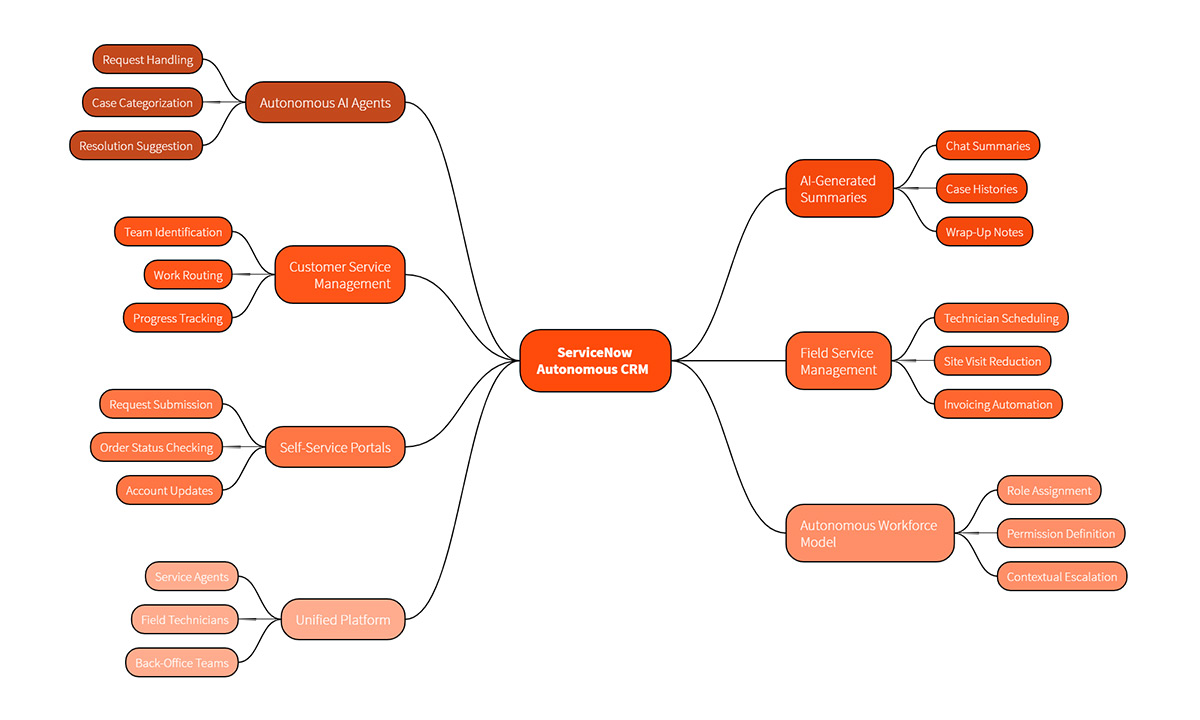
- Autonomous AI agents that work around the clock: AI agents handle incoming requests, categorise cases, suggest resolutions, and close interactions independently. ServiceNow’s own data shows they already automate 37% of internal customer support case workflows.
- AI-generated summaries, case histories, and wrap-up notes: Now Assist prepares human agents before they engage: generating chat summaries, surfacing case histories, recommending resolutions, and producing wrap-up notes automatically once each interaction closes.
- Customer Service Management with cross-department workflow routing: When a request arrives, the platform identifies which teams need to act, routes work accordingly, and tracks progress across departments without agents chasing internal handoffs or customers repeating themselves.
- Field Service Management with AI-optimised scheduling and dispatch: AI schedules field technicians using live customer and case data, reduces unnecessary site visits, and triggers invoicing automatically on job completion. Ranked #1 in the ISG Buyers Guide for Customer Engagement and Proactive Maintenance.
- Self-service portals with autonomous resolution: AI-backed portals let customers submit, track, and resolve requests without agent involvement, including checking order status, updating account details, and completing standard service tasks.
- The Autonomous Workforce model: The Autonomous Workforce assigns AI agents to specific service roles with defined permissions and business context, so they handle complex multi-step workflows autonomously and escalate with full context when human judgment is needed.
- Unified platform across service, field, and back-office teams: Service agents, field technicians, billing, and operations teams share one customer view. Cases retain full context across department boundaries without requiring separate systems or manual data transfers.
Why Mid-Market Enterprises Need Autonomous CRM
CRM for mid-market companies presents a specific challenge. Mid-sized businesses have grown beyond basic CRM tools but rarely have the platform operations teams that large enterprises maintain. The result is disproportionate manual coordination work, and the data reflects it. According to the Xantrion analysis of the RSM US Middle Market Business Index and Baker Tilly 2026 Mid-Market Report:
- 72% of mid-market organizations anticipate higher operating costs in the coming months
- Technology adoption is their single biggest concern heading into 2026, ahead of tariffs and regulatory change
- 59% consider technology investment a core part of their current business strategy
- 76% cite workflow automation as the primary reason they are investing in AI
The gap between data and action is where this becomes costly in practice. A sales rep who sees a renewal due in 30 days still has to manually prepare a quote, check on open service tickets, and coordinate with billing before the conversation can happen. Each step depends on a human completing a handoff, and when one is delayed, the rest wait.
For CRM for scaling mid-size businesses, ServiceNow’s autonomous CRM addresses this by collapsing those handoffs into automated workflows. The platform:
- Identifies the renewal signal and triggers quote preparation automatically
- Surfaces open service cases to the account manager before the renewal conversation
- Initiates billing coordination without anyone manually orchestrating the sequence
- Carries workflows across department boundaries, connecting service requests to billing updates, field dispatches to inventory checks, and renewal triggers to finance approvals
- The people closest to the customer focus on the conversation. The platform handles the coordination behind it.
Benefits of AI-Powered CRM Systems
Mid-market leaders are already moving in this direction. Capstone Partners’ 2025 Middle Market Business Owners Survey found that improving efficiency is the leading operational initiative for mid-market CEOs heading into 2026, with 60% of those investing in AI citing overhead cost reduction as the primary driver. The CRM automation benefits of ServiceNow’s platform map directly to these priorities.
1. Faster resolution with fewer escalations: AI agents handle routine requests from intake through resolution. Resolution times drop because the CRM automation software does not wait on people to pass information between systems.
2. Higher sales productivity: With AI managing CPQ tasks and data entry, sales reps spend more time in customer conversations. This matters most for AI CRM for enterprises where the same people carry both quota responsibility and operational tasks.
3. Lower dependency on manual coordination: Pulling reports, copying data between platforms, and sending status update emails are recurring time costs. Workflow automation CRM capabilities replace this with automated orchestration that runs without manual prompting.
4. Headcount efficiency at scale: ServiceNow scaled from roughly 6,000 to over 26,000 employees between 2017 and 2024 while improving its employee-to-IT-support ratio by running entirely on its own platform, per ServiceNow’s Autonomous Business Services whitepaper. This is an operational benchmark, not a projection, and a strong indicator of CRM ROI for enterprises that commit to the platform long term.
5. Connected front and back office: ServiceNow CRM connects sales and service teams to the operational systems behind them, so a customer request does not get stuck because fulfillment, billing, or IT has not yet received the information they need to act.
ServiceNow CRM vs. Traditional CRM
Most traditional CRM platforms were built for a world where customer data needed to be organised and surfaced to humans who would then decide what to do next. ServiceNow is built for a world where the platform decides and acts, with humans stepping in only when the situation genuinely requires judgment. Understanding this distinction is central to evaluating any what is AI-driven CRM system conversation.
| Dimension | Traditional CRM | ServiceNow Autonomous CRM |
| Core function | System of record (stores data) | System of action (executes workflows) |
| AI role | Assists users with suggestions | Completes tasks autonomously |
| Back-office connectivity | Limited; requires custom integrations | Native; connects IT, finance, HR, and fulfillment |
| CPQ capabilities | Often, a separate tool | Built in via Logik.ai acquisition |
| Data unification | Front-office data only | Cross-enterprise via Workflow Data Network |
| Self-service | Basic portals | AI-driven, autonomous resolution |
| Headcount model | Add seats as volume grows | AI agents absorb volume growth |
Use Cases for Mid-Sized Businesses
B2B sales and quoting: A mid-market manufacturer handling complex, configurable orders can use CRM with workflow automation capabilities to generate accurate quotes faster, without requiring a solution engineer at every deal stage. That frees senior technical staff for the deals that genuinely need them.
Customer service and support: A professional services firm managing multiple client accounts can route incoming support requests automatically based on contract tier, case type, and current workload, without a triage coordinator sorting the queue manually each morning.
Field service coordination: A technology company with a field installation team can connect its ServiceNow CRM to scheduling, inventory, and billing so that field technicians arrive with the right information, and completed jobs trigger invoicing without manual entry.
Subscription and renewal management: A SaaS business can automate the identification of at-risk accounts, trigger renewal workflows at the right lead time, surface outstanding service issues before the renewal conversation, and route the quote automatically once approved.
Cross-department request management: When a customer’s request spans sales, service, and billing, which is common in CRM for mid-market enterprises, ServiceNow’s connected architecture means the handoffs happen through automated workflows rather than email chains and follow-up calls.
Challenges and Considerations Before Adoption
Any credible conversation about autonomous CRM should include an honest assessment of the practical realities involved in getting there.
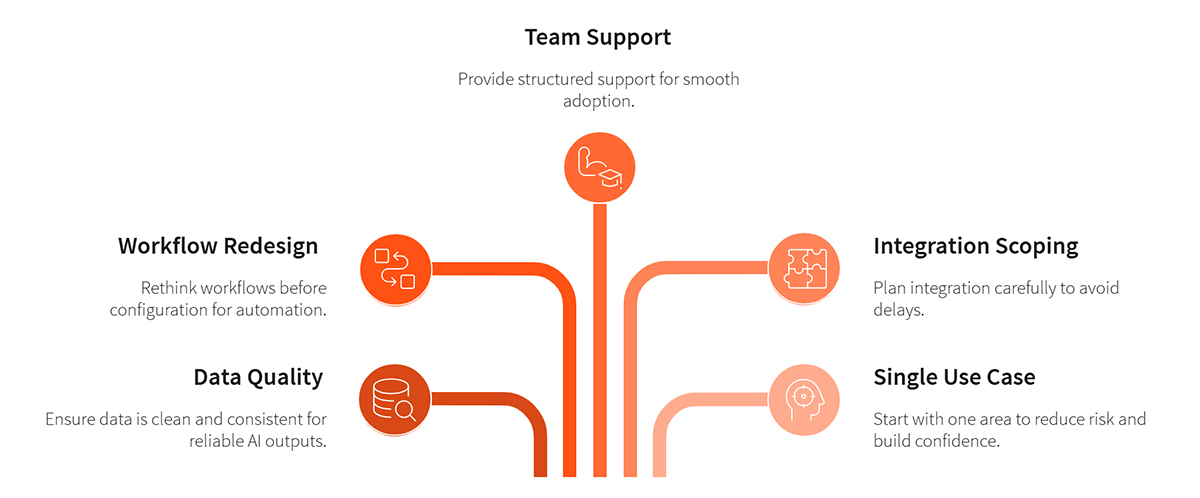
- Data quality determines how well the platform performs: If your customer data is fragmented, inconsistent, or incomplete, AI agents will operate on flawed inputs and produce unreliable outputs. A data audit before implementation is a prerequisite, not an optional step.
- Workflow redesign comes before software configuration: Moving from a system of record to a system of action requires rethinking how customer-facing workflows are structured. The platform cannot automate processes that are not clearly defined. Organizations that treat this as a pure technology deployment rather than a workflow redesign project tend to find that the value they expected does not materialize.
- Sales and service teams need structured support during transition: People who have worked within a particular CRM for years will need deliberate guidance to adopt new workflows. The learning curve is real, and the quality of change management during rollout significantly affects adoption rates.
- Integration work requires proper scoping: While ServiceNow’s Workflow Data Fabric reduces the volume of custom integration work, connecting your existing ERP, billing systems, or legacy applications still requires planning, testing, and governance. Underestimating this in the project timeline creates pressure later.
- Starting with a single use case reduces risk: Beginning with one well-defined area, such as customer service automation or renewal management, before expanding to sales and fulfillment gives your team time to build confidence, identify gaps, and refine processes before the scope widens.
How to Implement ServiceNow CRM
A structured implementation approach for mid-market enterprises typically follows these steps:
Step 1: Discovery and scoping. Map the customer journeys you want to automate. Identify the systems involved, the data that needs to be connected, and the handoffs that currently rely on manual intervention. This step produces the workflow blueprint that guides the entire project.
Step 2: Data audit and preparation. Assess the quality and completeness of your customer data. Establish governance policies for how data will be maintained on the new platform.
Step 3: Core platform configuration. Build and configure the ServiceNow CRM environment, establish integrations with your existing systems via Workflow Data Fabric, and set up the AI agent rules and escalation paths.
Step 4: Workflow automation buildout. Develop the automated workflows for your priority use cases, whether that is CPQ, case routing, renewal management, or field service coordination.
Step 5: Testing and validation. Run the automated workflows against real scenarios before full deployment. Validate that AI agent decisions align with your escalation expectations and business rules.
Step 6: Team training and change management. Train sales, service, and operations teams on how their work changes in an autonomous CRM environment. The focus should be on what the platform handles and where human judgment remains central.
Step 7: Go-live and optimization. Deploy in phases where possible. Monitor workflow completion rates, resolution times, and escalation patterns. Use the AI Control Tower to govern and refine agent behavior over time.
Why Choose Ranosys for ServiceNow CRM Implementation
CRM implementation for mid-market businesses requires a partner who understands both the platform’s architecture and the operational realities involved: resource constraints, existing system complexity, and the change management demands that come with a CRM digital transformation of this scope.
Ranosys is a certified ServiceNow partner with a proven track record of delivering CRM transformations across enterprise and mid-market environments. Our implementation experience spans complex Salesforce CRM deployments across retail, manufacturing, and professional services, where we have helped clients restructure customer workflows, integrate back-office systems, and improve resolution times and sales productivity. As we deepen our ServiceNow practice, that same methodology carries forward: we start with how your customer operations actually work today, not with technology decisions, and build from there.
Our ServiceNow CRM services cover:
- CRM readiness assessment and integration landscape review
- Platform implementation, including AI agent setup, workflow automation, and CPQ configuration
- Systems integration via Workflow Data Fabric across ERP, billing, and legacy platforms
- Data migration and governance to support autonomous workflows from day one
- Change management and training for sales, service, and operations teams
- Managed services and ongoing optimization as your business evolves
- CRM digital transformation roadmap from a system of record to a fully autonomous system of action
Mid-market businesses across manufacturing, professional services, technology, and retail are restructuring their customer operations using ServiceNow CRM, reducing manual coordination, improving resolution times, and freeing their teams for work that actually requires human judgment.
If you are evaluating ServiceNow CRM pricing or want to understand the CRM cost for mid-market businesses, contact our ServiceNow team to walk through your current environment and explore what a phased implementation path might look like for your organization.