Talk to our experts
Summary
Salesforce Data 360, the significantly upgraded evolution of Salesforce Data Cloud, represents a foundational shift to an enterprise-wide intelligence layer, powering the Agentforce AI ecosystem. It moves beyond mere data unification to consolidate fragmented customer and operational data from hundreds of disparate systems into a single, real-time Customer 360 profile. This robust data foundation is now critical for ensuring AI agents receive accurate, contextual information, enabling transformative capabilities and informed, immediate actions across sales, service, and marketing functions for enterprise organizations navigating an increasingly agentic future.
Key enhancements include Intelligent Context for processing unstructured data, Tableau Semantics for enforcing consistent metric definitions across clouds and external data sources, and mature Zero-Copy federation, which allows direct querying of external data lakes without costly duplication. These advanced capabilities ensure data integrity and real-time activation, driving personalized customer journeys, enabling smarter business decisions, and facilitating regulatory compliance across diverse sectors such as retail, financial services, and healthcare, providing operational depth previously unattainable with disconnected systems.
While Data 360 offers transformative potential, successful implementation demands meticulous planning around data architecture, quality, and cost optimization. Ranosys, a 3X award-winning Salesforce Data Cloud implementation partner and trusted authority in Salesforce and Digital Transformation, provides the essential technical depth and strategic expertise. We help organizations design robust data architectures, accelerate implementation, build AI-ready data foundations, ensure rigorous governance, and ultimately deliver measurable ROI, enabling seamless adoption and optimization of Data 360 to power digital commerce and enterprise-wide transformation.
TLDR :
Salesforce Data 360 is the renamed and significantly upgraded version of Salesforce Data Cloud, announced at Dreamforce 2025. It moves beyond data unification to become the core intelligence layer powering every Agentforce AI agent.
Key additions include Intelligent Context (for unstructured data), Tableau Semantics (for consistent metric definitions), mature Zero-Copy federation, and AI-driven governance. It works across retail, financial services, healthcare, fashion, and education, and while the platform is powerful, it requires proper architecture planning, clean data, and an experienced implementation partner to deliver real value.
Enterprise leaders have long battled the same persistent challenge: critical customer data scattered across hundreds of disconnected systems, none of which talk to each other. Sales reps work from incomplete records. Marketing campaigns fire to the wrong audiences. Service teams miss context that could resolve tickets in minutes. And leadership makes decisions based on reports that are already out of date by the time they land.
That’s where the Data 360 (formerly known as Salesforce Data Cloud), a Salesforce customer data platform, comes in.
If you’ve been tracking the evolution of Salesforce’s data platform, you’ve likely seen it go through several iterations over the years. The latest and most significant is the renaming and repositioning to Salesforce Data 360, unveiled as part of the Agentforce 360 launch at Dreamforce 2025. But this is a foundational shift in how Salesforce’s entire AI-powered ecosystem operates, and for enterprise leaders navigating an increasingly agentic future, it’s one of the most important developments in Salesforce’s recent history.
In this guide, we demystify Salesforce Data 360: what it is, how it evolved, what’s new, how it works, the industries and use cases it serves, and how your organization can maximize its value.
A Brief History: From CDP to Data 360
Salesforce’s journey with its enterprise data platform spans more than six years and several meaningful name changes, each reflecting a shift in scope and ambition.
2019–2021 (Customer 360 / Customer 360 Audiences / Salesforce CDP): Launched at Salesforce Connections 2019 as a Salesforce customer data platform, renamed twice, and settled on Salesforce CDP in May 2021. During this period, it also served as the backbone of the Salesforce Marketing Cloud customer data platform, focused primarily on identity resolution, data unification, and marketing segmentation.
2022–2024 (Salesforce Genie / Data Cloud): Dreamforce 2022 brought a genuine expansion, not just a rename. The platform extended beyond marketing into sales, service, and commerce, introducing real-time processing and early Zero-Copy architecture. By 2023, it became Salesforce Data Cloud, one of the most talked-about Salesforce data cloud services in the ecosystem.
2025–Present (Data 360): A move from passive data storage to an active context engine powering Agentforce. Data 360 introduces Intelligent Context, Tableau Semantics, and mature Zero-Copy federation, making it the core data infrastructure across the entire Salesforce ecosystem.
The pattern across each iteration is consistent: Salesforce has progressively expanded the platform’s scope from marketing-centric data unification toward enterprise-wide data infrastructure. Data 360 represents the fullest expression of that trajectory.
What is Salesforce Data 360?
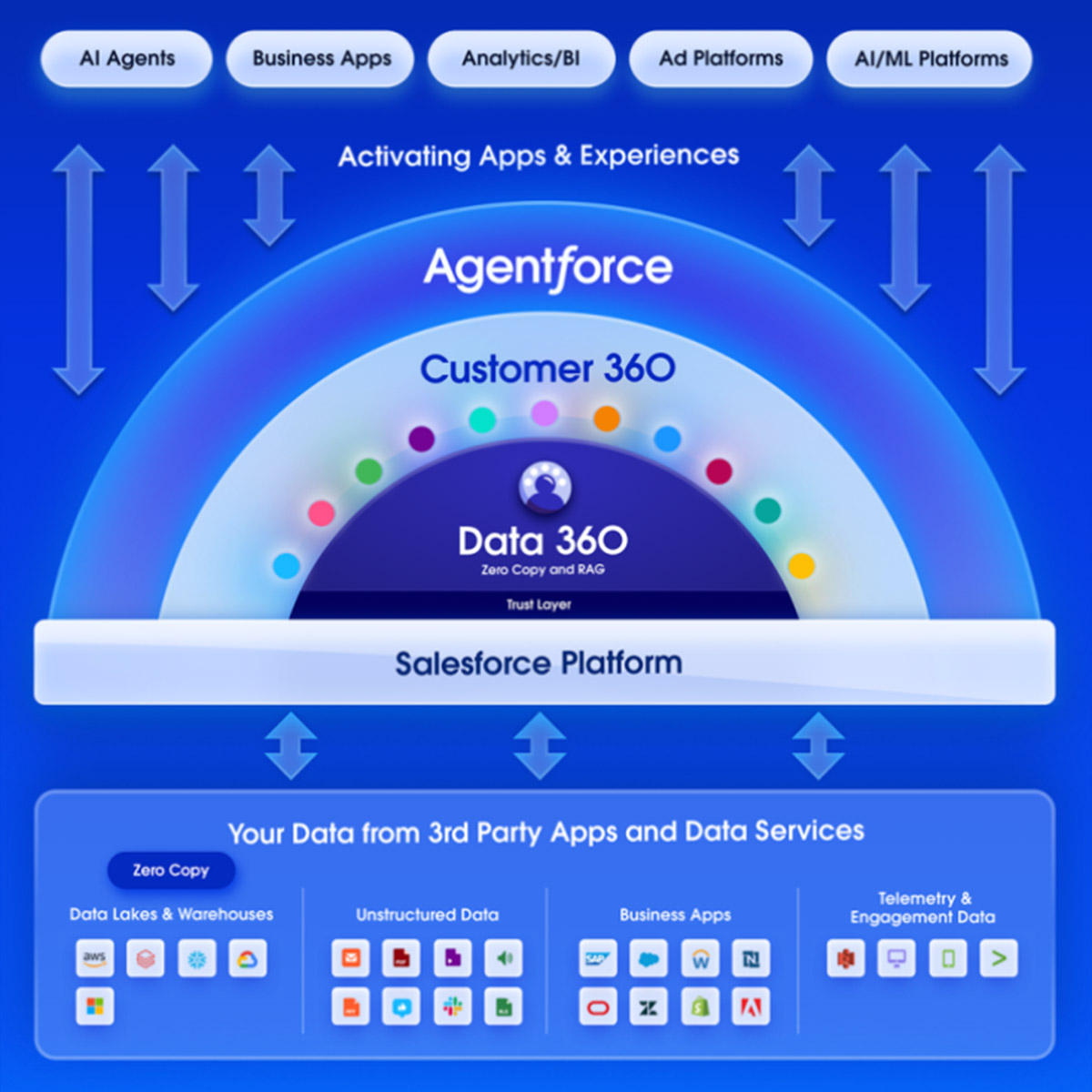
Salesforce Data 360 is the real-time data engine underneath the entire Salesforce platform. It unifies fragmented customer and enterprise data CRM records, billing systems, web data, external data lakes, legacy applications- into a single, trusted Customer 360 profile, making it Salesforce’s most advanced approach to Salesforce customer data management to date.
It operates as a hybrid data lakehouse (a structured Salesforce Cloud database), combining large-scale data lake storage with the query-ready performance of a data warehouse. Everything is brought natively into Salesforce’s metadata model, so sales, service, marketing, and commerce teams can act on unified data through familiar Salesforce interfaces, with no custom translation work required.
More importantly, Data 360 is now the foundational data layer for Agentforce, Salesforce’s AI agent platform. Every AI agent in Agentforce depends on Data 360 to access the right context, at the right moment, to take the right action. Without it, agents operate blindly. With it, they become transformational.
Source: https://www.salesforce.com/data/
Key Features and Capabilities of Salesforce Data 360
Data 360 ships with a set of capabilities that go well beyond what Data Cloud originally offered. Some of these are completely new. Others are significant upgrades to features that existed in earlier forms. Together, they make Data 360 a fundamentally different kind of platform.
- Intelligent Context: Most enterprise data lives in PDFs, contracts, manuals, and transcripts. Intelligent Context processes this through a low-code pipeline, chunking, embedding, vectorizing, and storing content in a searchable knowledge graph so Agentforce agents can surface accurate, context-specific answers in real time.
- Tableau Semantics: When “revenue” means something different in Sales Cloud than it does in Finance, AI agents produce inconsistent outputs. Tableau Semantics enforces a shared business language across the Customer 360 Semantic Data Model, applying consistent metric definitions across all Salesforce Clouds, Databricks, dbt Labs, and Snowflake.
- Mature Zero-Copy Federation: Instead of duplicating data into Salesforce, Zero-Copy lets Data 360 query it directly where it lives, Snowflake, BigQuery, Databricks, Amazon Redshift, and more. Data never moves, giving teams warehouse-level analytical depth for operational use cases without rebuilding their data architecture.
- Activation-Triggered Flows: The moment a segment publishes or a Data Model Object updates, an outbound flow fires automatically, pushing data to Marketing Cloud, advertising platforms, or any external API. No code, no manual steps, no delay.
- Clean Rooms: Organizations can analyze data jointly with external partners without sharing underlying records. Queries run against a combined governed dataset; results feed directly back into Salesforce for immediate action. Native AWS Clean Rooms integration is also supported.
- Agentic Setup and Data Management: Teams configure and manage their entire Data 360 pipeline using plain language instructions. The system provides guided setup suggestions and orchestrates the pipeline accordingly lowering the technical barrier between data connection and activation significantly.
- Agentic Enterprise Search: A single search interface across 200+ external data sources. Users get a synthesized answer drawn from across the connected data estate and can trigger agent actions, updating a record, routing a case, or initiating a workflow, without leaving the interface.
- AI-Driven Data Governance: Data 360 automatically detects and classifies sensitive information PII, financial records, health data, and applies policy-based controls. Spring ’26 added integrated Right to Be Forgotten (RTBF) workflows, enabling record deletion across both the Salesforce org and Data 360 in one governed process.
- Private Connect: Encrypted, point-to-point connectivity between Data 360 and external platforms entirely off public network routes. Built for financial services, healthcare, and government organizations where network isolation is a hard compliance requirement.
- Platform Encryption with Customer-Managed Keys: Organizations bring their own encryption key to protect data at rest in Data 360, giving security and compliance teams direct control without depending on Salesforce-managed infrastructure.
Key differences: Salesforce Data 360 vs. Salesforce Data Cloud
While Data 360 builds upon everything Data Cloud offered, data ingestion, identity resolution, unification, segmentation, and activation, the rename signals a meaningful leap forward in platform capability. Here’s a clear breakdown of what’s changed:
| Capability | Salesforce Data Cloud | Salesforce Data 360 |
| Platform Role | Standalone data unification platform | Foundational intelligence layer for the entire Agentforce 360 ecosystem |
| AI Integration | Fed data to Einstein models | Natively integrated with Agentforce agents; grounds every agent action with real-time trusted context |
| Unstructured Data | Limited, primarily structured data ingestion | Full support via Intelligent Context; extracts and structures knowledge from PDFs, contracts, manuals, diagrams, and images |
| Semantic Consistency | Metric definitions varied across Clouds | Tableau Semantics enforces a unified business language via the Customer 360 Semantic Data Model (SDM), consistent across all Salesforce Clouds, Databricks, dbt Labs, and Snowflake |
| Zero-Copy Architecture | Available but foundational | Matured real-time federated access to Snowflake, BigQuery, Databricks, and more without duplicating data |
| Activation | Segment activation to marketing channels | Activation-Triggered Flows (GA): instant, automated data pushes to any downstream system when a segment publishes or DMO activates |
| Unstructured Data Processing | Not available | Enterprise-grade pipelines: chunking, vectorization, embedding generation, semantic search, knowledge graph construction, and agent memory |
| Voice & Multimodal Support | Not available | Powers Agentforce Voice with real-time context grounding for voice agent interactions |
| Data Architecture | Data lakehouse on the Salesforce Platform | Evolved hybrid data lakehouse with deeper metadata-driven object model and full compliance and governance controls |
| Target Personas | Marketing, CRM, and data teams | Enterprise-wide: sales, service, marketing, commerce, IT, data, and AI/agent teams |
Key Features and Capabilities of Salesforce Data 360
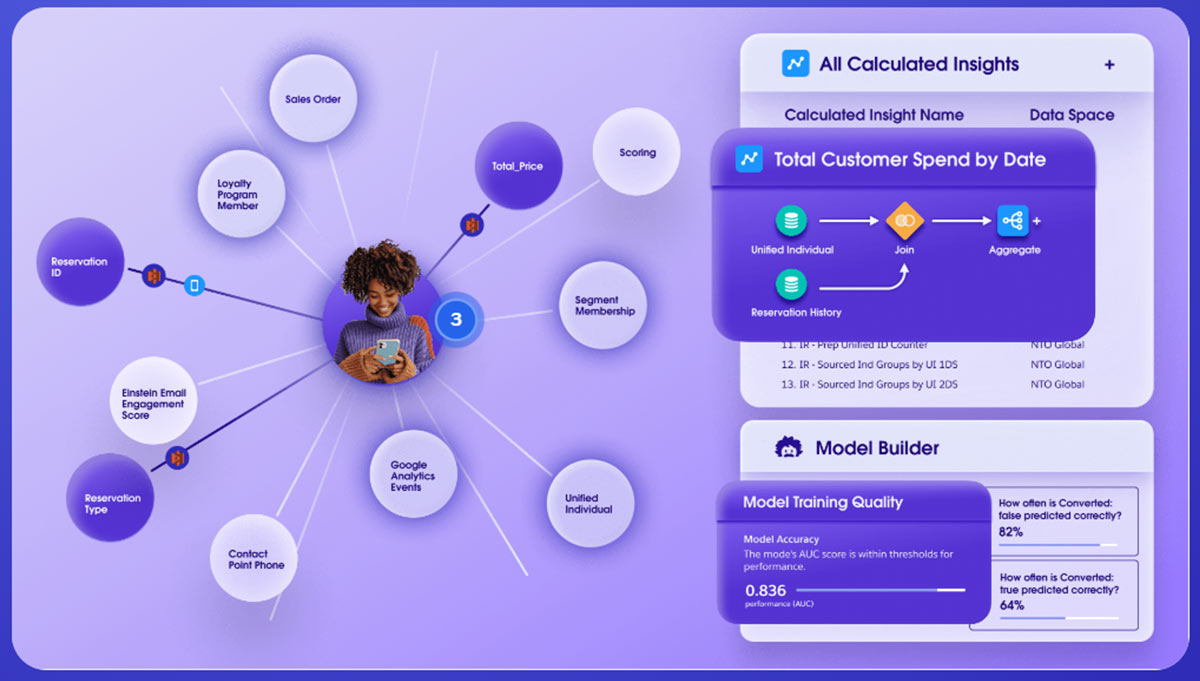
At a high level, Data 360 achieves a unified, intelligent view of every customer and enterprise entity through three core capabilities:
1. Connect and Ingest All Data: Data 360 pulls data from CRMs, ERPs, e-commerce platforms, cloud warehouses, and legacy applications through pre-built connectors and streaming APIs. Its Zero Copy federation allows it to read data directly from external lakes like Snowflake or BigQuery, eliminating the need for costly data duplication or latency.
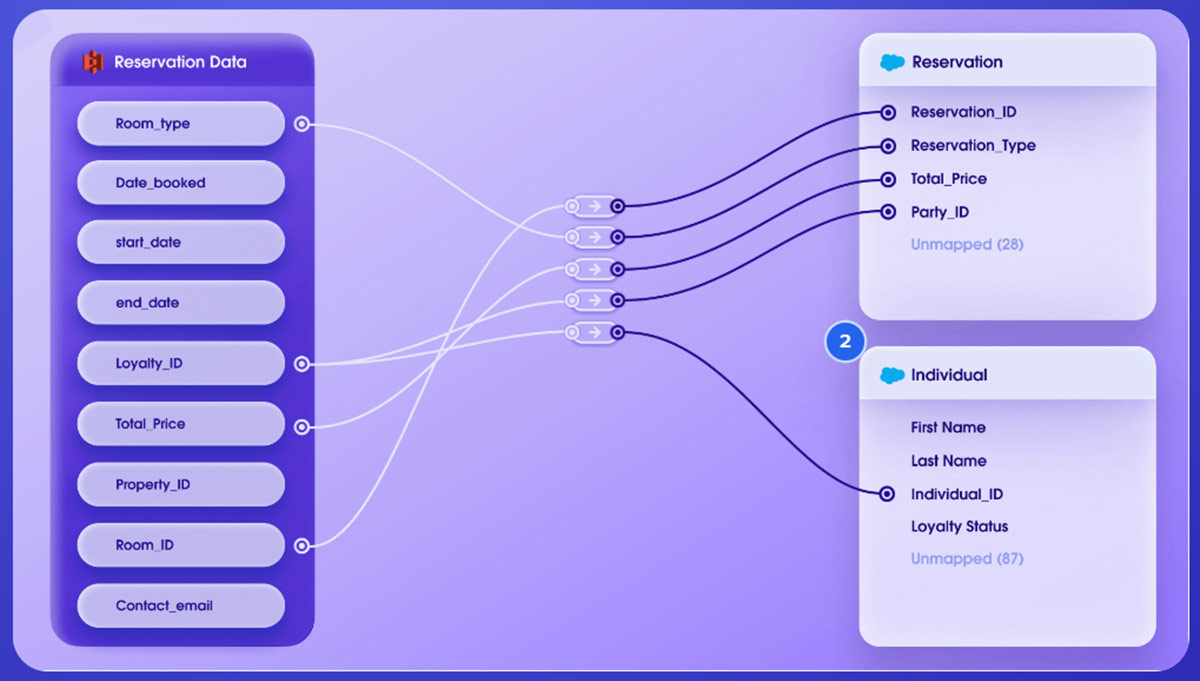
2. Harmonize and Model: Once ingested, data is mapped against the standardized Salesforce Metadata Model using point-and-click tools. This transforms fragmented “Data Lake Objects” into unified “Data Model Objects,” ensuring that information from completely different systems speaks the same language and adheres to a consistent business structure.
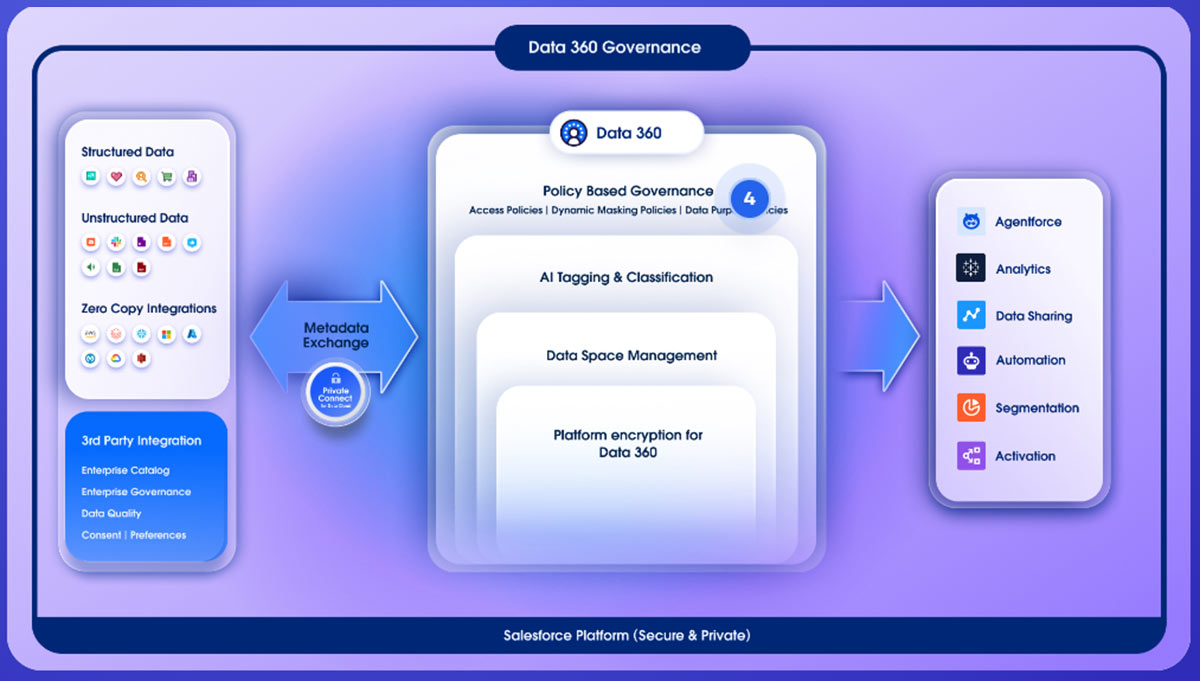
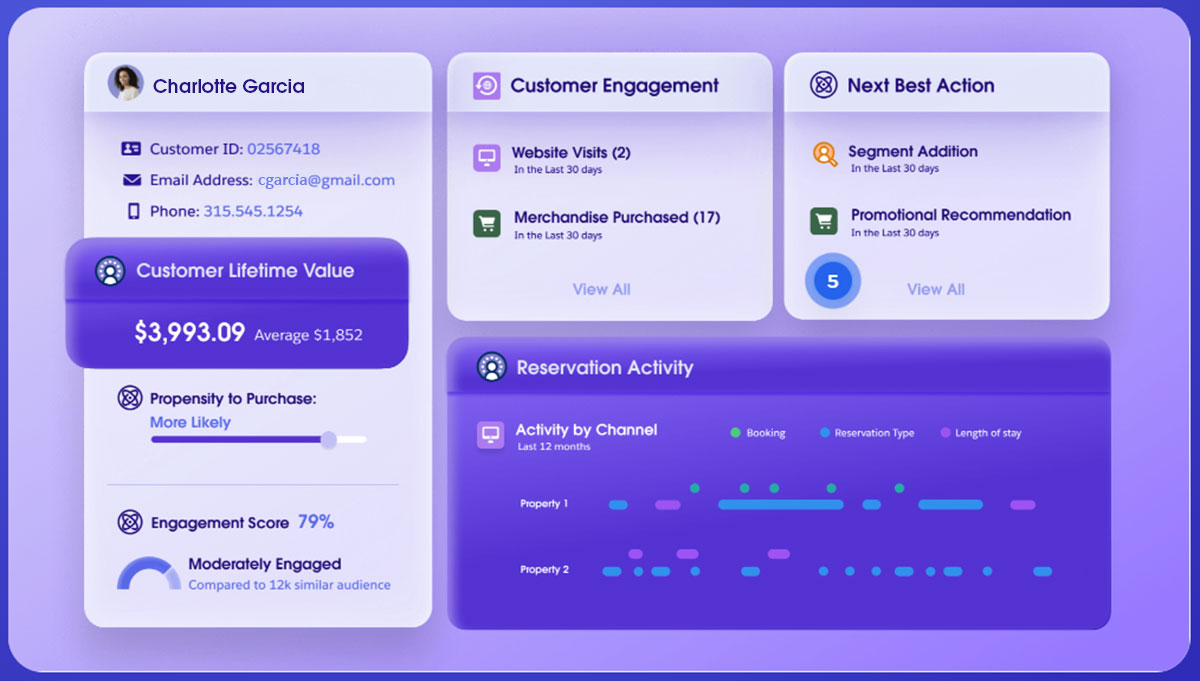
Source of these images: https://www.salesforce.com/in/data/how-it-works/
3. Unify with Identity Resolution: Data 360 uses advanced matching and reconciliation rules to stitch together disparate data points, such as different email addresses or device IDs, into a single, persistent Customer 360 Profile. This creates a “golden record” that identifies the same human being across every touchpoint in the enterprise.
4. Govern for Trust and Compliance: Data 360 provides native, policy-driven governance to manage data at scale. It uses AI-powered tagging to identify sensitive PII, enforces granular access through Data Spaces, and applies Dynamic Data Masking to ensure that every AI agent and business user interacts only with the data they are authorized to see.
5. Activate and Automate in Real Time: Data 360 puts this intelligence to work by instantly triggering Agentforce workflows, personalizing marketing journeys, and routing service cases. It pushes segmented data across Salesforce Clouds and external systems via Activation-Triggered Flows, allowing businesses to respond to customer behavior the moment it happens without custom engineering.
Salesforce Data 360 Use Cases by Industry
No two industries face the same data challenges, and no two industries unlock Data 360’s value in exactly the same way. Here’s how Salesforce Data 360 delivers measurable impact across the industries we work with most.
- Retail & eCommerce: Data 360 unifies browsing behavior, in-store transactions, loyalty activity, and support interactions into one shopper profile. Teams act on real-time signals — abandoned cart offers, next-product recommendations, loyalty tier triggers, while service agents resolve queries on the first interaction with full customer context already in view.
- Financial Services & Banking: Data 360 consolidates account data, transaction history, product holdings, and risk profiles into a single governed record across retail banking, wealth, and lending teams. Advisors identify the right cross-sell opportunity at the right life stage, while data lineage tracking and consent management keep every interaction audit-ready.
- Healthcare & Life Sciences: Data 360 builds a HIPAA-aligned patient profile from appointments, care plans, prescriptions, and insurance data. Care teams flag overdue screenings, close care gaps proactively, and personalize post-discharge outreach with full audit controls, ensuring every data access stays governed and explainable.
- Fashion & Apparel: Data 360 combines purchase history, browse behavior, returns data, and social signals into one profile then activates it instantly. Marketing teams push micro-segments across email, paid social, and SMS in real time. Agentforce agents guide shoppers through recommendations during live interactions, using everything the brand already knows.
- Education: Data 360 connects the full student lifecycle, from applicant to alumni, into one shared profile. Admissions triggers targeted nurture journeys. Student success teams get early disengagement signals before a learner drops off. Alumni teams run focused stewardship campaigns. Intelligent Context surfaces course guidance or financial aid documents mid-conversation.
Limitations and Mitigation Strategies
Data 360 is powerful, but it demands a thoughtful approach. Enterprise leaders should plan around the following realities:
- Consumption-Based Costs Can Grow Quickly: Pricing scales with ingestion, identity resolution, and activation volume. Be deliberate about what needs real-time flow versus batch ingestion. A well-planned architecture delivers similar outcomes at significantly lower cost.
- Schema Design Is Not Forgiving: A poorly designed schema produces oversized profiles, slow queries, and inaccurate segmentation. Invest in proper data modeling before you build, ideally with a certified Data 360 partner.
- Data Quality Determines Agent Reliability: The accuracy of your unified profile directly determines how well every Agentforce agent performs. Address governance, deduplication, and consent management before going live at scale.
- Cross-Cloud Connectivity Needs Planning: Enterprises with data lakes outside AWS may face additional network configuration requirements. Scope cross-cloud networking solutions during implementation planning, not after.
- Implementation Takes Preparation: Data 360 requires a clear plan, an experienced team, and cross-functional buy-in. Organizations that treat it as plug-and-play consistently underdeliver on the investment.
How Ranosys Can Help with Data 360 Implementation
Salesforce Data 360 is, without question, the most comprehensive enterprise data infrastructure Salesforce has ever built, and for organizations already invested in the Salesforce ecosystem, it represents a transformational opportunity. But realizing that opportunity takes more than a license. It takes a strategy.
As a 3X award-winning Salesforce Data Cloud implementation partner, Ranosys brings the technical depth and strategic expertise to help you:
- Design the right data architecture — mapping your enterprise systems, identifying the right ingestion modes, and building a schema that scales
- Accelerate implementation — from initial provisioning and connector setup to identity resolution configuration and segment activation
- Build AI-ready data foundations — ensuring your Data 360 implementation is structured to power Agentforce agents with reliable, trusted context from day one
- Govern your data estate — implementing privacy controls, data lineage tracking, and consent policies across your entire connected ecosystem
- Deliver measurable outcomes — defining the use cases that matter most to your business and building toward them in a structured, ROI-driven roadmap
Whether you are implementing Data 360 for the first time, migrating from an earlier Data Cloud configuration, or looking to extend your existing implementation to power Agentforce, our certified Salesforce consultants are here to guide every step.

Sakshi Sihag
Content Writer
Sakshi is a content writer at Ranosys, where she crafts insight-led content on digital commerce and digital transformation for enterprise brands across retail, banking, healthcare, logistics, and manufacturing. With a background in engineering and hands-on experience in B2B tech content, she specializes in turning complex enterprise technology topics into clear, insight-driven stories that support brand awareness, demand generation, and thought leadership for global enterprises. Connect with her on LinkedIn.


