
Talk to our experts
The cost of operating B2B commerce through separate, unconnected systems creates increasing financial burdens that most retailers fail to recognize. Pricing, inventory, and customer data each live in separate platforms that were integrated at different times, by different teams, for different reasons. IT ends up spending more time keeping these connections alive than building anything new.
The numbers create a better understanding of the situation. Retailers who operate separate commerce systems spend 22% more to maintain their systems without reaching the functionality of businesses which use a single unified commerce platform. According to independent research cited by Shopify, organizations face 34% increased expenses for data migration when they operate separate systems for their commerce needs. According to Shopify, 72% of B2B customers expect real-time pricing and self-serve ordering, while only 36% of vendors meet this requirement.
The global B2B ecommerce market is projected to reach $36.16 trillion in 2026, up from $32.11 trillion in 2025, growing at a CAGR of 14.5%. Buyers have more options than ever, and switching suppliers has never been easier.
Shopify Plus unified commerce brings B2B and DTC operations onto one platform—one data model for products, orders, inventory, customers, and pricing across every channel. Less maintenance overhead, fewer integration failures, and a buying experience that matches what B2B buyers actually expect today.
What is unified commerce for B2B and why does it matter?
Most B2B retailers already sell through multiple channels which include a wholesale portal, retail website, physical store, and their field sales team. The problem is that each of these channels often runs on its own system. Price changes in one location do not update in other locations. Buyers see inventory information which does not match actual stock availability. A sales representative who provides a price quotation through phone communication may use different information than what is available on the online portal.
The unified data model ecommerce approach by this unified commerce B2B system fixes all these issues by combining all business elements into one central system, which provides multiple channels of access for their business operations, including products, orders, inventory, pricing, and customer information. All system components update simultaneously when a buyer completes a purchase through any available purchasing method. The system eliminates all delay times because it needs no manual system updates, and it protects against contradictory system operation.
According to independent research cited by Shopify, retailers that move to a unified platform see 20% faster implementation times, 34% lower data migration costs, and a 22% lower total cost of ownership compared to those running separate systems.
Key business benefits of Shopify Plus for B2B retail
1. Your inventory is always accurate, across every channel
When stock levels are managed across separate systems, errors are inevitable. A buyer orders a product that shows as available, but it has already been allocated to another order in a different system. The result is a cancelled order, a frustrated buyer, and a support ticket that takes time to resolve.
Real-time inventory management on Shopify Plus keeps one inventory record across all channels online, in-store, and wholesale that updates in real time. Because of real-time inventory management, if the stock goes down in the warehouse, every channel reflects that immediately. Sales teams, buyers, and fulfillment staff are all looking at the same numbers at the same time.
As of Q1 2025, 98% of companies are using AI within their supply chains for demand forecasting and stock planning. Shopify Plus has these tools built in, so you do not need a separate system or a custom build to access them.
Delifrance, a Singapore-based food and beverage brand, activated Buy Online, Pickup In Store (BOPIS) on Shopify Plus, synchronizing inventory across digital and physical channels for accurate stock counts and fewer fulfillment errors.
2. Buyers can place and manage orders without calling anyone
A large portion of B2B buyers today would rather log into a portal and sort things out themselves than call a sales rep or wait for an email reply. According to a 2024 Forrester-commissioned survey cited by Shopify, 73% of B2B buyers want a fully digital buying experience, but only 36% of suppliers currently offer one.
The native B2B portal on Shopify gives each buyer account its own portal where they can see their specific pricing, reorder past purchases, review payment terms, and track deliveries—all without contacting your team. For your sales reps, this means less time on routine order management and more time on accounts that actually need attention. This directly helps improve B2B customer experience across every touchpoint.
3. Every buyer sees pricing and products relevant to their account
In B2B, buyers receive different prices, product ranges, and payment terms. Managing this manually or across multiple systems—is time-consuming and prone to errors. These small mistakes add up and erode trust over time.
Shopify Plus for B2B handles this at the account level through a single customer view e-commerce approach. Each company gets its own price list, product catalog, and payment terms, set once and applied automatically every time a buyer logs in. This level of personalization in ecommerce has a direct impact on repeat orders and overall ability to increase conversion rate ecommerce.
Shopify Plus handles this at the account level. Each company gets its own price list, its own product catalog, and its own payment terms—set once and applied automatically every time that buyer logs in.
4. Fewer manual steps mean lower operating costs
A lot of B2B processes are still dependent on manual work, like quote approval, raising a purchase order, and verifying payment before dispatching the order. Each task of these tasks are time consuming because each task needs to be done before moving to the next one, and is done by different team members.
Ecommerce automation for enterprises on Shopify Plus automates these workflows with Shopify Flow, a built-in automation tool that requires no coding. The system allows you to set your own rules to control how borders are processed, handle inventory restocking, assign customer classifications, and more. When buyers handle their own orders through the self-serve portal, your team handles fewer routine requests, which directly reduces operational costs.
5. Managing multiple markets does not have to mean multiple platforms
B2B retailers expanding into new regions often end up running a separate ecommerce instance for each market. Different pricing, different languages, different tax rules—each one becomes its own maintenance burden.
Shopify Plus multi-store management lets you run separate storefronts for different markets, each with its own language, currency, pricing, and product catalog, all from one backend. This is what makes genuine international ecommerce expansion achievable without rebuilding the infrastructure each time.
According to Shopify’s 2025 global commerce report, international revenue on Shopify grew 42% year over year in Q2 2025. Multi-currency, VAT compliance across 26 EU countries, and cross-border duty tools are all built in.
Amazin’ Graze, a global food and wellness brand, set up a Shopify Plus multi-store management configuration to run distinct storefronts across Southeast Asia, with shared inventory and localized payment providers, cutting international market entry time by months.
6. Build the buying experience your buyers need, not what a template allows
Some B2B purchasing processes are very complex. A buyer might need to configure a product, submit it for internal approval, get a quote, and then check out against the credit line all in a single process. Standard ecommerce templates are not built for this.
Shopify Plus supports headless commerce, which means your development teams can build an entirely tailored front end while Shopify manages all back-end functions, including inventory, order management, payment processing, and customer data. This makes it possible to deliver a unified customer experience that is built around how your buyers actually purchase. Your team can still manage everything from one place, maintaining the benefits of a unified commerce platform without sacrificing front-end flexibility.
How Shopify Plus works in practice for a B2B business
Shopify Plus gives B2B brands a single platform to manage wholesale and retail operations without running separate systems for each. Here is what that looks like day to day:
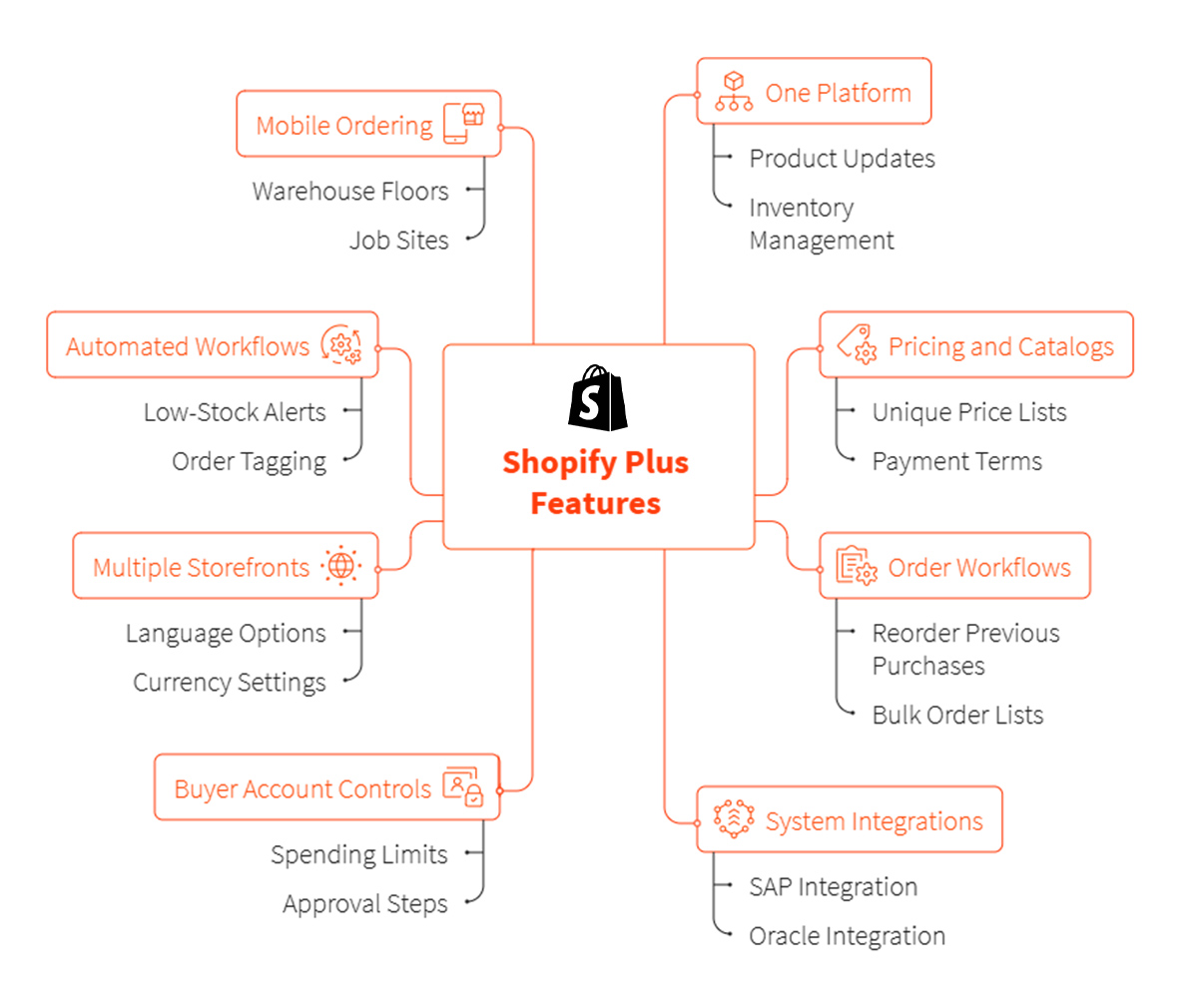
1. One platform for both B2B and DTC
Instead of maintaining separate wholesale and retail stores, Shopify Plus lets you manage both from one backend. Your team updates products, pricing, inventory, and content in one place, and it reflects everywhere.
2. Pricing and catalogs set per buyer account
Shopify Plus B2B ecommerce lets you assign unique price lists, payment terms, and product catalogs to each buyer account—no custom development required. When a buyer logs in, they only see what is relevant to their account and at the price they have agreed to.
3. Order workflows built for how B2B buyers actually buy
Buyers can reorder previous purchases, upload bulk order lists, or add large quantities of SKUs in one go using Shopify’s quick order features. What used to take a phone call and an email chain takes a few minutes through the portal.
4. Connects to the systems your business already runs on
Shopify Plus integrates directly with SAP, Oracle, NetSuite, Microsoft Dynamics, Salesforce, HubSpot, and most major ERP and CRM platforms via API. Orders flow into your ERP automatically. Customer data updates in your CRM without manual input. Inventory stays accurate across every channel without anyone moving data by hand. This is how cross-channel commerce keeps everything connected and working simultaneously.
5. Buyer account controls and approval workflows
You can assign different roles to buyer teams procurement, finance, store managers each with their own spending limits and approval steps. Complex procurement processes are supported without building a custom portal from scratch. This is one of the core Shopify Plus capabilities that makes it well-suited to enterprise B2B operations.
6. Multiple storefronts for brands selling across regions
Multi store e-commecre on Shopify Plus lets you run separate storefronts for different markets each with its own language, currency, pricing, and product catalog—all managed from one backend. Expanding into a new region does not mean building a new platform.
7. Automated workflows that reduce manual work
Through Shopify Flow, teams can automate tasks like low-stock alerts, order tagging, account approvals, and ERP syncs. According to verified Shopify POS data, retailers using Shopify’s unified POS report 150% omnichannel GMV growth quarterly on average year over year—partly because automation frees up teams to focus on accounts rather than admin.
8. Mobile ordering for buyers who are not at a desk
Buyers in manufacturing, distribution, and field service place orders from warehouse floors and job sites. Mobile-responsive commerce is built into Shopify Plus from the ground up. Shop Pay—used by more than 200 million people globally—increases mobile conversion by 91% compared to a standard guest checkout, according to Shopify’s conversion data.
9. Ship from store and BOPIS fulfillment
Shopify Plus supports ship from store and BOPIS (Buy Online and Pickup In Store)natively, giving the wholesale buyers the option to collect from a local branch or request faster local delivery. Orders are routed to the right location automatically, without adding complexity to your operations.
10. Platform performance that holds up under volume
Shopify Plus handles large product catalogs, high order volumes, and peak traffic without performance issues. B2B buyers get a consistent experience whether they are placing a routine reorder or a large seasonal purchase.
Common B2B commerce challenges and how Shopify Plus solves them
| Challenge | Business Impact | Shopify Plus Solution |
| Fragmented inventory across channels | Stockouts, overselling, broken buyer trust | One inventory record updated in real time across all channels |
| Manual B2B quoting and order management | High sales overhead, slow order cycles | Native B2B portal with self-serve quoting and draft orders |
| Separate systems for wholesale and DTC | Duplicated work, inconsistent customer data | One backend managing both channels from a single admin |
| Limited international scalability | Slow market entry, compliance risk, and margin pressure | Multi-store setup with local pricing, tax, and currency built in |
| Generic buyer experiences | Lower repeat orders, higher churn | Account-level pricing, custom catalogs, and tailored portals |
What the data says about B2B commerce right now
- B2B ecommerce in the US grew 13% to $2.93 trillion in 2025, with over 90% of B2B transactions now happening electronically.
- 75% of B2B organizations will complete their highest revenue deals through digital channels by 2028, according to Gartner making platform readiness a decision that needs to happen now.
- 22% lower total cost of ownership compared to separate commerce stacks (independent research via Shopify).
- 34% lower data migration costs when moving to a unified platform (same source).
150% omnichannel GMV growth for retailers using Shopify’s unified POS (Shopify POS statistics). - 91% higher mobile conversion with Shop Pay versus guest checkout (Shopify conversion data).
- Mobile is driving nearly 60% of all global ecommerce traffic in 2026, including B2B buyers on the move, who expect platforms that keep up.
How Ranosys can help
Ranosys is a certified Shopify Plus agency with 17+ years of experience delivering Shopify Plus development services for mid-market and enterprise retailers across Southeast Asia, the US, and the UK. We have worked with global brands including Steve Madden, Havaianas, Delifrance, and Amazin’ Graze, helping them move from fragmented systems onto a unified Shopify Plus platform that their buyers actually want to use.
We handle:
- B2B portal setup company accounts, custom pricing, payment terms, and buyer permissions
- ERP, CRM, and PIM integrations (SAP, Salesforce, Akeneo, and others)
- Multi-store builds for brands selling across multiple regions
- Headless commerce development for complex buying journeys
- BOPIS and ship-from-store fulfillment configuration
- Platform migrations from Magento, Salesforce Commerce Cloud, and custom builds
- Ongoing support, performance work, and platform updates after launch
For brands that need to go live fast, we also offer Plover—our enterprise-ready Shopify Plus accelerator built specifically for high-volume, fast-growing brands. Plover comes with pre-built templates, pre-configured integrations, and multi-store capabilities out of the box, cutting time to market to as little as 4 to 6 weeks at a significantly lower cost than a custom build. It covers the majority of what a B2B or DTC retailer needs to get online including localized payment solutions, ERP and CRM integrations, guided selling, and conversion-optimized design—while leaving full room for customization where your business needs it.


