Talk to our experts
Summary
The automotive customer journey is increasingly complex, spanning online research, dealership visits, and extensive post-purchase engagement. Fragmented customer data across disparate systems—websites, CRM, service platforms—creates significant silos, making it challenging for brands to achieve a unified customer view and deliver relevant experiences. Adobe Experience Platform (AEP) directly addresses this by integrating these diverse data sources, establishing a crucial foundation for real-time personalization essential for meeting varying customer needs throughout their lifecycle, from initial vehicle exploration to long-term ownership and retention.
By unifying customer data into comprehensive, real-time profiles, AEP—leveraging Adobe Real-Time CDP and Adobe Journey Optimizer—empowers automotive brands to orchestrate highly personalized journeys across all touchpoints. This enables precise messaging for vehicle recommendations, test-drive invitations, service reminders, and loyalty programs, moving beyond generic communications. The result is enhanced customer engagement, improved retention, and a deeper understanding of customer behavior, leading to more informed business decisions and a superior overall customer experience.
Implementing AEP successfully demands addressing complex data integration, identity resolution, and cross-dealer coordination challenges. Ranosys, a 3X Adobe Partner of the Year with extensive expertise across Adobe Experience Cloud, including AEP, Real-Time CDP, and Journey Optimizer, transforms fragmented customer and vehicle data into measurable, personalized journeys. A trusted authority in Digital Transformation and AI & Analytics, Ranosys helps automotive organizations implement, optimize, and scale these solutions, building the essential data and experience foundation needed for superior customer lifecycle management.
The auto buying process starts long before a customer visits a dealership. Customers explore models online, evaluate features, review financing options, watch reviews, customize vehicles, connect with dealers, and book test drives. After buying the vehicle, the connection continues through servicing, connected car features, accessories, upgrades, and customer loyalty initiatives.
These activities create customer data across websites, mobile apps, dealerships, service platforms, and an automotive CRM. When information stays fragmented, brands can find it difficult to understand the complete automotive customer journey or deliver relevant communication. Adobe’s 2026 automotive research found that only 4% of surveyed automotive organizations said their customer data was fully integrated, while 57% said data silos were their biggest challenge.
For brands adopting automotive digital transformation, bringing customer data together can create a stronger base for personalization. Adobe Experience Platform can help connect relevant information and enable interactions across marketing, sales, service, and ownership.
Why personalization matters in the automotive customer journey
Car buyers have different requirements at different stages of the buying and ownership journey. Someone exploring their first vehicle may need model comparisons, while an existing owner may be seeking service information, accessories, or an upgrade. Using the same messaging for both customers can lead to experiences that may not align with their expectations.
Personalised communication enables brands to use browsing patterns, customers’ interests, vehicle details, past buying activity, and earlier customer interactions to deliver more personalised messages. A customer frequently exploring SUVs could be shown information about suitable models, while someone who has customised a vehicle could receive a test-drive invitation. This can support automotive customer engagement and make customer interactions more meaningful throughout the customer journey.
Adobe’s 2026 research reported that only 3% of automotive customer journeys are highly personalized. A reason for this is that automotive customers come into contact with brands through a wide variety of touchpoints, including researching vehicles, visiting dealerships, taking test drives, making purchases, receiving service, and using the connected vehicle features. The problem that brands face is achieving a single, unified view of the customer across all these interactions. Adobe Experience Platform (AEP) can assist in meeting this challenge by gathering customer data from various sources, enabling brands to gain a better understanding of customer needs and to provide more relevant experiences at each stage of the journey.
Since automotive retail is increasingly heading in the direction of digital research, omnichannel interactions, and the use of AI to aid in product discovery, this integrated approach is becoming more important. It can also assist brands in remaining relevant following a purchase by sending out service reminders, providing information about the vehicle, offering details on accessories, and communicating about upgrades, thus helping to improve automotive customer retention.
What is Adobe Experience Platform (AEP)?
If you are wondering what Adobe Experience Platform is, AEP is Adobe’s technology platform for gathering, organizing, managing, and using customer experience data from multiple sources. It can bring together data from websites, applications, CRM systems, commerce platforms, and other business systems. For automotive companies, these sources can include OEM websites, dealership systems, service platforms, mobile applications, and marketing channels.
Adobe Experience Platform acts as the foundation of Adobe Real-Time CDP, which enables single customer profiles and audience building. Adobe Journey Optimizer can work with customer profiles, audience data, and behavioural signals to deliver relevant communications across different customer touchpoints. These capabilities can support automotive customer experience management across the different stages of the customer journey.
How AEP enables real-time automotive customer profiles
Customer data unification is an important requirement for automotive personalization. A customer may browse a vehicle online, contact a dealer, book a test drive, purchase a vehicle, and later schedule a service appointment. Each interaction may be stored in a different system, making it difficult to understand the complete customer history.
Adobe AEP and Adobe Real-Time CDP can bring relevant information together to support a Unified customer profile. This profile may include vehicle ownership, browsing behaviour, model preferences, dealer interactions, purchase history, service records, marketing activity, and communication preferences. Connected vehicle information can also contribute where the required integrations and customer permissions are in place.
A Real-time customer profile gives teams more context when creating audiences and planning communications. Identity resolution can help associate interactions from different channels with the same customer, while consent controls can define how customer information is used. This creates a data foundation for more relevant customer journeys.
How personalization can improve the automotive customer experience
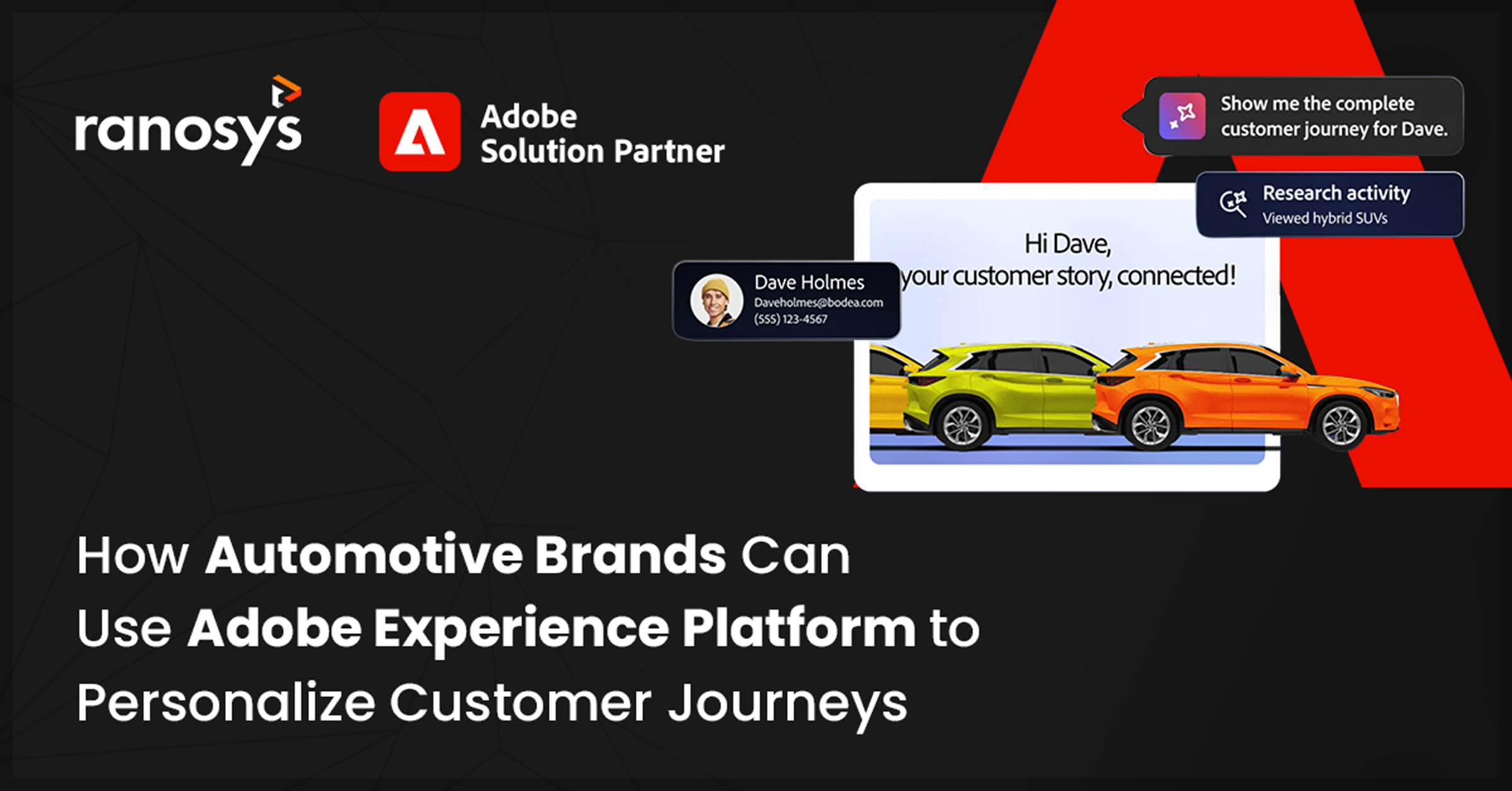
A connected customer profile can help brands respond to customer behaviour with relevant communication. Someone who has configured a vehicle and shown purchase intent could receive a test-drive invitation, while an owner approaching a service milestone could receive a reminder based on vehicle and service information. These experiences can reflect the customer’s current needs instead of relying on the same message for every audience.
Connected data can also support automotive data analytics by giving teams a broader view of customer behaviour across websites, campaigns, dealerships, and service interactions. Marketing teams can examine content activity, while sales and service teams can use relevant customer information during later interactions. This can help brands understand customer movement across different stages of the journey.
How automotive brands can use AEP across the digital customer journey
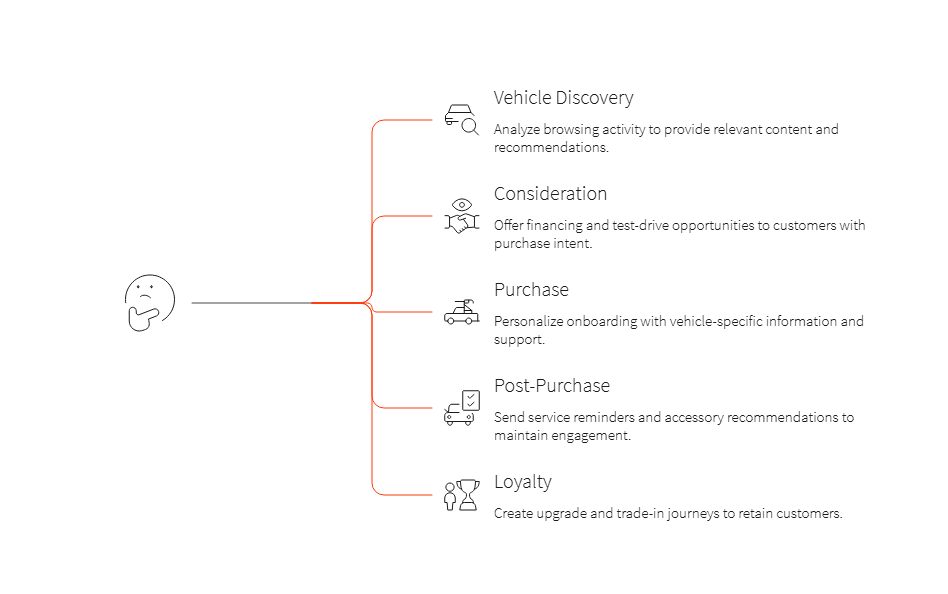
AEP can support different stages of the automotive customer lifecycle, from initial research to long-term ownership. At each stage, brands can use relevant customer and vehicle information to determine which content or interaction is appropriate.
1. Vehicle Discovery and Research
Brands can analyze browsing activity, content consumption, model searches, and feature interest to understand what customers are researching. This information can support relevant vehicle content, comparisons, and recommendations based on customer behaviour.
2. Consideration and Test Drive
Customers showing stronger purchase intent can receive financing information, dealer recommendations, or test-drive opportunities. Adobe’s automotive use cases include personalized test-drive scheduling and dealer recommendations, helping connect digital research with dealership interactions.
3. Purchase and Onboarding
After purchase, brands can personalize onboarding based on the customer’s vehicle, selected features, and preferences. Communications can include vehicle education, connected services, maintenance information, and available support.
4. Post-Purchase Engagement
Post-purchase engagement can include service reminders, warranty information, accessory recommendations, vehicle education, and connected feature communications. Using ownership information can help brands determine which messages are relevant at different points after purchase.
5. Loyalty and Retention
Brands can use ownership history and customer behaviour to create upgrade, trade-in, and loyalty journeys. Customers approaching a potential replacement stage could receive information about newer models or trade-in options, supporting automotive customer retention.
Automotive personalization use cases with Adobe Experience Platform
A CDP automotive strategy can support personalization across the entire customer lifecycle, from vehicle research to ownership and service:
- Vehicle recommendations: Use data on browsing behaviour, preferences, and the user’s profile to recommend appropriate vehicle models.
- Test-drive journeys: Spot customers who demonstrate a desire to buy and direct them towards appropriate test-drive opportunities.
- Service reminders: Send out maintenance and service reminders by using the details about the vehicle and the ownership
- Accessories and connected features: Suggest accessories, upgrades, or connected vehicle features that are appropriate according to customer and vehicle information.
- Trade-in and upgrade campaigns:In trade-in and upgrade campaigns, use a customer’s ownership history and their activity level to spot those customers who may be ready to trade in their vehicle or move up to a new one.
- Dealer engagement: In terms of dealer engagement, it is important to provide dealer teams with more context regarding customer activity and interests so that the conversations they have can be more relevant.
- Recall and safety communications: We should identify the vehicle owners who are affected and then provide them with the appropriate recall or safety information.
A customer data platform’s approach in the automotive sector can therefore go beyond lead generation and provide support for the entire customer journey, covering the periods of purchase, ownership, service, and retention.
Challenges automotive brands should address before implementing AEP
Automotive brands need to address several data and integration challenges before implementing an AEP-based personalization program:
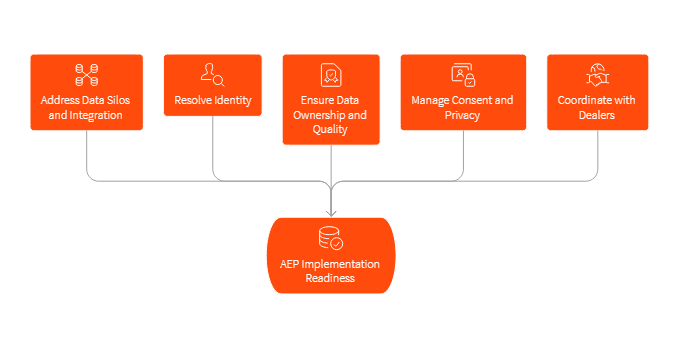
- Data silos and integration: Customer information may be distributed across CRM, dealer, service, commerce, and connected vehicle systems. Legacy platforms may also use different technologies and data structures, making data integration more complex.
- Identity resolution: Customers can interact with a brand through multiple channels and dealerships. Duplicate or incomplete records can affect the accuracy of customer profiles and audience segments.
- Data ownership and quality: Brands need clear ownership rules for customer data and processes to maintain accurate, complete, and consistent information across systems.
- Consent management and data privacy compliance: Clear rules are needed for collecting, storing, and using personal information, as well as respecting customer consent across different marketing channels.
- Dealer coordination: Automotive brands need agreed processes for sharing relevant customer data between OEMs and dealers and coordinating communications across the customer journey.
Implementation considerations for automotive brands
An AEP implementation should begin with specific business objectives rather than attempting to connect every available data source at once. Brands can start with journeys such as vehicle research, test drives, service reminders, or post-purchase engagement, then identify the data sources and integrations required for each journey.
Audience segmentation can group customers according to behaviour, ownership stage, vehicle characteristics, or purchase intent. Adobe Real-Time CDP can support profile and audience activation, while Adobe Journey Optimizer can coordinate relevant interactions across selected channels. Brands can then expand to additional journeys as data and processes mature.
Measurement should be defined from the beginning. Automotive brands can track test-drive bookings, conversions, service participation, repeat purchases, engagement, and Customer lifetime value to assess the performance of personalized journeys.
Why choose Ranosys for automotive personalization?
Automotive personalization requires more than connecting an Adobe platform to existing systems. The real challenge is turning fragmented customer, vehicle, dealer, and engagement data into journeys that can be measured and improved. Ranosys brings Adobe-specific implementation experience to this process, with expertise across Adobe Experience Platform, Adobe Real-Time CDP, Adobe Journey Optimizer, Analytics, Target, Commerce, and other Adobe Experience Cloud solutions.
Ranosys is a 3X Adobe Partner of the Year Award winner, with 120+ Adobe experts, 100+ Adobe projects, and 90+ Adobe certifications. Its AEP practice specifically covers capabilities such as real-time data unification, identity resolution, audience segmentation, data governance, and cross-channel journey orchestration.
For automotive brands, this combination can help connect the technology layer with practical customer journeys, from vehicle research and test-drive engagement to service, post-purchase communication, loyalty, and retention. Rather than treating personalization as a standalone campaign activity, Ranosys can help organizations build the underlying data and experience foundation needed to make personalization part of the wider automotive customer lifecycle.
Ranosys combines Adobe expertise with experience in complex enterprise implementations, helping brands connect customer data, build unified profiles, and activate personalized journeys across channels.
Conclusion
The automotive customer journey now extends across online research, dealerships, vehicle ownership, servicing, connected features, and future purchases. Connecting information from these interactions can give brands a clearer view of customer needs and create opportunities for relevant communication throughout the relationship.
Adobe Experience Platform can provide the foundation for this approach through customer data unification, a Unified customer profile, Audience segmentation, Adobe Real-Time CDP, and Adobe Journey Optimizer. These capabilities can support personalized experiences across research, purchase, ownership, service, loyalty, and retention.
For automotive brands investing in automotive digital transformation, a connected data strategy can help improve the automotive customer experience while giving teams better information for customer engagement and lifecycle decisions.