
Talk to our experts
Building a Global Capability Center in India once meant one thing: lower operating costs. That logic still holds, but it no longer tells the full story. According to the Nasscom-Zinnov GCC Landscape Report 2026, India now hosts 2,117 GCCs employing 2.36 million professionals and generating $98.4 billion in annual revenue. The EY GCC Pulse Report 2025 found that 92% of GCC leaders confirm their centers now contribute far beyond cost arbitrage. For enterprises still treating their India center as a back-office satellite, that distance between what is possible and what is being delivered compounds every quarter.
You may recognize this tension. Your GCC is operational and the team is capable, but somewhere between the original business case and today’s board-level conversations about AI, product ownership, and digital resilience, you sense the center is running below its potential. Other enterprises in your industry are assigning their India teams full product engineering ownership, GenAI deployment mandates, and innovation leadership. Your center is still processing tickets.
Closing that distance is exactly what a structured GCC transformation strategy is designed to do. This guide walks through what a high-performing GCC requires, which operating model fits your situation, and what innovation looks like when capability building is done correctly.
What is a global capability center (GCC)?
Definition: A Global Capability Center (GCC) is a captive entity fully owned and operated by a parent enterprise to deliver strategic business functions from India, retaining direct control over hiring, technology, data governance, and institutional knowledge.
GCC vs outsourcing: In an outsourced model, the vendor controls the talent and institutional memory. When you change vendors, you reset. In a GCC, capability compounds: engineers know the product architecture, data scientists are trained on proprietary datasets, and architects know the roadmap two years out. That compounding effect is what the GCC vs outsourcing conversation ultimately hinges on.
Why GCCs matter today: Modern enterprise GCCs handle functions unthinkable in a captive center a decade ago: full-stack product engineering, GenAI model development, cloud platform ownership, real-time analytics, and global customer experience design. The shift from support center to strategic capability center is structural, not incremental.
Why India has become the preferred destination for global capability centers
India’s dominance as the world’s primary GCC setup destination is not a legacy advantage. Several structural factors continue to strengthen in 2025 and 2026.
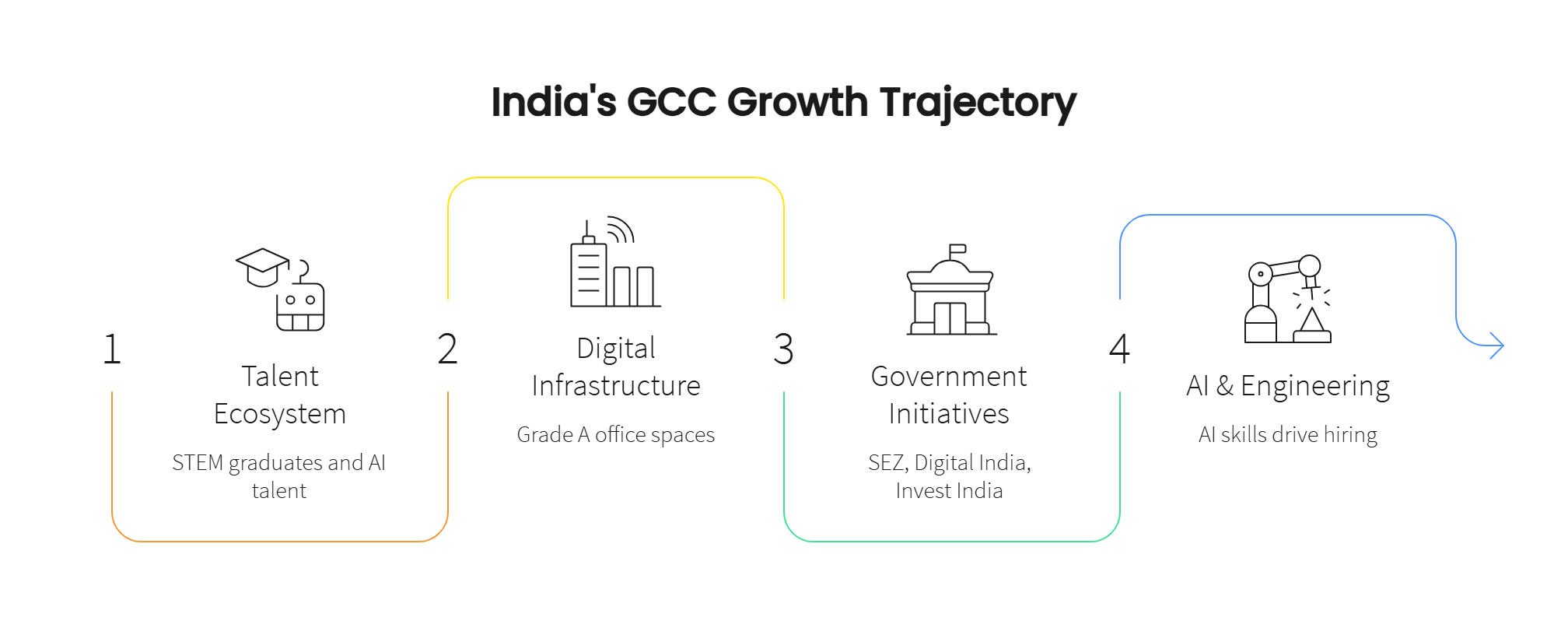
- Talent ecosystem: India produces over 2.5 million STEM graduates annually. Per the India Skills Report 2026, India commands 16% of the global AI talent pool, projected to reach 1.25 million professionals by 2027.
- Digital infrastructure: Grade A office ecosystems across Bengaluru, Hyderabad, Pune, Chennai, and NCR provide enterprise-ready facilities, while Tier 2 cities now offer meaningful cost and attrition advantages.
- Government initiatives: SEZ frameworks, MeitY’s Digital India program, and Invest India’s GCC policy have materially reduced the friction of setting up and scaling captive centers, with multiple state governments running dedicated GCC location strategies.
- AI and engineering capabilities: AI and data skills now drive two in three new GCC hires, per FY2026 data cited in Business Standard. GCCs added nearly 200,000 net employees in FY2026, almost double the 110,000 added by IT services firms. The Nasscom-Zinnov GCC Landscape 2026 report identifies India as the world’s number-one AI hiring market.
- India’s GCC growth: Over 506 Forbes Global 2000 companies operate GCCs in India, with the ecosystem growing 32% since FY2021. Global leadership roles in India GCCs have grown at approximately 40% CAGR over five years, per Zinnov’s 2026 analysis, and the market is projected to reach $99-$105 billion by 2030.
From cost centers to innovation engines: the evolution of GCCs
Understanding where your center sits on the GCC maturity curve is the starting point for any meaningful GCC strategy conversation.
Traditional captive centers: Early GCCs focused on transactional work: data entry, IT helpdesk, and basic finance. Value was measured in cost-per-transaction, and the relationship with the global parent was one of delivery and instruction.
Digital transformation: GCCs expanded into shared services, cloud migration, and application modernization. Technical depth began differentiating centers, shifting the conversation from cost savings to delivery quality.
AI-powered GCCs: The EY GCC Pulse Report 2025 shows 58% of GCCs are investing in agentic AI (29% more plan to within 12 months) and 83% are scaling GenAI. Fortune 500 GCCs in India have built over 126,600 AI-aligned professionals, per the ANSR and Wizmatic AI Talent Trends Report 2025.
Centers of Excellence: Leading GCCs formalize AI and platform capability into dedicated Centers of Excellence, giving teams the governance frameworks and talent pathways that allow capabilities to scale across functions. EY data shows 86% of GCCs are operationalizing business intelligence and 67% are formalizing data strategies.
Business innovation: At the frontier, GCCs hold P&L accountability for product lines and function as co-headquarters. Per Zinnov’s 2026 analysis, more than 50% have moved into portfolio and transformation hub stages. The question is not whether your center can get there; it is whether your GCC operating model was designed for that destination.
Building a successful GCC: key components beyond infrastructure
Entity structure and city selection matter, but the building blocks that distinguish high-performing GCCs from those that plateau are operational and organizational.
- Strategic planning: Effective global capability center strategy begins with defining what the center will own, setting a three-to-five-year capability roadmap, and securing executive alignment before the first hire.
- Governance: GCC governance design covers accountability structures, escalation paths, and performance measurement. Centers that design governance at setup transition from shared services to product ownership far more smoothly than those retrofitting it after problems emerge.
- Talent strategy: GCC talent strategy determines whether the center attracts the senior specialists required for innovation-stage work. The EY GCC Pulse Report 2025 shows 71% of GCCs ran structured reskilling programs in 2025, and Tier 2 cities offer attrition rates of 8-12% vs 16-22% in Tier 1 metros.
- Technology ecosystem: The technology stack a GCC inherits determines its capability ceiling. Defining the integration architecture and data infrastructure before headcount scales prevents expensive retrofits at the 18-month mark.
- Engineering delivery: DevOps maturity, CI/CD pipeline ownership, sprint cadence, and release governance are practice decisions, not just people decisions. Centers that establish their engineering delivery model from the start reach productive output faster.
- Compliance: Data residency, IP ownership frameworks, and cross-border regulations evolve as the center’s scope expands. Engaging compliance advisory before entity formation prevents regulatory exposure that surfaces when a center’s function outgrows its original framework.
- Operating model: This is a structural decision that should be made before entity formation. Section 5 covers the specific model options in detail.
- Innovation culture: Centers that reach innovation-stage maturity share one characteristic: GCC leadership has genuine authority to define priorities and influence global product decisions. Where that authority is absent, capability stagnates regardless of headcount.
Choosing the right GCC operating model
The choice of operating model is the most consequential early decision in any GCC setup advisory engagement.
Build-Operate-Transfer (BOT): A specialist partner builds the center, operates it for 18-36 months, then transfers full ownership. BOT compresses setup risk while preserving long-term captive ownership. It suits enterprises new to India or entering a new city.
Managed GCC: A partner operates the center under defined SLAs without a planned ownership transfer. The enterprise gets India capability without building captive governance infrastructure, suited to specific function delivery at controlled cost.
Hybrid GCC: Core functions sit in a captive entity while specialist or variable-demand work is handled through managed partnerships. Hybrid balances control and speed across multiple capability domains.
| Factor | BOT | Managed GCC | Hybrid |
| India experience | New | New or established | Established |
| Time to operation | 6–12 months | 3–6 months | 4–8 months |
| Long-term ownership | Yes | No | Partial |
| Best for | First GCC, risk-managed entry | Specific function delivery | Multi-domain scale |
The right structure depends on your timeline, existing India presence, and the strategic importance of the functions moving to the center.
Scaling a GCC for long-term business innovation
Moving from a productive GCC to an innovation-stage GCC is a capability architecture challenge, not a headcount one.
- Engineering talent: Professionals with four to ten years of experience account for 56% of GCC hiring in FY2026, per Outsource Accelerator. Attracting this cohort requires an employer brand that signals genuine ownership opportunity, not task execution.
- Product engineering and DevOps: When a GCC team owns architecture decisions, sprint planning, and release management, the center builds product context that compounds into a structural asset. DevOps maturity and QA capability determine how fast that ownership translates into shipped output.
- Platform engineering: Shared internal platforms and infrastructure automation let product teams operate at speed without reinventing foundational capabilities for each new initiative.
- AI Centers of Excellence: An AI CoE provides the governance framework, tooling standards, and talent pathways that allow AI capabilities to scale across functions. The EY GCC Pulse Report 2025 shows 58% of GCCs are already investing in agentic AI and 83% are scaling GenAI.
- Scaling delivery teams: Effective scaling requires onboarding frameworks that transfer institutional context, career pathways that retain experienced engineers, and leadership development that builds the next generation of technical leads from within.
How enterprises across industries use GCCs to accelerate innovation
Digital commerce: Retail and BFSI enterprises build personalization engines, order management systems, and real-time inventory platforms through their GCCs. A captive team with full context of the enterprise’s architecture iterates faster than any vendor constrained by contract scope.
Product engineering: Technology companies assign full product line ownership to India GCC teams, including architecture decisions and release management. The knowledge advantage a GCC product team builds over two to three years cannot be replicated through outsourcing.
AI and GenAI adoption: Enterprises deploy AI at production scale from their GCCs: fraud detection in BFSI, demand forecasting in retail, predictive maintenance in manufacturing, and document processing in financial services. A GCC team trained on proprietary data produces AI outputs that generic vendor solutions cannot match.
Cloud modernization: GCCs lead cloud architecture decisions and cloud-native development, reducing time-to-market for new capabilities. Deep product context means fewer integration issues than a vendor-managed migration where the team learns the architecture mid-project.
Data and analytics: GCC analytics teams build data platforms and insights that influence global product decisions and operational efficiency. Functions requiring deep institutional context are particularly well-suited to GCC ownership.
Customer experience: GCC teams designing CX platforms have access to multi-market customer data and interaction history that external vendors typically do not. This context produces personalization and support automation measurably more relevant to the enterprise’s actual customer base.
Automation: Automation engineers embedded in GCC operations for two to three years know which processes are genuinely automatable and which generate the highest business impact per engineering hour, an advantage no vendor brief can replicate.
What to look for in a GCC consulting partner
Selecting a GCC consulting services partner is a decision with long compounding effects. The choices made at setup determine what the center can become at the two-year, five-year, and ten-year marks.
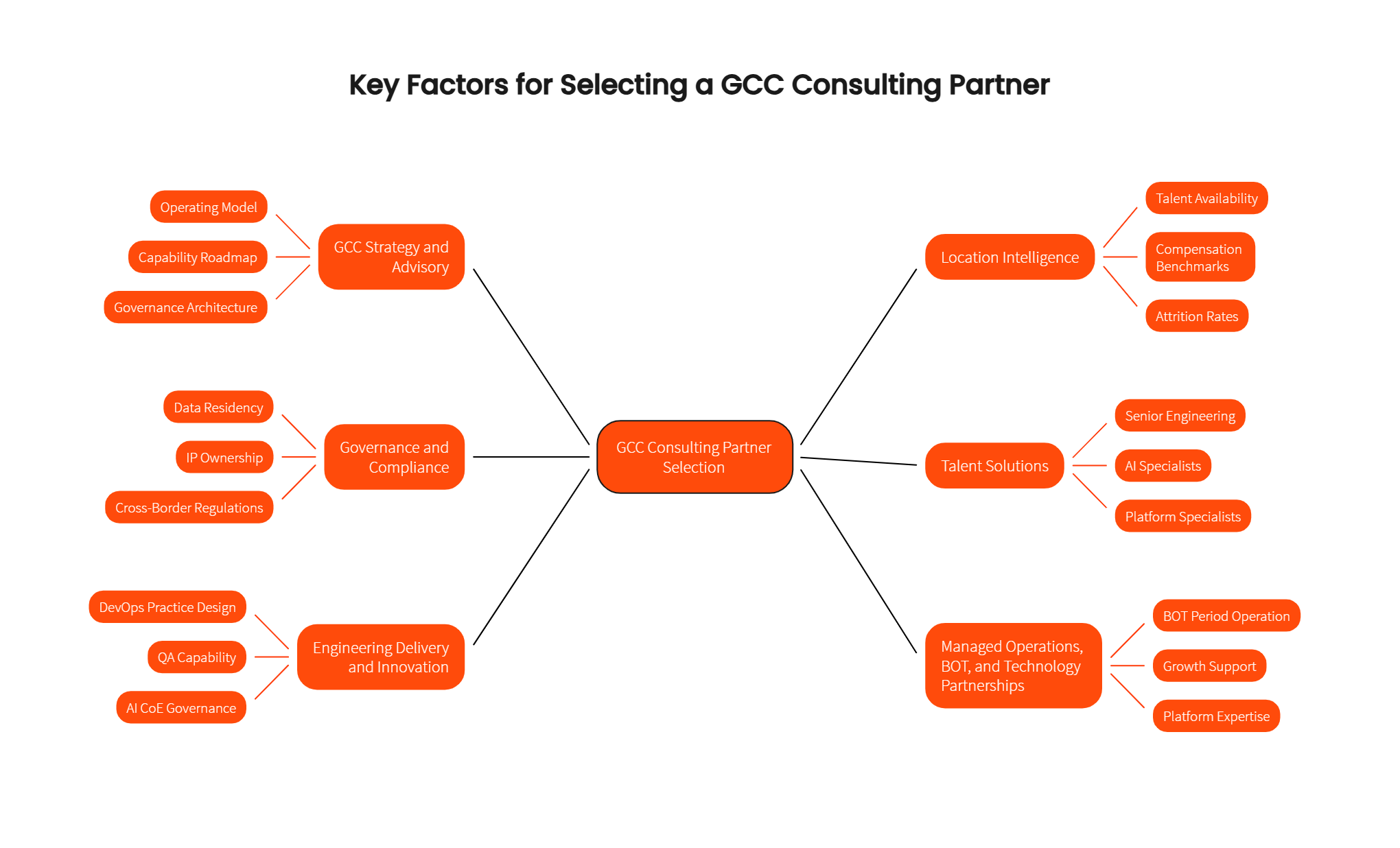
GCC strategy and advisory: The right partner defines your operating model, capability roadmap, and governance architecture before the first hire, not after the first hiring mistake.
Location intelligence: Look for data on role-specific talent availability, compensation benchmarks, attrition rates, and Tier 1 versus Tier 2 trade-offs specific to your function mix, not just a generic city shortlist.
Governance and compliance: Data residency, IP ownership, cross-border regulations, and accountability structures need to be embedded at charter stage. Retrofitting these at the 18-month mark is expensive in both time and leadership bandwidth.
Talent solutions: The partner’s ability to source senior engineering, AI, and platform specialists at the right experience bands within realistic hiring timelines is one of the most operationally consequential differences between advisory firms.
Engineering delivery and innovation: DevOps practice design, QA capability, and AI CoE governance determine how fast the center ships and whether AI capability scales across functions or stays trapped in individual teams.
Managed operations, BOT, and technology partnerships: A partner who can operate the center during a BOT period, support growth through 1,000-plus employees, and bring certified platform expertise, Adobe, Salesforce, Shopify Plus, OutSystems, or ServiceNow- makes advisory grounded in implementation reality.
How Ranosys helps enterprises build and scale GCCs that lead
The distance between a GCC that processes work and one that owns product lines and leads AI adoption is a strategy, operating model, and capability architecture problem. Ranosys brings direct, certified implementation experience across the enterprise platforms, Adobe, Salesforce, Shopify Plus, OutSystems, and ServiceNow, that mature GCCs most commonly take ownership of. When your India center moves from maintaining those environments to leading them, the difference between a partner who has built on those platforms and one who has only advised on them is measurable.
Our GCC consulting services India practice covers the complete lifecycle:
- GCC Strategy and Advisory: Operating model assessment (BOT, Managed, Hybrid), capability roadmap, governance architecture, and Tier 1 and Tier 2 location intelligence
- GCC Setup and Onboarding: Entity structuring, SEZ and compliance navigation, and Day 1 governance foundations
- Talent Solutions: Senior engineering, AI, and platform specialist acquisition across major hubs and Tier 2 cities, alongside structured reskilling programs
- Engineering Delivery: DevOps practice design, CI/CD pipeline ownership, QA capability, and platform engineering foundations
Innovation and Centers of Excellence: AI CoE design, GenAI and agentic AI deployment frameworks, and use case prioritization - Managed Operations: Managed GCC and BOT delivery models with defined SLAs and a structured transition to full ownership
Connect with our GCC consulting team to discuss your operating model, explore capability roadmap options, and build the strategy that positions your India center as a long-term competitive advantage.
Ready to build a GCC in India that leads, not just delivers?
Enterprises that build high-performing GCCs share one characteristic: they made the right operating model, governance, and capability architecture decisions before they scaled headcount. The centers that plateau made those decisions reactively.
Ranosys works with enterprises at every stage: first GCC setup, operating model transition, AI capability buildout, and maturity progression from shared services to product engineering ownership.
Talk to our GCC advisory team to discuss your objectives, timeline, and the capability domains you are planning to move to India.


