Talk to our experts
Summary
The landscape of enterprise content operations is rapidly transforming. AEM AI Agents represent a significant shift, offering goal-oriented, context-aware decision-making capable of interpreting unstructured data for complex tasks like site migrations or content classification. This contrasts with traditional AEM automation, which remains crucial for predictable, rule-based processes such as approval workflows and scheduled publishing. Understanding this distinction is vital for optimizing content delivery, a core aspect of Digital Transformation where Ranosys holds proven expertise.
Implementing AI agents enhances productivity by redirecting human effort from routine processing to high-value judgment calls, thereby accelerating critical timelines, such as website modernization. However, their use demands caution due to potential "hallucinations," explainability challenges, and current native agent limitations to specific architectural scopes like Edge Delivery Services. Organizations must meticulously assess data quality, existing AEM architecture, and robust governance models to mitigate risks and ensure successful, scalable deployment.
The optimal approach for most enterprises is a hybrid model, where traditional automation provides a stable, deterministic foundation, while AI agents add an intelligent interpretation layer. Humans retain essential oversight, especially for brand and compliance-critical outputs. Ranosys, a trusted authority in Adobe and Digital Commerce, guides organizations through this integration. Our expertise includes comprehensive AEM implementation, solution design, and governance framework development, ensuring secure and practical adoption of AI agent capabilities that effectively scale digital experiences.
Content operations that once ran on rules and schedules are now generating new questions. When an AI agent can interpret a brief, generate metadata, classify assets, and flag outdated pages without a defined trigger, the role of your existing automation changes. For enterprise content teams managing thousands of assets across multiple channels, that shift carries real operational weight. Workflows built around fixed rules were not designed for context-dependent decisions. Governance models that worked cleanly for deterministic systems need a different structure when an agent is choosing what to do rather than executing an instruction.
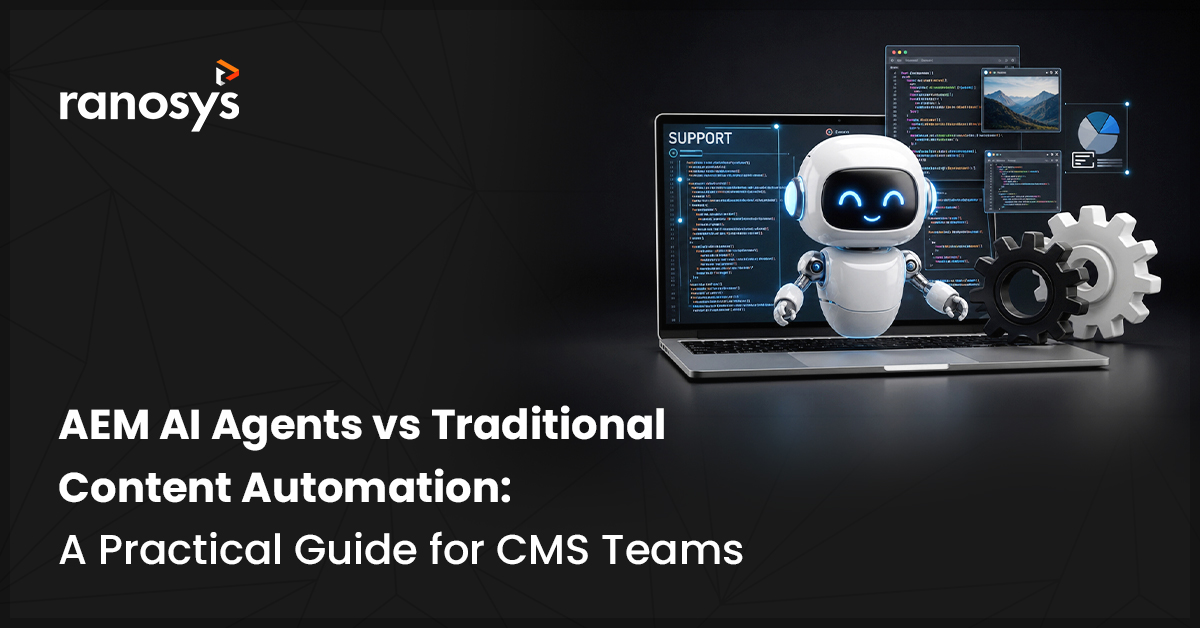
Most AEM environments already run a content automation platform layer that handles predictable work: approval workflows, scheduled publishing, tag-based asset rules. Adobe’s AI agents are built for something different. Where traditional automation executes a fixed rule when a condition is met, an AI agent works toward a goal, interpreting content and coordinating across systems to produce an output that a human then reviews.
For enterprise content teams, that distinction has practical consequences. This blog covers how AEM AI agents differ from traditional content automation, which use cases they currently support, where the limitations sit, and how to assess whether your environment is ready.
What Are AEM AI Agents?
AEM AI agents are software components that pursue a defined goal by reasoning over context, selecting actions, interacting with tools or systems, and evaluating outcomes, without requiring a predefined rule for every step.
An AI agent can be given a goal, such as identifying all product pages not updated in 18 months with declining organic traffic, and work across multiple systems to produce a prioritized output. That kind of AI content automation requires reasoning and sequenced decision-making that a trigger-rule-action model cannot handle.
Adobe has introduced purpose-built agents directly into AEM as part of its AI-powered content management roadmap. The Experience Modernization Agent, part of Adobe’s Brand Experience Agent suite, is generally available via a web-based console at aemcoder.adobe.io. It automates website migrations into Edge Delivery Services, handling content import, block mapping, and design system application through natural language instructions, with GitHub-integrated review workflows keeping developers in authority over what ships. Adobe’s AI coding agents use a skill-based architecture covering refactoring, scaffolding, error diagnosis, and content model updates. The skill library has expanded from 6 to 14 capabilities as of late 2025.
Complex adobe experience manager automation across multiple enterprise systems still requires custom implementation and LLM integration beyond what Adobe’s native agents provide out of the box.
What Is Traditional Content Automation?
Traditional content automation in AEM follows a deterministic model: a defined trigger causes a defined action. Every step is predictable because every outcome is pre-specified.
Common examples include:
- Approval workflows that route content when a page status changes
- Scheduled jobs that push content live at a specified time
- Tag-based rules that apply metadata categories based on asset naming conventions
- Replication jobs that distribute content to CDN nodes when a publish action fires
These automations are highly reliable, fast to configure, and straightforward to audit. For repeatable, rule-driven processes, that predictability is a strength. Where traditional automation falls short is when inputs vary, context matters, or a decision requires interpreting information rather than matching a condition.
AEM AI Agents vs. Traditional Content Automation: Key Differences
| Criterion | Traditional Automation | AEM AI Agents |
| Decision-making | Rule-based: follows predefined if-then conditions. | Goal-oriented: reasons toward a defined outcome. |
| Handling Unstructured Inputs | Limited: requires structured triggers and inputs. | Capable: can interpret text, briefs, metadata, and other unstructured inputs. |
| Context Awareness | Low: acts primarily based on predefined triggers and rules. | High: considers broader context and available data when performing tasks. |
| Adaptability | Static unless rules or workflows are manually reconfigured. | Can handle variations within its defined scope and objectives. |
| Human Involvement | Minimal for routine, predefined tasks. | Required for oversight, validation, and exception handling. |
| Error Handling | Predictable: typically fails at predefined points when conditions are not met. | Variable: may generate plausible but incorrect outputs that require validation. |
| Governance | Clear audit trail based on predefined rules and workflow actions. | Requires additional monitoring, validation, and explainability controls. |
| Best-fit Use Cases | Publishing schedules, approvals, tagging rules, and other repetitive workflows. | Content classification, migration support, quality checks, and context-driven content tasks. |
| Enterprise Risk | Low for well-defined workflows and known inputs. | Higher due to potential hallucinations, variable outputs, and additional governance requirements. |
Traditional automation executes instructions. AI agents pursue goals. That difference determines which approach belongs in which part of your content operation.
How AI Agents Change CMS Content Workflows
The operational change is not simply a matter of speed. Certain tasks that previously required a human decision at each step can now be handled by an agent, with human review concentrated at exception points rather than every handoff.
Consider a content localization process. In a rule-based workflow, a status change triggers a translation job, a project manager assigns it, a translator works on it, a reviewer approves it, and the localized page gets published. Each step requires a human handoff. An agent-assisted approach can handle the initial translation pass, apply brand terminology checks, flag sections with cultural references for human review, and stage the output, leaving a human to act on exceptions rather than manage each step.
The workflow does not disappear. Human judgment does not disappear. What changes is where in the process human attention is concentrated.
This also changes governance requirements. Rule-based automation is straightforward to audit because the rule either fired or it did not. When an agent makes a judgment call, you need to record what information it acted on, what output it produced, and whether that output was reviewed before reaching production. Building that audit layer in from the start is not optional in regulated environments.
AEM AI Agent Use Cases for Enterprise Content Teams
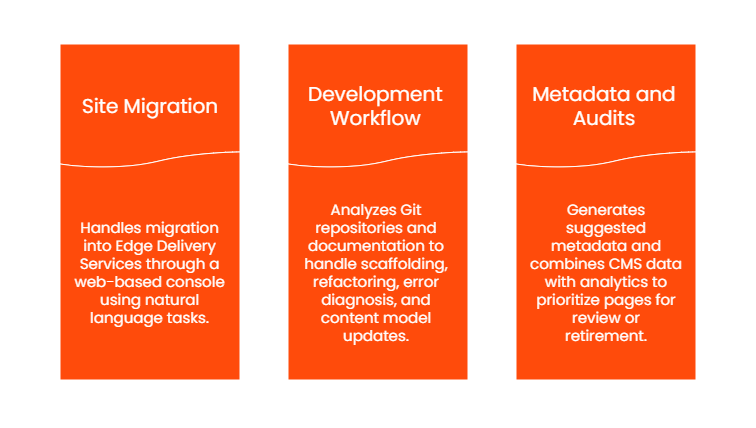
Adobe’s native agents cover three areas of intelligent content automation where rule-based systems fall short.
Site Migration and Modernization
Adobe’s Experience Modernization Agent handles migration into Edge Delivery Services through a web-based console. Teams submit tasks in natural language; the agent manages content import, maps source content to Edge Delivery block structures, applies design system rules, and stages output for GitHub-based review. A Site Catalog skill inventories all page templates and block variants before any code is written, giving project leads an accurate scope assessment upfront. Adobe’s documentation describes timelines compressed from months to weeks or days.
Confirm before planning an agent-led migration:
- The agent targets Edge Delivery Services only
- HTL-based delivery, headless and SPA patterns, MSM, MarTech integrations, and custom business logic are outside its scope
Development Workflow Support
Adobe’s AI coding agents analyze the project’s Git repository, documentation, and content model to build a structural picture of the site. Specialized skills handle scaffolding, refactoring, error diagnosis, and content model updates. As described in Adobe’s developer blog, the AEM Development Agent parses pipeline failure logs, identifies root causes, and proposes fixes in context, without requiring developers to reproduce failures locally. Developer time shifts from repetitive structural work toward architecture decisions.
CMSWire documented a case where an agent searching for EDS returned medical results rather than Edge Delivery Services documentation. Role-based permissions and developer review remain essential before any agent-proposed change reaches production.
Metadata Generation and Content Audits
An agent can generate suggested metadata, including titles, descriptions, alt text, and structured data, based on page content and surface those suggestions for author confirmation. For audits, an AI assistant in AEM can combine CMS data, analytics signals, and content freshness indicators to produce a prioritized list of pages for review or retirement, compressing work that previously took weeks of analyst time.
Keep these in place:
- Metadata suggestions should be reviewed before publishing, particularly in regulated industries
- Final decisions on content retirement should remain with content owners
AEM AI Agents vs. Traditional Automation: Benefits and Limitations
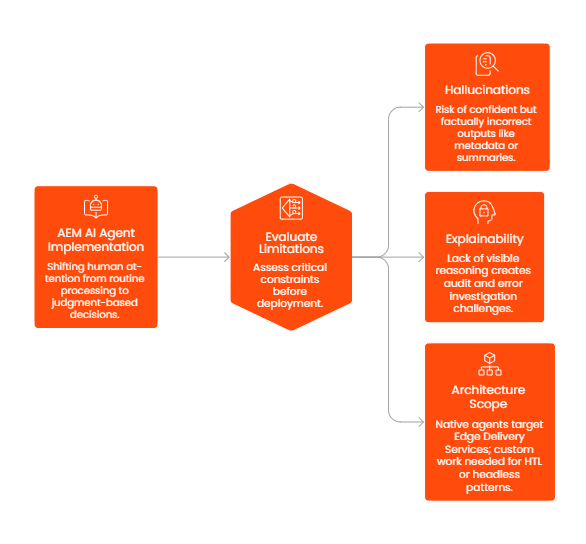
According to a PwC AI Agent Survey, 66% of companies using agentic AI report increased productivity. For content operations, the primary gain is concentration: AI content workflow automation shifts human attention from routine processing toward decisions that require judgment.
Three limitations deserve direct attention before any implementation begins:
Hallucinations. AI agents can produce confident, plausible, and incorrect outputs. Generated metadata, tags, or summaries may be coherent but factually wrong. Without human review, these reach production.
Explainability. When an agent makes a decision, the reasoning is not always visible. This creates audit challenges in regulated industries and makes error investigation harder than with rule-based systems.
Architecture scope. Adobe’s current native agents target Edge Delivery Services. Teams on HTL-based delivery, headless patterns, or with complex third-party integrations will require custom implementation work, which is where AEM AI upgrade consulting adds the most value.
When to Use Each Approach
The choice between AI agents vs. traditional automation depends on whether your process requires consistent execution or contextual judgment.
Use traditional automation when:
- The process is fully predictable with structured inputs
- Consistency matters more than adaptability
- You need a clear audit trail for compliance
Examples: Publishing schedules, approval routing, asset replication, taxonomy assignment by naming rule.
Consider AI agents when:
- The process requires contextual decisions that vary by input
- Multiple systems need to be coordinated based on a goal rather than a trigger
- Teams spend significant time on judgment calls that follow repeatable patterns
Examples: Site migrations, content audits, metadata generation, quality pre-screening.
In most enterprise environments, a hybrid model is the practical answer. An AI driven CMS does not replace rule-based AEM automation; it adds a reasoning layer on top of it. The AI agents vs. traditional automation question is rarely either/or. Traditional automation handles the deterministic backbone. AI agents handle the interpretation layer. Humans retain decision authority on outputs that affect brand, compliance, or customer experience.
How to Introduce AI Agents Into Existing AEM Workflows
You do not need to rebuild your existing AEM automation architecture to introduce agents. The practical entry point is identifying where agent-assisted decision-making adds genuine value alongside what already works.
- Identify high-friction processes. Look for areas where human effort concentrates on judgment calls that follow patterns: content audits, tagging reviews, quality pre-screening before approval.
- Map the existing workflow. Understand every step, every handoff, and every decision point before introducing any change.
- Assess data and system dependencies. Agentic workflows need access to content, metadata, and in some cases analytics or external systems. Check what data is available and how clean it is.
- Start with a bounded use case. Choose a workflow with clear inputs, clear success criteria, and low production risk: metadata generation or content flagging rather than automated publishing.
- Define human oversight at every output point. Decide what the agent produces, who reviews it, and what an acceptable output looks like before anything escalates.
- Build a controlled proof of concept. Run the agent in a non-production environment against real content samples before expanding scope.
- Monitor outputs continuously. Agent output quality can shift as content types evolve. Build monitoring into the workflow from the start rather than adding it later.
How to Evaluate Whether Your Organization Is Ready for AI Agents
Gartner warns that more than 40% of agentic AI projects will be cancelled by end of 2027 due to unclear business value. Work through these questions before committing scope:
| Readiness Area | Questions to Ask |
| Business Use Case | Is there a specific, measurable problem that AEM AI Agents can solve? |
| Data Quality | Is content and metadata in AEM structured, accurate, and consistent enough for an agent to work with? |
| AEM Architecture | Are APIs documented and accessible, and is your delivery model compatible with the capabilities and scope of the agents? |
| Governance Model | Do you have a defined process for reviewing, monitoring, and auditing agent outputs? |
| Human Oversight | Are qualified reviewers identified to validate agent outputs for each target operation? |
| Measurement | Can you measure agent output quality, accuracy, and efficiency against a defined baseline? |
Where gaps exist in data quality, governance, or workflow maturity, addressing those first produces better results than moving quickly on underprepared foundations.
Why Choose Ranosys for AEM AI Agent Implementation?
Adding AI agents to an enterprise AEM environment is an implementation and integration project. The challenge most organizations face is not a shortage of AI tooling. It is the work required to connect AEM with LLM APIs, analytics platforms, and content systems in a way that is secure, governed, and practical for content teams with existing AEM content automation in place.
Ranosys brings AEM implementation experience across complex multi-site, multi-language, and multi-channel environments. We assess existing AEM architectures, identify where gaps exist, and design approaches that add agent capabilities alongside what already works, covering environment assessment, integration design, governance framework development, proof of concept delivery, and team training.
If your team wants to start with a scoping conversation, we are available to help.
Conclusion
Enterprise content teams that get the most out of AEM AI agents are not the ones that move fastest. They are the ones that are clearest about which problem they are solving, which workflows are genuinely suited to agent-assisted decision-making, and what governance their environment can sustain. The hybrid approach works because it is honest: rule-based automation handles what is predictable, agents handle what requires judgment, and humans stay in authority over what reaches production.
If you are evaluating where AI agents fit in your AEM environment, speak with the Ranosys team to start with a structured assessment rather than a general mandate.