
Talk to our experts
Summary
Many retailers struggle to leverage vast customer data effectively due to persistent silos between commerce and marketing platforms. This disconnect hinders real-time engagement and personalization, resulting in missed revenue and inconsistent customer experiences. Salesforce Marketing Cloud Next directly addresses this by unifying Commerce Cloud data with marketing intelligence via Data Cloud, fundamentally transforming how retailers activate customer insights for more timely and relevant interactions. Marketing Cloud Next moves beyond traditional batch-based processing, providing real-time access to unified customer profiles, purchase histories, and behavioral signals. Powered by Einstein AI and Agentforce, it enables dynamic personalization at scale, autonomous campaign execution triggered by live commerce events, and delivers higher customer lifetime value. This sophisticated integration ensures marketing actions are consistently informed by the most current customer state. Successful implementation of this advanced ecosystem requires a clear unified data strategy and expert journey architecture. Ranosys, a trusted authority in Salesforce, Digital Commerce, and Digital Transformation, leverages its Summit-tier partnership and extensive experience across Commerce Cloud, Data Cloud, and Marketing Cloud to guide retailers. Ranosys helps organizations seamlessly integrate, optimize, and scale these solutions, ensuring robust, AI-powered customer engagement that drives sustainable growth for Retail & Consumer Goods businesses.Most enterprise retailers today are not struggling because they lack customer data; they are struggling because they do not act on it fast enough. Every day, shoppers browse products, abandon carts, respond to campaigns, and interact across multiple channels, leaving behind valuable signals. Yet for many retailers, commerce and marketing still operate in silos. Marketing teams rely on static audience segments, promotions miss the right customers, and personalization often stops at the storefront.
The result is more than an inconsistent customer experience. It means missed revenue opportunities, lower customer retention, wasted marketing spend, and growing pressure on teams to deliver one-to-one engagement at a scale that’s increasingly difficult to manage manually.
Many enterprise retailers have already invested in Salesforce Commerce Cloud to power their digital storefronts. But a robust commerce platform alone isn’t enough to create connected customer journeys. The real value comes from extending Commerce Cloud with a marketing platform that can turn commerce data into timely, relevant, and AI-powered customer interactions.
That’s where Marketing Cloud Next comes in. By connecting commerce, customer data, AI, and journey orchestration within the Salesforce ecosystem, it enables retailers to deliver personalized experiences that drive engagement, loyalty, and long-term growth. In this blog, we’ll explore how retailers can unlock that value and what it takes to make the integration successful.
What is Marketing Cloud Next?
Marketing Cloud Next is Salesforce’s reimagined marketing platform, built natively on Salesforce Data Cloud and powered by Agentforce. Unlike Marketing Cloud Engagement, which was designed as a standalone email and journey tool, Marketing Cloud Next treats customer data as a real-time, unified asset shared across commerce, service, and marketing.
The key difference in Marketing Cloud Next vs Marketing Cloud Engagement: Engagement required data imports, scheduled syncs, and significant connector work to access commerce data. Marketing Cloud Next accesses live customer profiles, purchase histories, and behavioral signals directly from Data Cloud, with no manual data movement. Agentforce then acts on that data autonomously, running campaigns, adjusting messaging, and triggering journeys based on real-time commerce events rather than predefined rules.
A premier US luxury jewelry retailer with over 80 stores migrated from Salesforce Marketing Cloud to Marketing Cloud Next with Ranosys, bringing their commerce and customer service operations onto a single connected platform. Read the full case study.
For retailers already on Salesforce Commerce Cloud, this isn’t a new platform to learn from scratch. It is the next layer on top of an ecosystem they’ve already built.
Why Integrate Salesforce Commerce Cloud with Marketing Cloud Next?
The case for Salesforce Commerce Cloud Marketing Cloud integration comes down to one problem: commerce data and marketing execution have historically lived in separate worlds. Orders, browse history, cart events, and loyalty status sit in SFCC. Campaigns, journeys, and email performance sit in a separate marketing tool. The two never fully synchronize in real time, which means your marketing team is always working with yesterday’s customer picture.
Marketing Cloud Next for retail addresses that disconnect by enabling:
1. Unified Customer Data Across Commerce and Marketing
Every purchase, product view, cart addition, and loyalty redemption in SFCC flows into a single customer profile in Data Cloud. Marketing Cloud Next draws from that profile continuously, so when a customer upgrades from silver to gold loyalty status at 9 am, they receive a personalized offer by 9:05 am, not in the next campaign batch.
2. AI-Powered Personalization at Scale
Salesforce AI marketing within Marketing Cloud Next uses Einstein and Agentforce to analyze purchase patterns, predict next best actions, and generate personalized product recommendations for each customer, without requiring your team to build and maintain separate segmentation rules for every scenario. According to Salesforce’s 10th State of Marketing Report, 85% of marketers say customer expectations are higher than ever, yet only 71% are satisfied with their organization’s ability to connect marketing, sales, and service touchpoints. That gap is exactly what AI-powered personalization, built on real-time commerce data, is designed to close.
3. Commerce-Triggered Campaign Execution
Retail marketing automation becomes genuinely autonomous with this integration. Cart abandonment triggers launch within minutes of the event, not after a nightly data export. Post-purchase sequences adjust based on what was actually bought. Win-back campaigns activate when purchase frequency drops below a customer’s historical baseline. These are workflows your team defines once; Marketing Cloud Next executes them continuously.
4. Higher Customer Lifetime Value
Commerce Cloud personalization connected to automated journeys directly impacts repeat purchase rates. When the right message reaches the right customer at the right moment in their post-purchase cycle, the probability of a second, third, and fourth purchase increases measurably. McKinsey’s January 2025 analysis found that retailers using targeted, AI-driven promotions are seeing 1 to 3 percent improvement in margins, with 65% of customers citing relevant, personalized offers as a primary reason to purchase.
5. Faster Marketing Execution
With Agentforce handling campaign generation and journey orchestration, your marketing team moves from building campaigns to reviewing and approving them. Agentic marketing retail ecommerce means a campaign that previously took three days of setup can be ready for review in hours.
How Salesforce Commerce Cloud and Marketing Cloud Next Work Together
The SFCC and Marketing Cloud integration in this architecture operates through Data Cloud as the central nervous system. Here’s how the key workflows function in practice:
- Customer Data Synchronization
SFCC continuously feeds purchase events, browse data, and session behavior into Data Cloud. Marketing Cloud Next reads from unified customer profiles in real time, meaning your marketing system never operates on stale data.
- Commerce Events Triggering Campaigns
When a customer abandons a cart containing a product they’ve viewed three times in the past week, that behavioral signal triggers a specific journey, not a generic abandonment email. The product, the customer’s purchase history, and their loyalty tier all inform the message automatically.
Ranosys integrated Salesforce Marketing Cloud with Salesforce Commerce Cloud for a US-based digital solutions firm, enabling comprehensive behavioral tracking across cart activity, abandoned carts, and order placement, with customer and catalog data synchronized automatically between platforms.
- AI-Generated Product Recommendations
Einstein within Marketing Cloud Next analyzes purchase patterns across your entire customer base and generates individualized recommendations for each recipient. These recommendations update dynamically based on new purchase data, so a recommendation email sent Tuesday afternoon reflects what the customer bought on Tuesday morning.
For a UK homeware retailer on Salesforce Commerce Cloud, Ranosys configured Einstein Search Recommendations, Product Recommendations, and Dictionaries, giving shoppers contextually relevant suggestions based on their browsing and purchase behavior across the site.
- Loyalty Campaign Automation
Salesforce omnichannel retail marketing allows loyalty tier changes, point milestones, and anniversary dates in SFCC to trigger automated campaigns in Marketing Cloud Next. A customer reaching gold status receives a personalized reward offer within the hour, across email, SMS, and push, without a single manual step.
A UK cycling retailer with 14 stores implemented Salesforce Marketing Cloud alongside Commerce Cloud, using it to automate post-purchase notifications, order pickup updates, and personalized dispatch emails, replacing manual marketing processes with event-driven communication workflows.
- Agentforce Capabilities
Agentforce Commerce retail strategy introduces autonomous agents that monitor campaign performance, identify underperforming segments, and recommend adjustments in real time. Rather than waiting for weekly reporting, your team receives actionable insights as performance deviates from targets.
Common Challenges and How the Integration Solves Them
| Challenge | Business Impact | How SFCC + Marketing Cloud Next Solves It |
| Data silos between commerce and marketing | Campaigns rely on outdated or incomplete customer data, resulting in poor targeting and missed engagement opportunities. | Salesforce Data Cloud unifies commerce and customer data in real time, eliminating manual data synchronization. |
| Fragmented customer journeys | Customers receive disconnected or irrelevant communications across channels after key commerce events. | Real-time commerce events automatically trigger personalized customer journeys based on context and behavior. |
| Manual campaign execution | Marketing teams spend excessive time building and managing campaigns instead of focusing on strategy. | Agentforce automates campaign creation, orchestration, and optimization to improve marketing efficiency. |
| Personalization at scale | Generic campaigns reduce engagement, conversions, and customer loyalty. | Einstein AI delivers individualized recommendations and personalized content for every customer. |
| Limited customer insights | Teams struggle to predict customer intent, churn risk, and next best actions. | Data Cloud creates unified customer profiles by combining behavioral, transactional, and engagement data. |
| Legacy marketing automation | Batch-based campaigns delay customer engagement and miss real-time buying moments. | Event-driven automation instantly launches campaigns based on live customer actions and commerce events. |
Best Practices for a Successful Integration
The integration between Salesforce Commerce Cloud and Marketing Cloud Next is well-architected by design, but how you implement it determines whether you see results in months or spend years untangling data and configuration issues. These practices reflect what separates integrations that deliver from those that fall short:
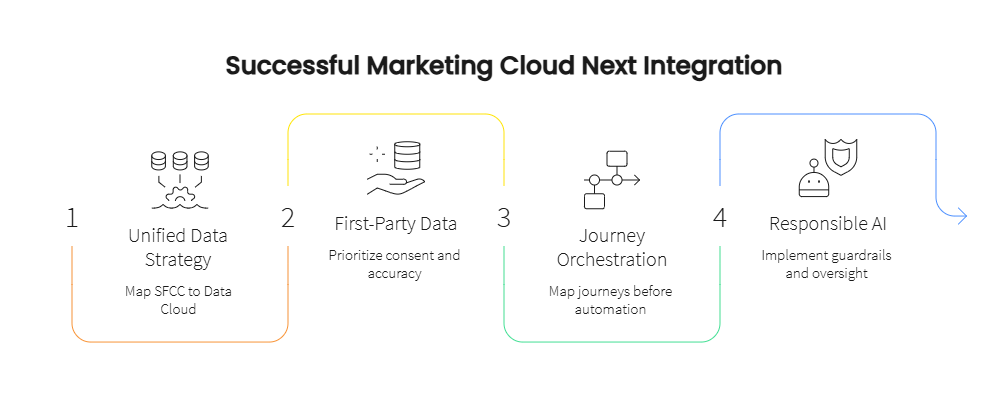
Start with a Unified Data Strategy
Before activating any Marketing Cloud Next capability, confirm that your SFCC data model maps cleanly to Data Cloud. Data quality issues at this stage compound downstream, so define your identity resolution rules, customer ID reconciliation approach, and data governance policies before go-live.
Prioritize First-Party Customer Data
Audit your current data collection practices, ensure consent preferences are captured consistently across every customer touchpoint, and synchronize that information with Data Cloud. As marketers place greater emphasis on first-party data and privacy-first engagement, maintaining accurate and trusted customer profiles has become essential for delivering effective AI-driven personalization.
Define Customer Journey Orchestration Before Building
Map your key customer journeys, welcome, post-purchase, re-engagement, loyalty progression, before configuring automation. Salesforce connected customer journey retail execution works best when the logic is clear before it’s handed off to Agentforce.
Use AI Responsibly
Agentforce autonomy requires guardrails. Define approval workflows for AI-generated campaigns, set spend caps for automated promotions, and establish human review checkpoints at appropriate stages. Autonomy and oversight are not in tension; they’re both necessary.
Measure Performance Continuously
Marketing Cloud Next implementation is not a one-time project. Establish KPIs at the journey level, not just the campaign level, and review them weekly. Retention rate, repeat purchase frequency, average order value by segment, and campaign-attributed revenue should all be visible in a shared dashboard.
Choosing the Right Salesforce Commerce Cloud and Marketing Cloud Partner
A Salesforce Commerce Cloud consulting services partner with genuine integration experience brings a different kind of value than a general Salesforce SI. Look for a partner with demonstrated capability across both SFCC and Marketing Cloud, not expertise in one with familiarity in the other.
Specifically, evaluate:
- Salesforce Data Cloud expertise: Can they model your commerce data correctly in Data Cloud, or will they default to workarounds?
- Journey architecture experience: Have they designed and launched complex, multi-channel journeys for retailers at your scale?
- AI capability understanding: Do they have hands-on Agentforce experience, or are they selling future state?
- Industry depth: Retail-specific knowledge, particularly around loyalty mechanics, seasonal campaign logic, and omnichannel fulfillment, reduces implementation risk significantly.
- Managed services capacity: Post-launch optimization matters as much as initial delivery. A partner offering ongoing support prevents the common pattern of strong launch followed by gradual performance decay.
Ranosys brings Summit-tier Salesforce partnership credentials alongside active delivery across Commerce Cloud, Data Cloud, and Marketing Cloud implementations for mid-market and enterprise retailers. The team operates across North America and Southeast Asia, with the technical depth to handle both initial integration and the continuous optimization work that follows.
The Next Step for Retailers Already on Salesforce Commerce Cloud
Salesforce Commerce Cloud provides the foundation for modern digital commerce, but delivering connected customer experiences requires more than a powerful storefront. Retailers also need the ability to activate customer data in real time, orchestrate personalized journeys across channels, and leverage AI to engage customers at every stage of the buying lifecycle. That’s where Marketing Cloud Next extends the value of your Salesforce investment.
Whether you’re planning a new implementation or looking to modernize your existing marketing capabilities, integrating Salesforce Commerce Cloud with Marketing Cloud Next can help unify commerce, customer data, and AI into a single engagement strategy. With the right implementation approach and an experienced Salesforce partner, retailers can accelerate personalization, improve marketing efficiency, and build stronger customer relationships that drive long-term growth.
Talk to Ranosys Salesforce Commerce Cloud experts to evaluate your current ecosystem, identify integration readiness, and map a phased approach to Marketing Cloud Next that delivers measurable results without disrupting what’s already working.


