
Talk to our experts
Summary
Customer retention is now the critical profit driver for omnichannel retail and eCommerce, offering a significantly higher ROI than new customer acquisition. As acquisition costs soar, a mere 5% increase in retention can boost profits by 25-95%. Success hinges on fluid, consistent customer experiences across all touchpoints—websites, apps, stores, and social platforms—transforming one-time buyers into loyal advocates and securing long-term growth. Effective retention strategies leverage behavioral data and AI for hyper-personalization, cultivate omnichannel loyalty programs, and optimize post-purchase journeys. They integrate feedback loops, targeted communication, and consistently deliver high product quality and frictionless customer experiences. The latest imperative involves deploying Generative AI advisors and predictive models to anticipate needs and proactively mitigate churn risks across every stage of the customer lifecycle. Architecting such a connected retention system requires unifying customer data, deploying advanced analytics, and integrating robust digital commerce and marketing automation platforms. Ranosys, a trusted authority in Salesforce, Adobe, Shopify, and Digital Transformation, brings 17+ years of expertise. We help leading global retailers implement comprehensive solutions, from our proprietary LoyaltyPlus to AI-powered personalization and predictive retention, optimizing customer lifetime value and scaling resilient growth.TLDR :
Customer retention has become the defining growth driver for omnichannel retail and eCommerce. In an environment where acquisition costs continue to rise, well-structured customer retention strategies now determine whether brands scale profitably or stall. As shoppers move fluidly between websites, apps, physical stores, and social platforms, sustainable revenue depends on strong Omnichannel customer retention that delivers consistency at every touchpoint. Even a modest lift in retail customer retention can significantly increase profitability, making it one of the most dependable levers for long-term performance.
This blog outlines eight practical customer retention strategies designed for modern retail:
1. Personalised engagement powered by behavioural data and AI
2. Omnichannel loyalty programs that reward engagement, not just spend
3. Structured post-purchase journeys that turn buyers into repeat customers
4. Embedded customer feedback loops that reduce churn early
5. Targeted email, SMS, and push communication based on lifecycle stage
6. Consistent product quality, fulfilment reliability, and innovation
7. Fast, frictionless customer experiences across channels
8. Generative AI advisors and predictive models that anticipate needs and identify churn risks
You’ll also find a step-by-step framework for building a connected retention system, from unifying customer data and defining KPIs to activating automation and predictive intelligence.
For retail and eCommerce brands focused on increasing repeat purchase rate, reducing churn, and improving customer lifetime value, retention is not a secondary metric. It is the foundation of resilient, profitable growth.
Acquiring a new customer costs five times more than keeping an existing one. Yet most retail and eCommerce brands continue to pour the majority of their budget into acquisition, and then wonder why their growth stalls.
Over the past 17 years, Ranosys has worked with retail brands across different markets like North America, Southeast Asia, and the UK, including Under Armour, Sketchers, Victoria’s Secret, and Nespresso, to build commerce and loyalty infrastructure that makes retention measurable and scalable.
This blog breaks down exactly how to build that strategy.
Why Retention Matters in Omnichannel
According to a Bain & Company research, a 5% increase in customer retention can boost profits by 25% to 95%. The range is wide because it heavily depends on industry, margin structure, and the quality of the retention strategies, and many other things.
The shoppers now expect consistency, speed, and personalization, no matter how they engage with a brand. Especially in the retail industry, where customers continuously switch between apps, websites, physical stores, and social channels, capturing their attention and loyalty requires a strategy that effectively integrates all these touchpoints.
Here’s what the data says:
- Returning customers spend 67% more than first-time buyers.
- According to Forrester’s 2024 Omnichannel Difference Report, 45% of firms saw better customer engagement, 35% retained more customers, and 35% reported improved customer loyalty due to omnichannel engagement. Additionally, 46% of respondents noted a rise in customer lifetime value (CLV).
- BCG’s 2024 Personalization Index found that top retailers stand to unlock an estimated $570 billion in incremental growth by harnessing first-party data to make customer interactions faster, easier, and more personalised.
Understanding your retention rate formula gives you a baseline to work from:
Retention Rate = ((Customers at End of Period – New Customers Acquired) / Customers at Start of Period) x 100
Track this monthly. If it’s declining, something in the experience is breaking down. If it’s growing, you’re doing something worth doubling down on.
The bottom line: retail customer retention is no longer a nice-to-have metric. It’s one of the clearest indicators of long-term business health.
What is Omnichannel Customer Retention?
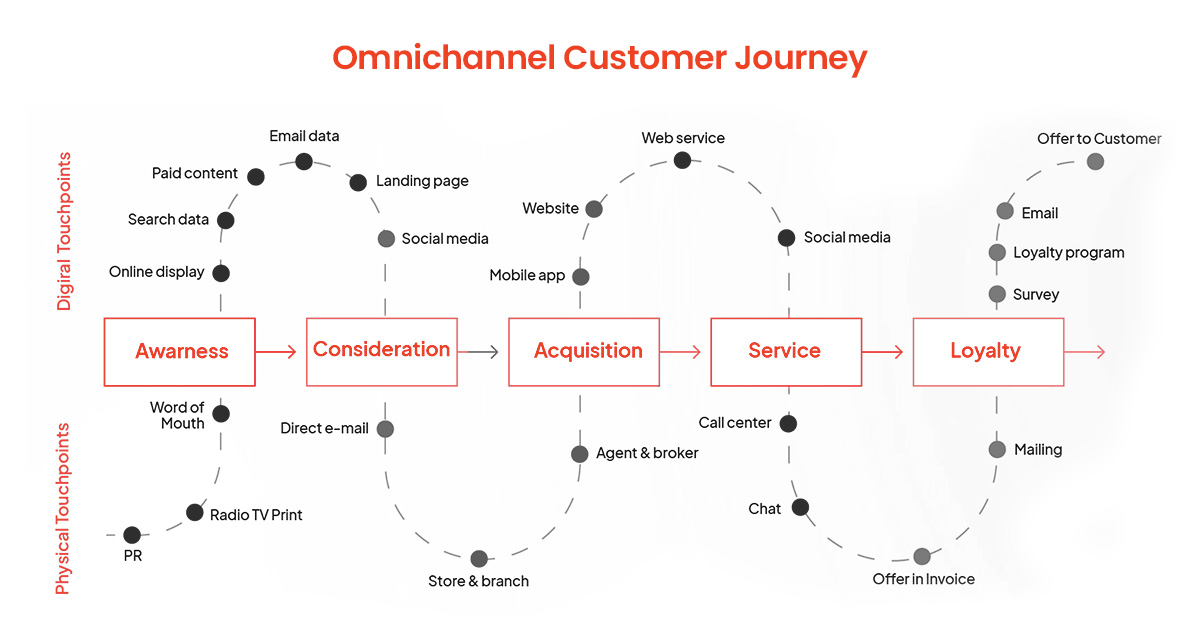
Omnichannel customer retention is the practice of keeping customers engaged across every channel they use, whether that is your website, mobile app, physical store, email, SMS, or live chat.
The key distinction:
Omnichannel is not the same as multichannel. Multichannel means you are present on multiple platforms. Omnichannel means those platforms are connected; the customer’s history, preferences, and interactions follow them wherever they go.
A loyalty point earned in-store is visible in the app. A cart abandoned on mobile can be picked up on desktop. Done well, this connected experience is what reduces customer churn in retail and turns one-time buyers into long-term advocates.
Customer Retention Strategies for Retailers
Strategy 1: Personalised Engagement at Every Touchpoint
Ecommerce Personalization strategies has moved well beyond inserting a first name into a subject line. Today’s retailers use behavioural targeting in eCommerce to serve recommendations based on browsing history, purchase patterns, and real-time in-session behaviour.
What to act on:
- Customer segmentation in retail: Group by purchase frequency, AOV, and lifecycle stage
- AI for eCommerce personalisation: Dynamically adjust homepage content, search results, and recommendations in real time
- AI personalisation in retail: Deploy recommendation engines that respond to in-session behaviour, not just historical data
Strategy 2: Loyalty & Reward Programs
A loyalty program worth having changes how customers think about your brand. Loyalty management in omnichannel environments requires the program to be channel-agnostic; points earned in-store, online, or via the app should roll into one unified account.
Loyalty program best practices that deliver results:
- Tiered loyalty programs create visible aspiration and outperform flat-rate models consistently. Sephora’s Beauty Insider is one of the best loyalty program examples in retail for this reason.
- Omnichannel retail loyalty programs should reward engagement beyond purchases: app downloads, reviews, referrals, and social shares
- AI loyalty programs predict which reward types motivate each customer, enabling dynamic incentive assignment
Customer loyalty programs for retail that are channel-accessible and personally relevant remain one of the highest-ROI investments a retailer can make.
Strategy 3: Post-Purchase Engagement
The sale is not the finish line. It’s the starting gun for the retention races. The strongest customer retention strategies beyond first purchase focus on what happens in the 14 days after the order lands.
A strong post-purchase engagement sequence includes:
- Order confirmation + delivery tracking: Real-time, proactive updates reduce anxiety and support tickets
- Onboarding content: If the product requires setup or has features worth highlighting, a short how-to email or video builds confidence and reduces returns
- “How are you getting on?” check-ins: Sent 7-14 days after delivery, these can surface issues early and show the customer you care about more than the sale
- Replenishment reminders: For consumable products, a timely reminder to reorder is a service, not a sales pitch
Cross-sell and upsell nudges: Based on what they bought, not a blanket catalogue email
Brands that execute post-purchase journeys well consistently see higher repeat purchase rates and lower return rates.
Strategy 4: Customer Feedback and Engagement
Customers who feel heard stay. Customers who feel ignored leave, and often tell others why.
Embedding feedback into the retention strategy is one of the most underused client retention techniques in retail. It works on two levels: it gives you the data to fix what’s broken, and it signals to customers that their experience matters to you.
How to build feedback into the retention loop:
- Post-purchase surveys: Keep them short (3-5 questions max). Ask about the experience, not just the product. A low score is an early warning sign of potential churn.
- NPS tracking: Your Net Promoter Score gives you a consistent metric to track retention health over time. Segment by channel, product category, and customer tier.
- Review requests: Timely, personalised review requests (not mass-blast emails) show customers they’re valued individually. Reviews also serve as social proof that attracts new customers.
- Closed-loop feedback: When a customer raises an issue, follow up. Let them know what changed as a result of their input. This is rare, and customers remember it.
- Community building: Forums, private groups, or brand communities give customers a space to connect with the brand and with each other. Community is one of the most powerful passive retention mechanisms there is.
Feedback is a key factor that directly informs efforts to improve customer retention strategies over time. What gets measured gets fixed.
Strategy 5: Leverage Push, SMS & Email for Consistent Nurture
Retention does not happen passively. User retention strategies across owned channels work when relevance drives frequency.
- Email: Behaviour-triggered sequences (welcome series, win-back flows, browse abandonment) consistently outperform batch-and-blast campaigns
- SMS: With a 98% open rate, SMS is best reserved for time-sensitive messages: flash sales, back-in-stock alerts, and personalised offers. One irrelevant SMS and opt-outs spike.
- Push notifications: Use predictive analytics in retail to time pushes when individual users are most likely to be active
Every message, whether email, SMS, or push, should feel like it was written for that specific customer.
Strategy 6: Consistent Quality and Product Innovation
Understanding how to retain customers in retail at a fundamental level means recognising that the product experience is the retention strategy. Engagement tactics amplify quality; they don’t replace it.
What “consistent quality” looks like in practice:
- Standardised fulfilment: Customers who receive damaged or incorrect orders churn at significantly higher rates. Operational quality is brand quality.
- Product range evolution: Existing customers want to see innovation. If the catalogue never changes, there’s less reason to return. Use customer segmentation in retail data to understand what categories your best customers are exploring and expand into adjacent spaces.
- Inventory transparency: Out-of-stock experiences are a leading driver of switching behaviour. Real-time inventory visibility across channels prevents the frustration that sends customers to a competitor.
- Returns experience: A frictionless returns process (online, in-store, or by post) removes one of the biggest barriers to repeat purchase. Customers who have a smooth return experience are more likely to buy again, not less.
Strategy 7: Prioritise Fast, Frictionless CX
Customers compare their experience with your brand against every other retail experience they have, not just your direct competitors.
Practical customer retention ideas focused on frictionless CX:
- Unified customer profiles: Every customer-facing team (support, in-store, and eCommerce) should see the same customer data. Nothing erodes trust faster than having to repeat information to multiple agents.
- One-click reorder: The single most direct way to improve repeat purchase rate is to remove friction from the repurchase journey. Make reordering as easy as possible.
- Self-service portals: Customers increasingly prefer to manage orders, returns, and account details without contacting support. A well-built self-service hub reduces support costs and improves satisfaction.
- Delivery speed and choice: Same-day, next-day, click-and-collect, and scheduled delivery options give customers control. Lack of delivery flexibility is one of the top reasons for cart abandonment.
- Live chat and chatbots: Immediate responses matter. A customer who gets a fast, accurate answer to a pre-purchase question is far more likely to convert and return. Use chatbots for common queries and route complex issues to human agents without making the customer start from scratch.
Strategy 8: Generative AI Advisors
Generative AI in retail has moved from experimental to operational faster than most predicted. AI customer retention in practice looks like this:
- AI shopping assistants that understand lifestyle, budget, and preferences, making recommendations the way a knowledgeable associate would
- Predictive analytics in retail: AI models identify early churn signals (reduced browsing, longer gaps between purchases, increased returns) and trigger re-engagement before customers are lost
- AI loyalty programs that dynamically adjust incentives based on individual behaviour
- Conversational commerce that answers sizing, compatibility, and availability questions in natural language, instantly
The brands investing in AI personalisation in retail now are building a structural retention advantage that will be difficult to close in 18 months.
Framework: How to Architect an Omnichannel Retention System
Knowing the strategies is one thing. Putting them together into a working system is another. Here’s a practical architecture for building an omnichannel retention system from the ground up:
- Unify Your Data: Implement a CDP; ensure CRM, eCommerce, and POS are connected. Customer segmentation in retail only works with clean, centralised data.
- Define Metrics: Baseline your retention rate formula, churn rate in retail, repeat purchase rate, and customer lifetime value retail benchmarks.
- Map the Journey: Audit every touchpoint for friction, personalisation gaps, and engagement opportunities.
- Build Loyalty Infrastructure: Design omnichannel retail loyalty programs with tiered structures, channel-agnostic mechanics, and personalised rewards.
- Activate Channels: Launch behaviour-triggered email, SMS, and push flows using behavioural targeting in eCommerce.
- Deploy AI Tools: Use predictive analytics in retail to identify at-risk customers. Roll out recommendation engines to increase customer lifetime value.
- Measure and Iterate: A/B test loyalty mechanics, email cadence, and CTA types. Track repeat purchase rate and NPS on a rolling basis.
Examples and Case Studies
Nike
Nike’s retention strategy operates at an ecosystem level. Through its suite of apps (Nike App, SNKRS, Nike Run Club, Nike Training Club), Nike keeps customers engaged whether or not they are actively shopping. Customer segmentation in retail is sophisticated; different content, offers, and product drops are surfaced to different member segments based on sport, purchase history, and engagement. Retail loyalty program strategies built around community participation, not just transactions, produce some of the most durable client retention strategies in modern retail.
Sephora
Sephora’s Beauty Insider is the textbook case for tiered loyalty programs in retail. Three tiers (Insider, VIB, Rouge) create visible aspiration and reward depth of engagement over spend. The program spans in-store, online, and app; customer retention for retail is embedded into every channel. Beauty Advisors access individual purchase history in real time, making each store visit feel tailored. This is a personalized customer experience in retail executed at an operational scale.
How Ranosys powers customer retention strategies for retailers
Ranosys is a multi-award-winning digital commerce and transformation partner with 17+ years of experience helping enterprise retail and eCommerce brands across NA, SEA, and UK build the infrastructure that makes retention possible. With strategic partnerships with Adobe, Salesforce, and Shopify Plus, and 240+ certified consultants, Ranosys turns retention frameworks into revenue-driving systems.
Omnichannel Commerce Architecture: Ranosys builds connected B2C, B2B, and D2C commerce experiences across Adobe Commerce, Salesforce Commerce Cloud, Shopify Plus, and commercetools; keeping customer data, inventory, and profiles unified across every channel. Explore Retail & eCommerce Solutions
LoyaltyPlus: Proprietary Loyalty Solution for Salesforce B2C Commerce Cloud: Ranosys’s own Salesforce loyalty cartridge that enables personalised reward structures, real-time point tracking, and frictionless customer enrollment, without heavy custom development. View LoyaltyPlus on Salesforce AppExchange
AI-Powered Personalisation, Agentforce & Predictive Retention: From AI shopping assistants and Salesforce Agentforce-powered autonomous agents to predictive churn models and dynamic AI loyalty incentives, Ranosys implements Einstein AI, Adobe Sensei GenAI, Agentforce, and Adobe Firefly to deliver personalised experiences, proactive re-engagement, and conversational commerce at scale. Explore AI Services
Data, Analytics and the Single Customer View: Ranosys implements Adobe Real-Time CDP, Adobe Customer Journey Analytics, and Salesforce Data Cloud to unify customer data across marketing, commerce, and service; giving retention teams the visibility to act before customers churn. Explore Data and Analytics
Marketing Automation: As a Salesforce Platinum Partner, Ranosys builds behaviour-triggered email, SMS, and push sequences; from welcome journeys and post-purchase flows to win-back campaigns and loyalty milestone communications. Explore Salesforce Marketing Cloud
Ranosys has partnered with leading global and North American retail brands, including Under Armour, Victoria’s Secret, Skechers, Berkshire Hathaway, Steve Madden, and Nespresso, to build the commerce and retention infrastructure that keeps customers coming back. Whether you are starting from scratch or optimising an existing program, Ranosys has the platform expertise, proprietary tooling, and retail-specific experience to make it happen.

Kali Charan Rajput
AVP of Marketing & Growth
Kali Charan Rajput is AVP of Marketing & Growth at Ranosys, a Salesforce Summit Partner, where he leads demand generation and thought leadership initiatives across the Salesforce ecosystem. With 15+ years of experience in digital marketing, branding, and B2B growth, he has supported enterprise organizations in driving large-scale digital transformation and commerce programs across global markets. Connect with him on LinkedIn.


